Thomas Mann and the Temptations of Fascism
The resurgence of right-wing populism has set the table for the far right’s renewed fortunes. Published in 1947, Thomas Mann’s Doctor Faustus offers a guide to the mythmaking and rejection of reason that continues to animate authoritarian politics today.
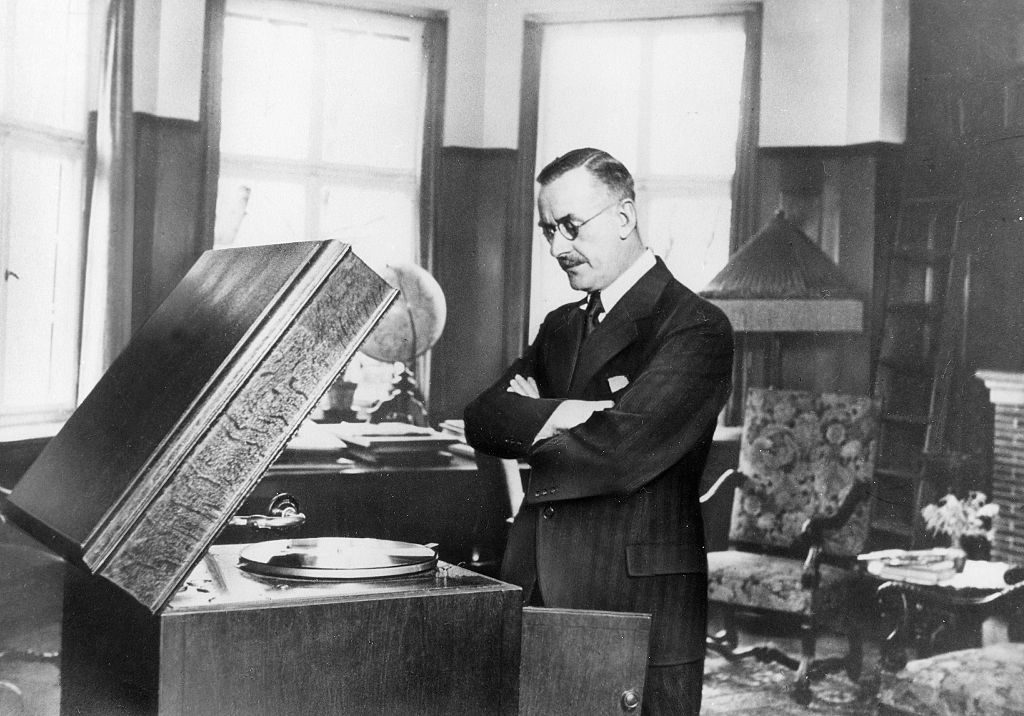
Published in 1947, Thomas Mann’s Doctor Faustus examined the allure of greatness without limit, contempt for reason, and seduction of myth. These forces remain central to authoritarian politics of our own time. (ullstein bild via Getty Images)
One of the most dangerous clichés about the far right is that it appeals exclusively to stupid people. But the truth is far more unsettling.
In The Anatomy of Fascism, historian Robert Paxton describes fascism as little more than a set of “mobilizing passions” that appealed to intellectuals, if at all, only in its early stages. Paxton insists that fascism was “an affair of the gut more than of the brain,” a characterization it’s easy to sympathize with when you think of how often fascists talk out of their ass. Even where the far right does try and speak articulately, many find the results underwhelming. The sociologist Michael Mann once sneered that fascist ideology was at best the playpen of the “lesser intelligentsia.”
Anyone who has suffered through the collected works of Curtis Yarvin or Auron MacIntyre will concede that stupid people are wildly overrepresented on the far-right end of the political commentariat. But it is simply untrue to describe the far right as uniformly thoughtless.
A Socratic error that has long persisted in our culture is that intelligence, education, and moral insight at least reinforce one another where they aren’t causally related. Satan was the world’s first theologian. In many depictions, most notably in John Milton’s Paradise Lost, he’s presented as a charismatic and intellectually ingenious character. The desire to create a world of pure intellect for himself is part of what drives him to make the world his own. Likewise, from the beginning, plenty of thoughtful, even profound, people have defended monstrous evils. For the Left to be effective in combatting a resurgent far right it is crucial to understand it without self-flattering illusions about our exclusive intellectual prowess. One of the finest works to dissolve these illusions is Thomas Mann’s opus Doctor Faustus.
His Satanic Majesty Presents
Born in Lübeck, Germany in 1875, Mann grew up in a comfortably bourgeois family at the height of Otto von Bismarck’s German empire. Mann would become one of Germany’s premiere authors, being awarded the Nobel Prize in 1929. His cultural ascendancy mirrored the political rise of Germany. Many of his fellow Germans saw their country as predestined to world preeminence, a “new” and young empire unfairly restricted by sclerotic and superficial rivals like Great Britain and France.
World War I imploded many of these conceits. Like most well-off Germans, Mann initially held moderately conservative nationalist views and resolutely supported his country through the carnage. Mann felt its humiliating defeat to be a tragedy. But his self-described “humanism” inoculated him against the harshest edges of revanchist bitterness. In his 1922 essay “On the German Republic,” Mann called for intellectuals to reconcile themselves with the liberal-democratic Weimar Republic. The Republic had largely been built by the Social Democratic Party (SPD), which Mann also viewed with increasing sympathy. Mann called on a younger generation to reject violence and the yearning for revenge against the liberal-democratic Allies, calling the fetishization of war an “utterly debased romanticism, an utter distortion of the poetic.”
Mann’s advice went unheeded. In 1933, Adolf Hitler won power supported by many of Germany’s cultural elite — including philosophers like Martin Heidegger and the esteemed jurist Carl Schmitt. Mann fled into exile in Switzerland and later the United States where we watched the rise and fall of Nazism with horror.
Published in 1947, Doctor Faustus is an allegorical novel that reworks the classic Faust myth that had inspired Christopher Marlowe and Johann Wolfgang von Goethe. Mann repurposed the story of Faust selling his soul to Satan to explore how Germany’s cultivated elite bartered everything away to the Nazis. The book centers around the complex relationship between narrator Dr Serenus Zeitblom and his childhood friend Adrian Leverkühn.
Both were born into comfortable circumstances in a Germany anxiously caught between an inglorious past and a present overripe with possibilities both attractive and dangerous. Zeitblom and Leverkühn’s lives parallel and diverge at important junctures. They grow up and receive a first-class education together. Zeitblom repeatedly expresses awed admiration toward his friend’s sharp intelligence and early theological and artistic interests. The initially small differences between the two young men eventually grow into moral chasms.
Zeitblom is ever fascinated and utterly invested in the well-being of his brilliant but troubled friend. Over time, Zeitblom’s warm personality and instinctive moderation ideologically organize into a self-described “humanism” that affirms balance in all things. Mann suggests Zeitblom derives his primary source of meaning from relationships with other people; the novel itself details his intense interest in the spiritual well-being of Leverkühn.
Zeitblom often acknowledges that this combination of moderation and a lack of psychological self-aggrandizement prevents him from achieving, or even wanting to aspire to, the intellectual and emotional heights of his friend. But his grounding in the human world means he apprehends the subjectivity of those who also inhabit the world more completely. Zeitblom’s innate sympathy for other people matures into an unsystematic set of moral sentiments that affirms the humanity of others. This in turn helps him find existential value in their well-being.
Zeitblom’s warmth is rarely reciprocated by Leverkühn, who from the beginning of life is drawn to infernal extremes of intellectual and aesthetic achievement. Leverkühn transitions from formal immersion in music to intensely studying theology, before returning to musical composition having internalized immense metaphysical pretensions. The tipping point in Doctor Faustus is an extended dialogue where Leverkühn agrees to sell his soul to Satan in return for twenty-four years of creative achievement. A major condition is that Leverkühn must further steel himself against any human love and attachment. Satan tells Leverkühn that he — Satan — will be “subject and obedient to you in all things, and hell shall profit you, if you but renounce all who live, all the heavenly host and all men, for that must be.” Satan insists that Leverkühn’s life must remain “cold” for his intellectual and aesthetic powers to truly be unsullied.
One of the core lessons of Doctor Faustus is that the humanist Zeitblom proves wiser than the tragic genius Leverkühn. This remains true even though Zeitblom never reaches the same heights of experience and romantic insight. Leverkühn perceives that the all-too-human world is filled with mediocrity and pedantry. From early in life, Leverkühn imagines he loses little by abandoning it to focus on a rarefied sublime that few, if any, apprehend. He even rationalizes that the pain of isolation he experiences might itself be creatively generative.
While he does manage to produce compositions of apocalyptic grandeur, they remain limited as textured expositions of his private pain. Moreover, artistic achievement proves utterly insufficient to compensate for the foolish decision to cut himself off from human contact. As is often aesthetically the case, Satan does not lie but delivers to Leverkühn exactly what he promised. Part of the pain he endures is realizing the banality of those aspirations. As he ages, Leverkühn regrets his choice and tries to break his compact by trying his hand at romantic and familial love. But he only brings pain and misery to those unlucky enough to become the objects of his affection.
In the end, Leverkühn confesses his Satanic pact to a bewildered audience of admirers and collapses into an infantile state. There are clear parallels between Leverkühn and Friedrich Nietzsche, a major inspiration for the character and a formative intellectual influence on the broader German right. Mann contrasts Leverkühn’s monomaniacal quest for abstract metaphysical grandeur with his eventual end as a near vegetable who is utterly dependent on his aging mother. Having spurned all human love, the one small mercy left to Leverkühn is to be tended to by a few, very ordinary people still bound by sentimental convention to care for him.
The Sublimity of Evil
Mann’s retelling of the Faust myth allegorizes Germany’s decline into nihilistic ambition and fascist self-destruction. The novel is punctuated by Zeitblom paralleling Leverkühn’s private descent with the concurrent decline of Germany into Nazism. The latter is cast in more than simple military and political terms. By the time of World War II, Zeitblom acknowledges that Germany had lost “our cause and soul, our faith and our history. Germany is done for, or will be done for. An unutterable collapse — economic, political, moral, and spiritual — in short, an all-embracing collapse looms ahead.”
What is striking about Mann’s choice of the Faust legend as the basis for his allegory is the level of self-conscious agency it implies about his country’s trajectory. This is presented with a measure of pity and understanding but never exoneration. Highly cultured Germans like Leverkühn felt themselves to be superior persons for whom everything ought to be permitted. This disconnects them from the reality of other people’s experience of the world. For someone like Leverkühn, this was experienced as artistic withdrawal from the intersubjective world of human relations: unobtainable aesthetic greatness was to be pursued at any price to others.
Many other Germans channeled these feelings in a more sociopolitical direction. They were convinced their innate cultural and even biological superiority entitled them to empire and dominion. In a memorable passage, Mann describes how these long gestating feelings were wounded and then myopically intensified through defeat in World War I:
This disregard, this indifference toward the fate of the individual might well have seemed to have been sired by our recent four-year bloody circus; but one ought not to be misled — for here, as in many other regards, the war had only completed, clarified, and forged as a common drastic experience something that had been developing and establishing itself as the basis of a new sense of life.
Far from abandoning their feelings of elevation, many Germans perceived their military defeat as the strong and worthy having their rightful position usurped by the weak and their supposed inferiors. The result was a toxic and addictive form of resentment at being dispossessed of power and status, coupled with the profound anxieties of a victim who sees internal and external persecutions everywhere.
In the heady days of Weimar, these feelings aligned with support for a revolutionary form of far-right politics. Democracy was cursed as a foreign idea imposed by Judeo-Bolshevik traitors. Right-wing intellectuals dismissed liberalism and socialism as leading to the banal rule of the working-class masses who would never aspire to more than materialistic comforts. As Mann puts it, “our democratic republic was not accepted for a single moment as a serious framework for the new situation they had in mind, but was unanimously shrugged off as self-evidently ephemeral, as predestined to meaninglessness in the present situation, indeed as a bad joke.”
After Hitler came to power with the support of conservative elites, war itself was reconceived as both the means and end of aesthetic greatness, whatever its impact on the countless victims of Nazism might be. Of course, the pact conservative and culture elites made with the far right didn’t lead to greatness but a defeat and humiliation as complete as any in modern history.
The Rhyming of History
Mann’s Doctor Faustus is a masterpiece of world literature with many important lessons for our era. History, as Marx famously put it, repeats itself, first as tragedy, then as farce. His insight is readily applicable to the present day. We can see the postmodern far right rejuvenating many of the attitudes Mann disparaged so acutely. These are not exact replications, of course, but rather a dark rhyming with a past many of us had hoped would remain just that.
The far right is once more gaining ground, and it has found willing and enthusiastic cultural partisans from Curtis Yarvin to the pseudonymous “Bronze Age Pervert” to J. D. Vance. As before, the inhumanity on display is facilitated by the fundamentally abstract way they conceive of the world. In her great book on MAGA intellectuals, Furious Minds, Laura Field notes how they often take an “ideas-first” approach to the world. Socialists have long had a name for this: idealism. Far from just an intellectual error, Doctor Faustus shows the dark consequences of believing that ideas make the world. By dissociating themselves from the flesh-and-blood people who actually do make up the world, it becomes ever easier to deny the moral relevance of their humanity and needs.
A well observed feature of the far right is its strange tendency to combine indifference to factual accuracy, or even honesty, with soaring rhetoric about truth, beauty, and greatness. Beyond just a well-documented willingness to obfuscate, bullsh–t, and lie, many of the far right’s core ideological convictions seem like bloviated imaginaries and outright fabrications. Often figures on the far right openly acknowledge this tendency, as in a 1922 speech where Benito Mussolini admitted his adulation of the rejuvenated Italian nation was a manufactured myth:
We have created our myth. The myth is a faith, a passion. It is not necessary for it to be a reality. It is a reality in the sense that it is a stimulus, is hope, is faith, is courage. Our myth is the nation, our myth is the greatness of the nation! And it is to this myth, this greatness, which we want to translate into a total reality, that we subordinate everything else.
This willingness to conjure patently artificial values into being, while still insisting all else be subordinated to the products of one’s fantasy, is hardly unique to the early twentieth century right. In 2004, a George W. Bush administration official widely believed to be Karl Rove dismissed the “reality based community” for failing to realize that, as an empire, “we create our own reality.” In The Art of the Deal, Donald Trump anticipated his political style by admitting he engaged in “truthful hyperbole” that “plays to people’s fantasies” and desire to “believe that something is the biggest and the greatest and the most spectacular.” More recently J. D. Vance, himself well-versed in far-right thought, has insisted that if he has to fabricate stories to attract people to his cause, then by God, he’ll do so.
It is bewildering how the far right oscillates wildly between a cynical dismissal of even true facts and arguments they don’t like and an utter credulity towards transparent fabulists from Mussolini to Trump, Vance, and the rest. The contradiction disappears when you understand the far right’s stance toward the world. For many on the far right, the stakes of politics need to be understood in theological terms. Ontologically, the world is highly unstable and continuously risks falling into ugly chaos. Only hierarchical order backed by strength can prevent this outcome.
Oftentimes the Right sublimates or naturalizes its preferred form of hierarchical order by suggesting that hierarchy is ordained by God or has emerged from nature. But when faith in these justifications falters, as it did for many in the early twentieth century, they will vest their convictions in strongmen who are unafraid of using force to transform power into authority. If this means imposing a value system upon hapless populations, so be it. Superior individuals like Leverkühn — or superior races — are entitled by what Hitler called the “aristocratic principle of nature” to create their own values and subordinate all else to them.
It is this enduring insistence that might doesn’t just make right, but alone can remake and bring order to the world itself, that inoculates the far right against the rationalistic objections so often pressed by centrists. Indeed, the far right often finds the efforts of liberal rationalists to fact-check them — insisting on epistemic and moral consistency — to be unbearably naive and funny. As far as they are concerned, liberals are fools to imagine logic, truth, and facts have anything to do with whose values prevail. Mann memorably describes this attitude late in Doctor Faustus.
The grotesque part was the vast machinery of scientific witnesses brought in to prove the humbug to be a humbug, a scandalous insult to truth — but from that angle there was in fact no arguing with a dynamically and historically productive fiction, with a so-called fraud, with, that is, a community-building belief; and the look on its advocates’ faces grew all the more sardonically arrogant the more diligently one attempted to refute them on a basis that for them was totally alien and irrelevant, on the basis of science, or respectable, objective truth. Good God! — science, truth! That exclamation echoed the predominant tone and spirit of these small-talker’s dramatic fantasies. They found no end of amusement in the desperate assault of critical reason against an invulnerable belief that reason could not even touch. . .
Holding Reason in Contempt
The far right tends to associate the liberal — and often socialist — emphasis on reason with an egalitarian inclination to treat all people alike. The basic idea is that all individuals possess a capacity to dialogue and reach correct, or at least mutually beneficial, conclusions about what is right and wrong and who ought to be in charge. The far right perceives this as threatening to orderly respect for hierarchical authority and the aspiration for greatness that gives life meaning and texture. Then as now, the far right expresses a strategic skepticism toward the claims of critical reason — but only in order to induce a deeper commitment to its preferred dogmatism. Once you deny that critical reason has any independent force, it is very easy to insist that power alone gets to decide who believes what.
From the far right’s standpoint, an excess of critical reason has a dangerous tendency to promote democracy by encouraging endless criticism and discussion that ultimately leads people to question authorities they are better off submitting to. Everyone reasoning and criticizing for themselves can only lead to political and moral chaos. Moreover, since most ordinary people tend to be motivated by low materialistic concerns, encouraging the democratic use of critical reason by all will tend to debase the aspirations of the political community.
For many on the far right, reason can never mobilize people’s passions, bind them together, and encourage them to submit to authority the way identification with myth, volk, power, and glory do. The Nazi jurist Carl Schmitt — a contemporary of Mann’s — captured this spirit well in Political Theology and other works, where he emphasized that political concepts are secularized theological concepts. Ultimately, we must all irrationally choose the God we worship together, and being a political community means defeating enemies who worship another. To this day, the far right’s ability to win converts is due to its radical emphasis on aesthetics at the expense of all convictions. Its aim above all is to excite, to not be boring. The irony is that this strategy reliably yields work of unusual tedium.
Where these mobilizing passions fail, the far right will usually follow the reactionary philosopher Joseph de Maistre in revering the awe-inspiring power of the hangman to induce unity through obedience. The far right has long argued these irrational passions are far more effective in binding a community together than the nebbishy concepts of liberal reason and socialist science. Whether they are true or not is beside the point. Logically, you might be able to demonstrate how one ought to treat all persons as equal ends in themselves, or scientifically prove that a king is just a man who deludes himself that he is a king. But that is only decisive if you think ordinary people feel logic is more persuasive than Triumph of the Will or bullets.