Brecht Was a Revolutionary
Not only did Bertolt Brecht transform German drama, but his work captured his radical commitment to socialist politics and the emancipation of working people.
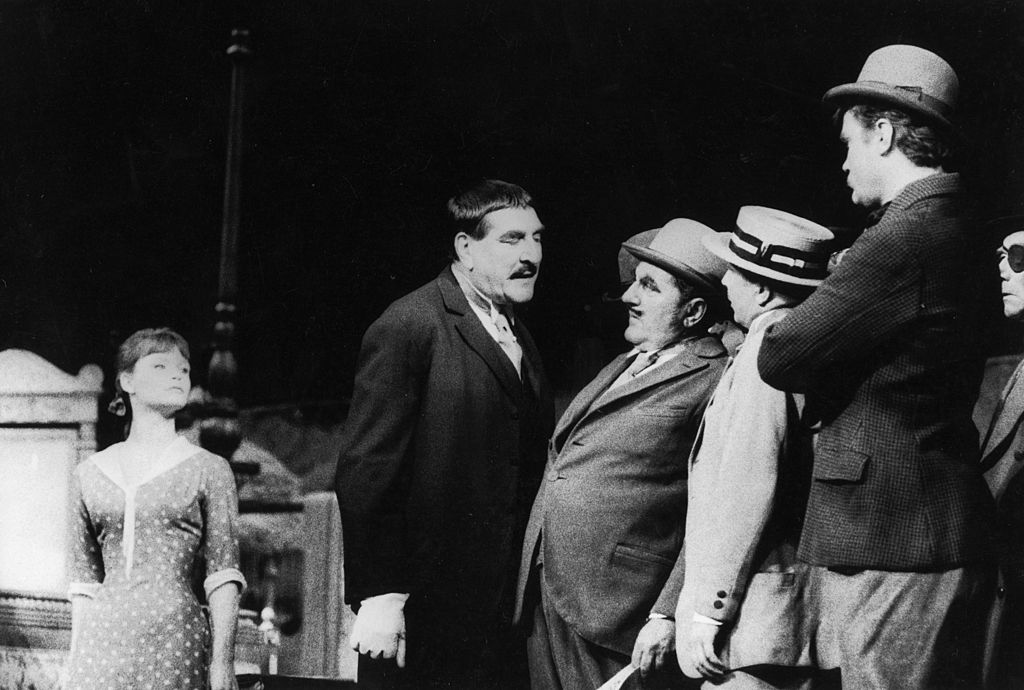
A performance of Berthold Brecht and Kurt Weill’s ‘Die Dreigroschenoper’ or ‘The Threepenny Opera,’ which opened at the Theater am Schiffbauerdamm in 1928.Erich Auerbach / Getty
Bertolt Brecht was one of the most important dramatists, poets, and thinkers of the twentieth century. An unorthodox Marxist who sought new ways to bring together art and politics, during his lifetime he was often considered a thorn in the side of more traditional communist theorists and cultural policy-makers, but also one of the most innovative modern writers.
After his death in 1956, the Cold War divide that sundered Germany also split the reception of his works along ideological lines. The onset of translations of Brecht’s theoretical and literary works into French, English, and Spanish in the late 1950s and 1960s introduced new problems, especially because of the author’s dense style and neologisms. His international reputation, based sometimes on odd choices and mistranslations, has led to controversies and confusion. But who is the Brecht we know today?
In 1964 the prominent Swiss author Max Frisch expressed probably for the first time the frustrated accusation of “Brecht exhaustion” as he spoke of the “striking ineffectiveness of a literary classic.” Frisch was referring not to Brecht’s works but to the dull reception of his plays among theater critics and to theaters’ resistance against his dramaturgical innovations. He thus summed up the attitude of those who treated Brecht as if he were a classic writer by ignoring his suggestions for a new type of theater and turning his plays into bland entertainment.