Spotify Deserves the Hate. But Don’t Forget the Major Labels.
Spotify’s excesses — ghost artists, boring mood playlists, and AI — don’t indicate some evil inherent to streaming. They stem from the major labels’ effective oligarchy over the music industry.
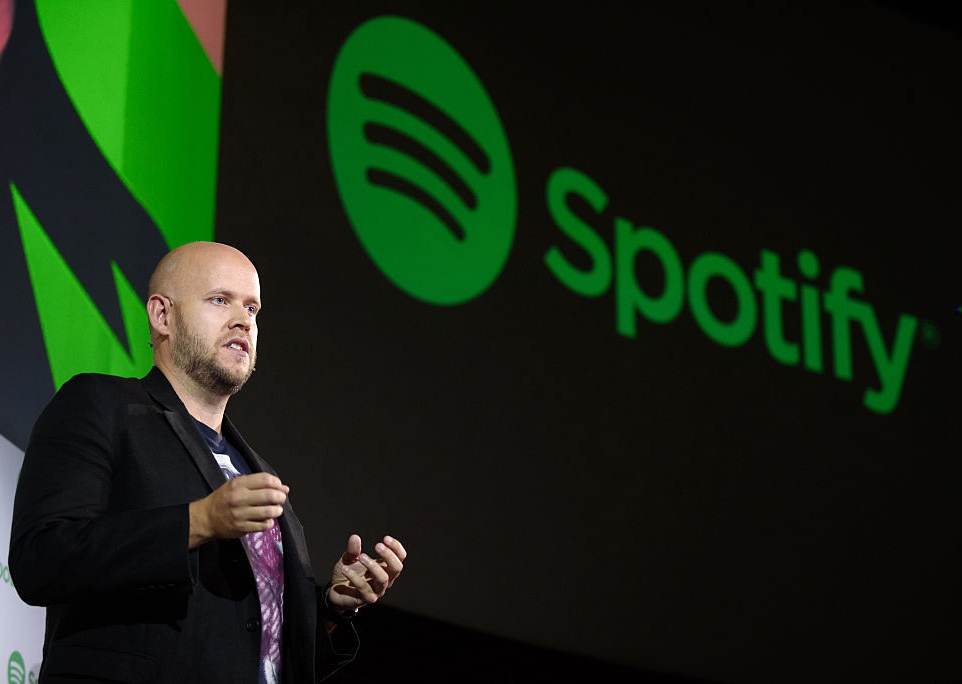
Daniel Ek, CEO and cofounder of Spotify, speaking during a news conference in Tokyo, Japan, on September 29, 2016. (Akio Kon / Bloomberg via Getty Images)
It was all the fault of Scandinavian social democracy. At the beginning of the twenty-first century, Sweden became a global center for music piracy largely through a perfect storm of universal and high-quality broadband, well-funded music education, and assertive personal privacy laws. Something had to be done. Record industry CEOs talked about the Nordic country as a lost market. The Recording Industry Association of America (RIAA) leaned on Congress to apply pressure. Audible in the background was the rise of Piratbyrån, a kind of underground Swedish think tank obsessed with copyright liberation, which unleashed a new BitTorrent search engine — The Pirate Bay — that threatened global consequences.
Years down the line, both Spotify and the major record labels — Universal Music Group (UMG), Sony, and Warner — would benefit in different ways from a neat story in which the plucky Swedish tech upstarts disrupted a complacent and declining music industry, running into town to save it from freewheeling pirates and bringing it back to robust growth. But that call was coming from inside the building.
Throughout the 2000s, major labels had worked on all-you-can-eat music subscription services. Forgotten enterprises like Press Play and Music.Net were hard sells during the profligate CD boom years. The majors wanted it, but couldn’t yet get away with it. “It’s becoming very obvious to me and my peers,” reported one artist manager to the New York Times in 2002 after finding their client’s music streaming for free, “that we’re becoming victims of what is a huge conspiracy.” Those platforms failed, but their intentions did not.