US Defeat in Vietnam Was the Final Act of an Unjust War
The US invasion of Vietnam was a catastrophe for the Vietnamese people, resulting in millions of deaths. Fifty years ago today, the US-backed regime finally collapsed as North Vietnamese forces took control of Saigon.
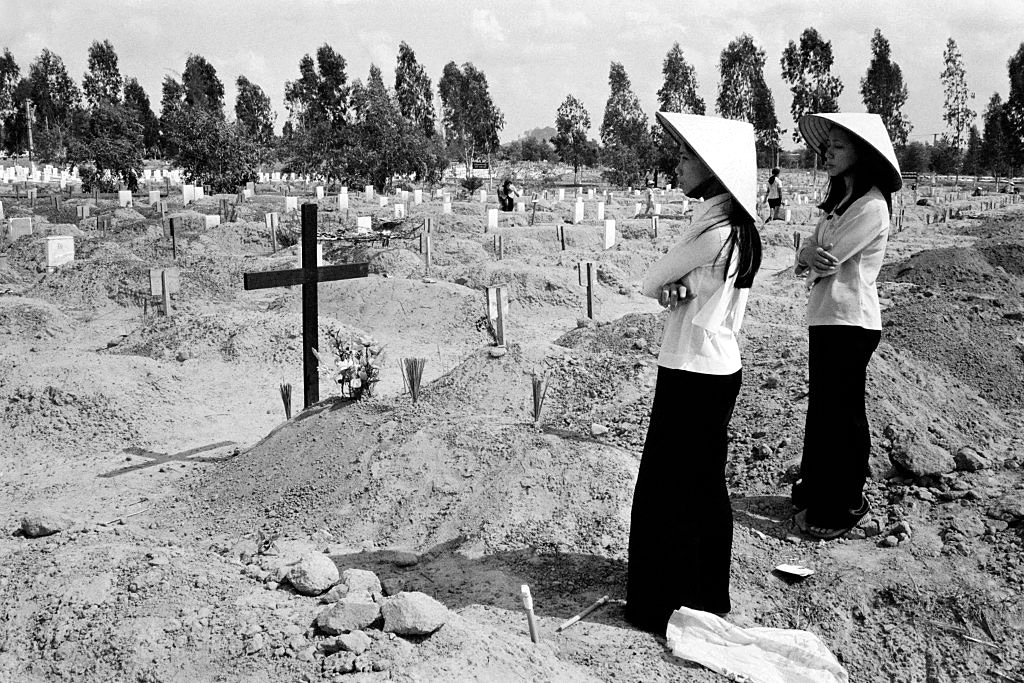
Two Vietnamese women mourn their relatives on April 29, 1975, at Bien Hoa military cemetery as the US started to evacuate their embassy in Saigon. (Françoise Demulder / AFP via Getty Images)
While Vladimir Lenin never actually wrote that “there are decades when nothing happens and there are weeks when decades happen,” it would make for an excellent description of April 1975. Just two weeks after the Khmer Rouge seized Phnom Penh, Saigon, the capital of South Vietnam, fell to North Vietnamese forces on April 30, 1975.
The date embodies both one of the American empire’s most devastating military defeats and one of international communism’s most spectacular revolutionary triumphs. The date is a point of national pride in Vietnam, and justifiably so.
A Century of Struggle
From one perspective, this event marked the end of the Vietnam War (more appropriately termed the Second Indochina War, ranging from 1954 to 1975), a conflict that ravaged the country for decades and left deep scars on its people and landscape. The exact number of Vietnamese deaths will never be known, but the toll may be over three million (a figure which dwarfs the 58,220 Americans lost in the war). As the conflict spilled over into Vietnam’s neighbors, it killed perhaps 60,000 and 300,000 in Laos and Cambodia, respectively.