Facing Up to the Horrors of the Mỹ Lai Massacre

Last month, Vietnam marked the 58th anniversary of the Mỹ Lai massacre, when US soldiers killed hundreds of defenseless civilians. US public memory largely ignores the history of atrocities like Mỹ Lai, making it easier to repeat them in the future.
Thi Trinh Pham

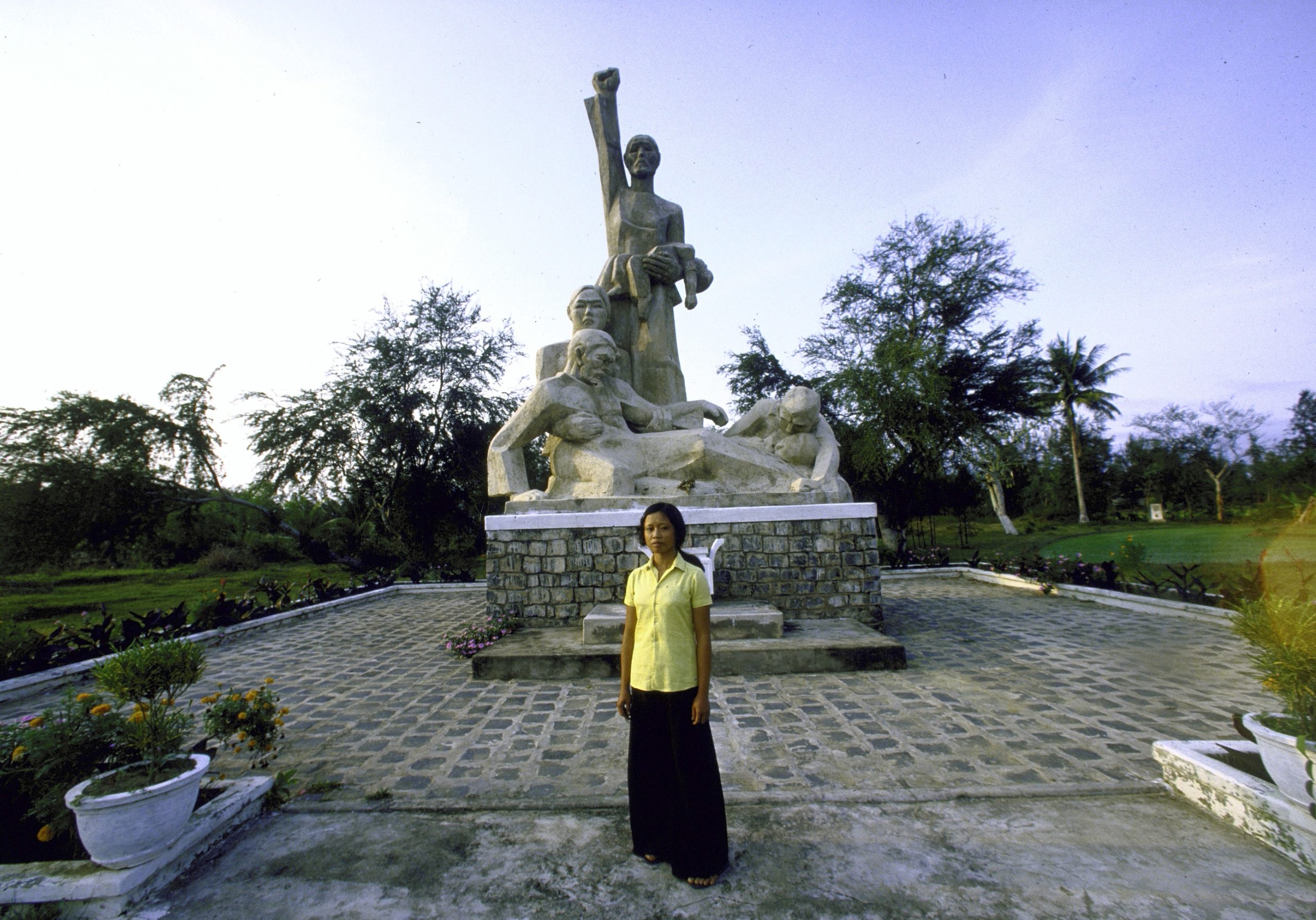
The memorial honoring victims of the Mỹ Lai Massacre stands as both accusation and warning, a place where the violence of the American war is neither abstract nor distant. (Dirck Halstead / Getty Images)


The road to Sơn Mỹ does not resemble the bustling circuits of Vietnam’s booming tourist economy. It veers away from the curated lantern light of Hội An and the resort sheen of Nha Trang, cutting instead through quiet rice fields and low houses, where daily life proceeds with little regard for foreign itineraries.

Here, in Quảng Ngãi province, stands one of the most important, if less visited, sites of historical memory in Vietnam: the Sơn Mỹ Memorial, commemorating what Americans call the Mỹ Lai massacre. Each year, roughly 40,000 Vietnamese visitors make the journey. Only 6,000 to 7,000 foreigners follow.

The imbalance is telling. For domestic visitors, Sơn Mỹ is a place of mourning, reverence, and national memory. For many international travelers it remains peripheral, distant from the narratives and routes that structure how the Vietnam War is remembered abroad.

Yet if one wants to understand how memory of that war is constructed, contested, and lived in Vietnam today, there are few more revealing places.

Landscape of Memory

Sơn Mỹ is not a static monument. It is a layered landscape of memory in which the official narrative of the Vietnamese Communist Party coexists (sometimes uneasily) with the lived, spiritual, and communal memory of survivors who still inhabit the surrounding village. It is at once a museum, a graveyard, a pilgrimage site, a land of wandering ghosts, and a living community. In that coexistence lies both its power and its contradictory nature.

On the morning of March 16, 1968, soldiers from the US Army’s Charlie Company entered the hamlets of Sơn Mỹ. What followed has been documented, litigated, and, in many ways, still contested in American public memory. For the people here, there is no ambiguity.

The official Vietnamese figure stands at 504 dead. While a few military-age men were killed, the dead were overwhelmingly noncombatants, the elderly, women, children, and infants. They were not killed in the chaos of battle — they were executed in cold blood.

Villagers were rounded up and shot in groups. Women were raped and then murdered. Children were killed at point-blank range. Elderly residents were beaten and murdered. The American soldiers killed babies. Then they slaughtered livestock and burned homes.

The soldiers hunted down dozens who sought refuge in shelters. Scores of bodies were left scattered in piles on the village’s dirt roads or in nearby canals and ditches. A seventy-two-year-old man named Trương Thọ was beaten, cast into a well, and shot. His floating body was photographed by Ronald L. Haeberle, a US Army photographer whose images exposed the massacre in November 1969.

After four hours of apocalyptic violence, they stopped for a cigarette break and chatted as they lounged on an embarkment. Haeberle captured this banal moment of war criminals enjoying a moment of respite.

Atrocity and Resistance

The state-run museum at the Sơn Mỹ Memorial complex tells this story with clarity and purpose. Haeberle’s photographs, testimonies, and preserved artifacts construct a narrative of atrocity and resistance. The complex houses a powerful statue in socialist realist style to the victims and a garden with reconstructed homes from the era. The emphasis is unmistakable: this was a criminal act of the American war.

But step beyond the museum complex, and the terrain shifts. The memorial does not stand apart from the community — it is embedded within it. The village surrounding the site is not a reconstruction. It is inhabited by survivors and their descendants. Life continues here, but it does so in the shadow of the past. According to residents, some of those shadows are spirits. Suffering bad deaths, their souls are unable to transition to the next life and they haunt the village.

Scattered among homes and footpaths are mass grave sites, marked but not isolated. The geography of everyday life overlaps with the geography of death. Children play near the graves. Farmers pass them on the way to the fields. The massacre is not confined to a museum exhibit; it is inscribed in the land itself.

At the heart of this popular memory is a distinctly Vietnamese, and deeply Buddhist, understanding of death and the afterlife. Within the memorial complex stands a Buddhist prayer hall. Here, monks perform rituals for the dead: chanting, offerings, and ceremonies intended to bring peace to souls that are believed to wander. Visitors offer presents to the spirits of the victims.

Beneath an altar holding both images of the Buddha and Haeberle’s images of murder, they place candy, cookies, crackers, and other treats. There are cans of soda and beer for thirsty souls. After one monk heard from the spirits that the children were sad because they couldn’t drink the beer, people began to leave milk and baby formula. On the floor is a large pile of toys and school supplies for the spirits of children.

Geography of Ghosts

These rituals are not peripheral. Visitors report spiritual encounters, and monks perform exorcisms for those who believe wandering souls have attached themselves to the living. This is a memory not just of history but of spirits. In his ethnographic interviews with the staff, survivors, and residents, Danish historian Kim Wagner has learned of the village’s geography of ghosts.

Here lies a tension. The Vietnamese Communist Party promotes a secular narrative of patriotic sacrifice. Yet the persistence of Buddhist ritual reveals another layer, rooted in grief, cosmology, and unresolved death.

Rather than suppress these practices, figures like Mrs Kiều, the museum director and daughter of a survivor, work to integrate them. She is deeply involved in organizing commemorations and eager to make space for Buddhist ceremonies, especially on anniversaries tied to the Buddhist calendar.

On March 16, there was a formal state memorial with party officials, hundreds of school children, and the dwindling number of survivors in attendance to mark the fifty-eighth anniversary. A few weeks later, on the lunar calendar, there was a Buddhist ceremony. This event comes not from the government but as a local initiative.

Mrs Kiều’s work reflects a broader truth: memory at Sơn Mỹ cannot be contained within ideology alone. It must also account for the lived and spiritual needs of the community. This may challenge many Cold War stereotypes of what is allowed in a Communist state. Here historical materialism and ghost stories coexist.

Complicated Memories

Americans have a moral obligation to visit the museum and the memorial. While some might hope for healing and recognition, the United States has still not fully come to terms with its identity as perpetrator of war crimes. And it is not the job of Vietnamese to attend to American needs.

Before this year’s anniversary, after a thoughtful and generally pleasant conversation with two party officials from the local government, one pointedly asked me about Donald Trump’s attempts to deny responsibility for the killing of over 150 girls at Iran’s Shajareh Tayyebeh elementary school. The subtext of the question was clear: Why do you people continue to do this?

Mr Duy Mai Lai, who has the job of greeting Westerners with his fluent English, did note that many are very shaken by their visit to the site. When he told me about visitors who were overcome with emotion by the evidence of war crimes, I earnestly, albeit thoughtlessly, suggested some sort of trauma-informed training for the museum staff and floated the idea of grief counselors. He quietly stared at me in disbelief.

While the staff, village residents, and Vietnamese visitors seemed appreciative of Americans who have taken the time to pay their respects at the site, some forms of tension and anger remain. One afternoon, a man who must have been in his early teens at the time of the massacre approached me and asked if I was American. He then launched into a passionate statement and urged me to come with him to see the images of what my country had done.

The museum staff politely ran interference and explained to me that for a certain generation, “memories are complicated.” They left his words untranslated but literal translation was unnecessary. His emotions transcended language.

For Vietnamese visitors, the site functions as a place of pilgrimage. For foreigners, it remains marginal. But that marginality says less about the site’s importance than about the limits of global memory. Sơn Mỹ stands as both accusation and warning, a place where the violence of the American war is neither abstract nor distant but immediate, embodied, and still unfolding in memory. While we hope that the wandering souls eventually find peace, these ghosts currently remain to remind of us the horror.