Kissinger in East Timor
Henry Kissinger once said that the slaughter of hundreds of thousands in East Timor would have occurred no matter what he did. He was too modest.
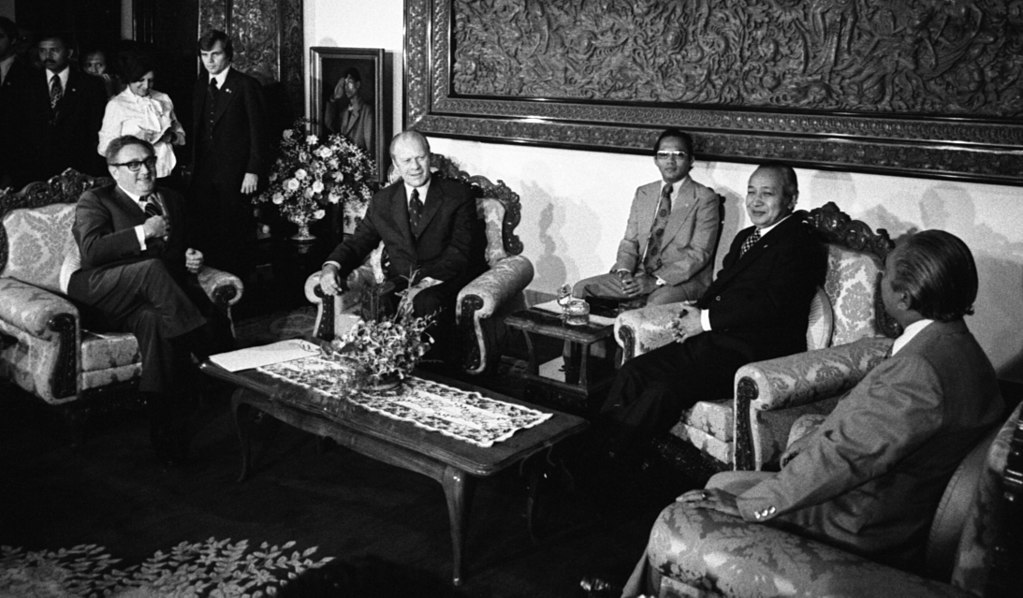
Henry Kissinger (far left) meeting with then US president Gerald Ford (second from left) and Indonesian president Suharto (second from right) in Jakarta, Indonesia, on December 6, 1975. (David Hume Kennerly / Gerald R. Ford Presidential Library via Wikimedia Commons)
In 1999, after almost a quarter century of Indonesian occupation, the small country of East Timor finally gained its independence. The 1975 Indonesian invasion and the occupation that followed — which has been described as “the clearest and most horrific instance of colonialism by a former colony” — took the lives of more than 200,000 East Timorese, about a third of the pre-invasion population.
Indonesia’s rule over East Timor had received crucial backing over the years from the United States, Australia and other Western powers. But Indonesia would have never succeeded in seizing the island nation in the first place without the diligent support of the United States. As secretary of state, Henry Kissinger helped make the occupation happen.
Portuguese sailors landed in Timor within years after their first passage through the Straits of Malacca in 1511. The Portuguese captured the eastern side of the island’s 32,300-square-kilometer area, the rest eventually falling under Dutch control. Colonialism drew East Timor into a violent history shared with the other subjects of the Portuguese empire, and added one more tradition to the island’s already variegated cultural mix. As independence leader José Ramos-Horta once put it, East Timor drew on influences that included Melanesian, “which binds us to our brothers and sisters of the South Pacific region; Malay-Polynesian, binding us to South-East Asia; and the Latin Catholic influence, a legacy of almost five hundred years of Portuguese colonization.”