Environmental Havoc Is Making Colombia’s Mosquitoes Deadlier
Colombia hosts many of the world’s most dangerous species of mosquitoes. Climate change is making them more prevalent.
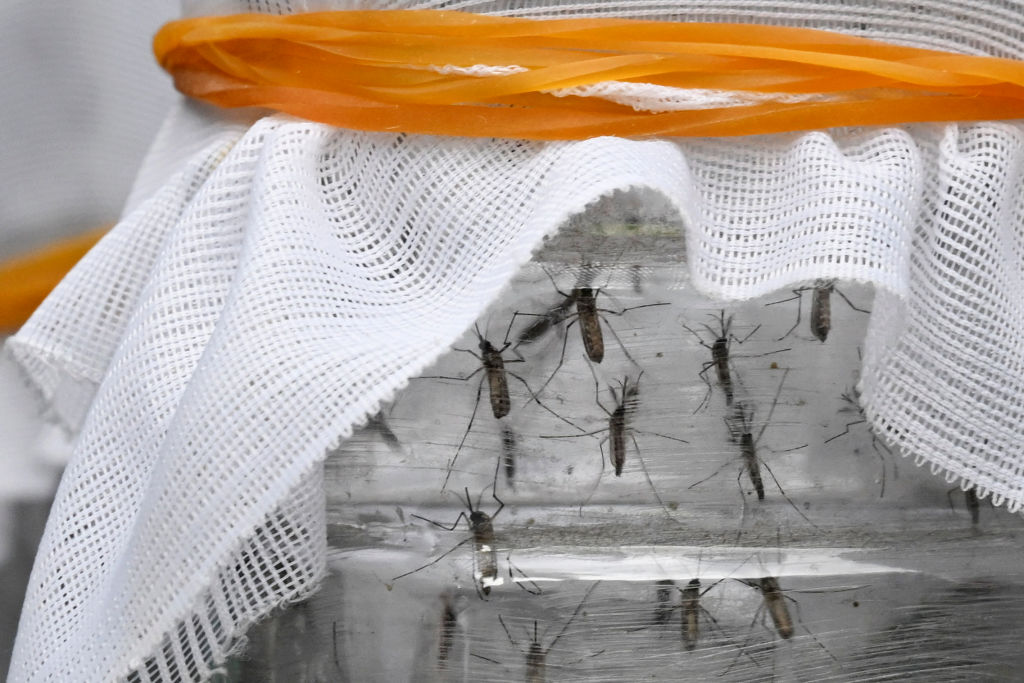
Aedes aegypti mosquitoes are pictured before their release in Cali, Colombia, on June 21, 2024. For almost a decade, the World Mosquito Program has been replacing the local population of Aedes aegypti mosquitoes with “biologically modified” insects of the same species to prevent the transmission of dengue fever. (Joaquin Sarmiento / AFP via Getty Images)
Cali, Colombia, my home for the past decade, is often ranked among the most violent cities on the planet. The most common way for an adult male to die in the city is from a bullet. Yet when I walk the streets of my adopted city during the day, I feel quite safe. It is only when the sun goes down and a cool breeze comes down from the mountains, awakening the little creatures that live in this lush, tropical city, that I fear for my life.
Each year, over four hundred thousand human beings on this planet are murdered by other human beings. Much more deadly, however, is a nearly invisible predator responsible for the annual deaths of over a million people, a predator that by some estimates has killed, since human history was recorded, a total of over fifty billion human beings — almost half of all those who have ever lived. This deadly assassin is, of course, the mosquito.
Small Flies
In the Americas, mosquitoes played an especially deadly role during the European conquest, spreading diseases that aided in the genocide of indigenous people throughout the continent, and they continue to kill record numbers of people throughout the continent, especially in cities close to the equator.
During the mid-1900s, a US-supported plan to wipe out the Aedes aegypti mosquito, the principal carrier of disease, especially dengue, was carried out in eighteen countries on the continent (precisely at the same time as the United States was training and funding paramilitary mercenaries to wipe out all communists and communist sympathizers). Although initially mosquito-borne diseases were held in check by DDT and other chemical killers, from the 1970s to the ’90s, thanks to extreme population booms and massive migrations into urban areas, and due to mosquitoes’ ability to adapt and survive, the insects flourished, and the diseases they carried became a serious health problem.
The twenty-first century has seen the greatest expansion of Aedes aegypti, bringing with it an alarming increase in the number of outbreaks of dengue. The dengue epidemic of 2024 was the worst ever recorded worldwide, with more than thirteen million cases and 8,500 reported deaths, more than triple that of any previous year.
The World Health Organization (WHO) has classified dengue outbreaks in 2025 as a grade G3 global emergency, with more countries under attack than ever before. Climate change, caused by the destruction of the environment, favors certain species, such as cockroaches, rats, and mosquitoes. In areas above 1,500 meters above sea level, mosquitoes were once rarely to be found, but today with global warming cities and towns that are as high up as 2,200 meters are under attack. This increased range of mosquitoes, due to radical changes in the climate caused by massive deforestation and industrial pollution, now puts almost everyone in Colombia at risk of dengue. A rise of just one degree in temperature increases the spread of dengue by 13 percent. In addition, as seasons are thrown out of whack by rising temperatures, the number of months of the year in which mosquitoes are active is increased.
While living in Cali, an epidemic of chikungunya broke out in 2014, and the following year zika spread death throughout the city. In 2016, dengue, the fastest-spreading disease on earth, was unleashed in the city and has since only grown in intensity. In 2024, around forty thousand people were infected, making Cali the center of dengue infection in Colombia, several times more than other major cities.
Hot, humid cities, such as Cali, are a paradise for mosquitoes. Located near the equator and only one thousand meters above sea level, the alternating heavy rain and hot sun in Cali provide a perfect breeding ground for mosquito eggs. The extreme weather phenomena of El Niño and La Niña, which push rainfall and fluctuating temperatures to extreme levels, favor mosquitoes more than humans.
In Cali, the mass influx of people into poor, marginal barrios, due mostly to the violence and forced displacement in the countryside, not only exposes internal migrants to high levels of discrimination, poverty, and violence, but also puts them at risk of mosquito-borne diseases. Often with poor or no sewage treatment and garbage removal, these inner-city barrios in Cali have become the biggest breeding grounds for parasites and disease transmitted by mosquitoes.
Mosquito in Spanish means a small fly, which is why in Cali, they’re called zancudos, in order to differentiate a simple pest from a deadly peste (plague). In this tropical city, everything that crawls or flies bites. If innocuous insects such as ants, cockroaches, daddy longlegs, and even fruit flies have evolved here to attack, it’s no surprise that zancudos have become extra bloodthirsty.
Mosquitoes are highly evolved predators with supersensitive sensors. They can smell the carbon dioxide breathed out by humans and the salt in their sweat and are especially attracted to the bacteria that cause human feet to stink. It was recently discovered that mosquitoes have heat and infrared vision, which means they can actually perceive the blood circulating within human bodies, which makes them especially lethal.
Mosquitoes have a highly developed mouth divided into six parts, some that guide the bite, others that saw their way through skin, and a needle nose, sharper than a syringe, designed to funnel human blood into the insect’s razor-thin body. When they jab this suction device into humans, mosquitoes inject spit into the wound to act as an anticoagulant to keep the blood flowing. They also urinate on their victims as a way to expel excess salt that human blood adds to their system. With this exchange of fluids between humans and mosquitoes, a wide variety of protozoa, bacteria, and viruses are released into the human body, the true source of mosquito-borne disease.
Like sharks, only a few species of mosquito lust for human blood, and of these, only pregnant females actually drink it (the mosquito buzzing sound is caused when they flutter their wings extra fast to lift their bloated belly). After fully gorging its guts on human blood (emptying their bowels while doing so to open up more storage space), female mosquitoes then rest for a few days to digest the blood and convert it into protein to nourish the eggs they carry.
In Colombia, there are thirty-two different species of zancudos, many of which are only to be found in the region. Nonetheless, it is the Aedes aegypti, the most “globalized” mosquito, the one that has colonized most of the planet, that causes the most disease and death here in Cali.
The name Aedes comes from the Greek word for “unpleasant” or “horrible.” Contrary to what its second name suggests, Aedes aegypti originally originated in Ethiopia and has since colonized all the inhabited parts of Earth (except for Iceland). Aedes aegypti first arrived in the Americas in the 1600s on the ships that brought slaves from Africa and was instrumental in spreading death among the indigenous population throughout the continent. Even today, it is responsible for the greatest number of epidemics throughout the Global South, especially dengue.
One of the things that make dengue especially deadly is that, while other mosquito-borne infections grant immunity to the infected people who survive, a second case of dengue almost inevitably leads to severe symptoms, such as bloody vomiting, extreme abdominal pain, and deathlike pale or yellowish skin. Nearly half of all people who are reinfected with the disease die, most commonly from internal hemorrhaging or shock.
Although scientists have long studied mosquitoes, there is no truly effective protection against these bloodthirsty assassins. In Cali, to keep the blood-lusting beasts at bay, DDT was for decades sprayed twice a year in schools, parks, and in people’s homes. Although DDT was eventually banned for its poisonous effects on human beings and other living creatures, other equally toxic pesticides are still being sprayed throughout the city. In any case, pesticides tend to kill only the adult mosquitoes, not the eggs, larvae, or pupae, and thus in no way solve the root of the problem. What’s worse, unlike human beings, mosquitoes quickly adapt and become resistant to any new toxic chemical cocktails that humans invent.
Another current plan in Cali to stop mosquitoes from multiplying is the cultivation and unleashing of thousands of guppies in large bodies of water. Guppies, like dragonflies, water striders, whirligig beetles, catfish, toads, frogs, turtles, ducks, swallows, and bats, love to munch on mosquito larvae, but as mosquitoes far outnumber all of these species together their effectiveness is limited.
Some cities in Latin America have released thousands of males that have been sterilized by exposure to gamma rays into the mosquito population to decrease reproductive rates. To keep people from killing off the best hope for mankind, scientists dyed the mosquitoes red before releasing them.
The latest strategy in Cali is to inject Wolbachia bacteria into lab-grown Aedes aegypti. The Wolbachia bacteria, naturally present in 60 percent of all insects (though not in mosquitoes), is extracted from fruit flies and then introduced by microscopic needles into mosquito eggs. Once inside, the bacteria selectively eliminates deadly viruses without harming the host. Although their bite still hurts, they still suck human blood, and they still lay thousands of eggs, these modified mosquitoes and their offspring don’t transmit deadly diseases.
With initial funding by Bill Gates, the US Agency for International Development, and the Wellcome Trust, millions of Wolbachia-infected eggs have been manufactured in large bio-factories in Colombia. The first phase of dispersing disease-free zancudos into the city was carried out in Cali in 2024. Even though the government announced the benefits of the program through official news networks and social media, the liberating of millions of mosquitoes within the city of Cali has caused some unrest among the local population. One employee who was caught releasing swarms of mosquitoes behind him as he rode around the city on his motorcycle was chased down, knocked off his bike, and almost lynched.
In the end though, nothing can really rid mankind of its most deadly enemy, especially as they far outnumber us, with a population estimated at over one hundred trillion. Mosquitoes were here before the dinosaurs walked the earth, and they will surely be buzzing around when human beings have become extinct.