Neoliberalism Has Always Been a Threat to Democracy
More than just a set of free-market policies, neoliberalism has always sought to alter society's balance of power in favor of bosses. Its assault on democracy and undermining of unions is now playing straight into the hands of the far right.
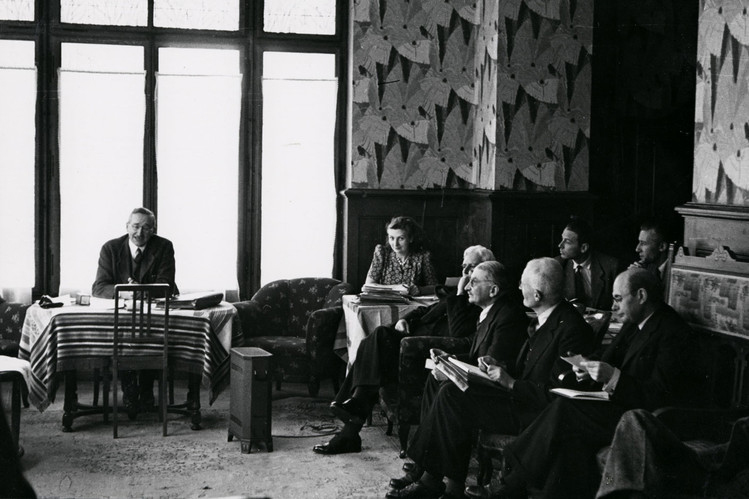
The first meeting of the Mont Pelerin Society, in 1947, with founders, Friedrich Hayek and Ludwig von Mises. (Mont Pelerin Society)
Neoliberalism has been with us now for more than three-quarters of a century. Since the Mont Pelerin Society’s efforts to reinvent old-fashioned liberalism in the 1940s, neoliberalism has taken various forms, be it the Chicago School and German ordoliberalism, the Pinochet-led Chilean coup of 1973, the Thatcher–Reagan revolutions, the IMF and World Bank–driven structural adjustments, or the European Third Way.
The topic of neoliberalism has produced a veritable cottage industry of commentary, which has only expanded in the last decade as pundits try to make sense of an increasingly contested and slippery term. Many of those who write about neoliberalism are now extolling what they believe to be its last waltz on the world stage: amid transformations brought about by the 2008–9 financial crisis, the rise of protectionist authoritarian governments, and the need for large-scale public policy solutions in the age of COVID-19, many have proclaimed that neoliberalism is indeed on its last legs.
But is that really the case? Or is neoliberalism simply lumbering on — in even more virulent forms?