The Rumors Are False — Neoliberalism Is Alive and Well
Recent announcements of neoliberalism’s demise in the wake of the pandemic are mistaken. Ending neoliberalism will require purposeful effort and struggle, not just economic and political crises.
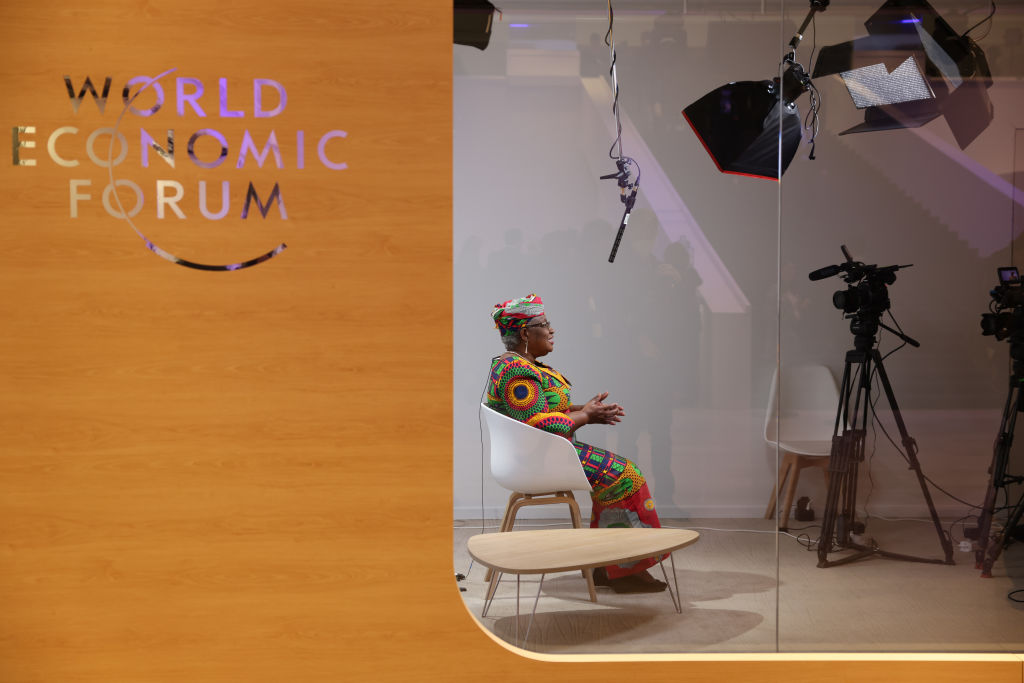
Ngozi Okonjo-Iweala, director general of the World Trade Organization (WTO), during an interview on the closing day of the World Economic Forum (WEF) in Davos, Switzerland, on May 26, 2022. (Hollie Adams / Getty Images)
Recent discussions about the supposed death of neoliberalism present a mirror image of past discussions about neoliberalism’s birth. For quite some time, scholars, intellectuals, and popularizers of many sorts were inclined to present neoliberalism as a mainly Anglo-American phenomenon that got its start in the late 1970s. Margaret Thatcher and Ronald Reagan have had the starring role in narratives of neoliberal politics, and Milton Friedman and Friedrich Hayek (an Austrian, but famous mainly for a career based in the United Kingdom and the United States) continue to be the best-known neoliberal intellectuals. Indeed, this group of four shared the cover of a noted history on the “birth of neoliberal politics.” Featured episodes in the history of neoliberalism elsewhere, like in Augusto Pinochet’s Chile, have still been presented in Anglo-American terms to the extent that they have been described (quite fairly) as a foreign imposition.
In some ways, these days are long gone. Hardly any serious scholar of neoliberalism would describe the ideology or its history as exclusively Anglo-American. The last decade has seen an explosion of interest in the history of neoliberalism and its practice around the globe. And yet, in ongoing discussions about the “death” of neoliberalism, we have seen a return to this limited outlook.
In 2016, a fresh round of obituaries was prompted by the election of Donald Trump in the United States and by the Brexit vote in the United Kingdom. More recently, during the early part of Joe Biden’s presidency, commentators eagerly prophesied, or even declared, neoliberalism’s demise. Sometimes their evidence consisted of little more than a progressive-but-unrealized Biden agenda. It strained credulity to imagine that, in the face of prospective legislative developments in a single country — and after forty years of never letting a crisis go to waste — the neoliberal era had finally encountered the crisis it could not survive. As if neoliberalism were incapable of withstanding American social spending provoked by the pandemic, there was a return to the original parochialism of the neoliberalism debates.