Thomas Sankara Gave His Life Fighting Neocolonialism
Anti-colonial revolutionary Thomas Sankara struggled to free his country, Burkina Faso, from the domination of foreign corporations and neoliberal economic institutions. And in 1987, he was assassinated for it.
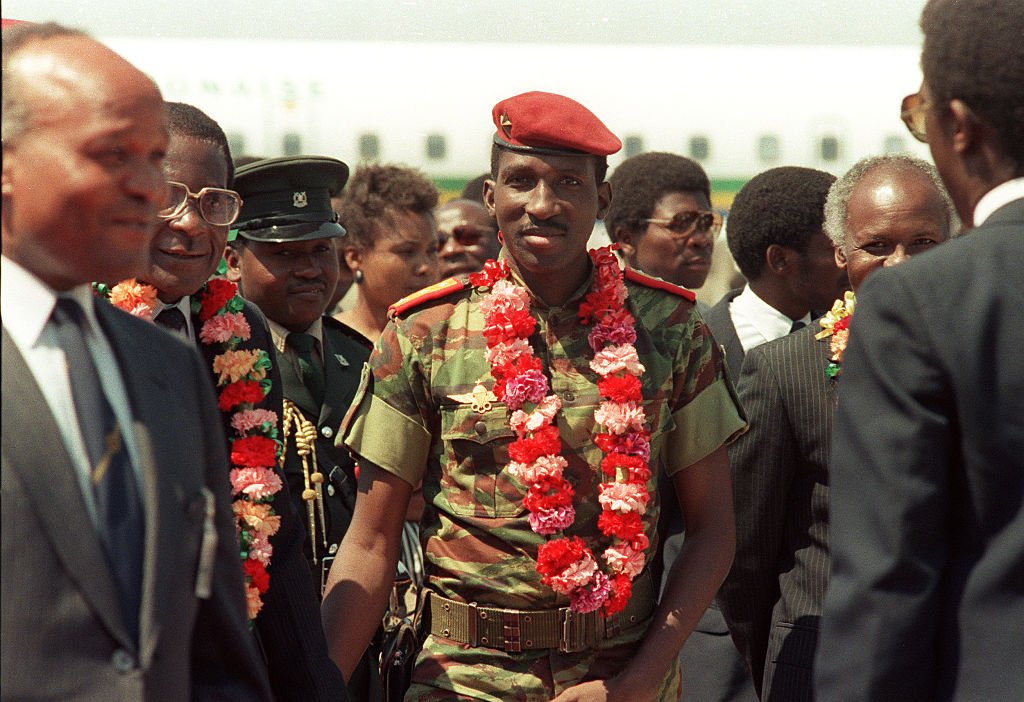
Thomas Sankara in Harare, Zimbabwe for the Eighth Non-Aligned Summit, 1986. (Alexander Joe / AFP via Getty Images)
Thomas Sankara’s 1983 to 1987 revolution in Burkina Faso was part of a small group of national, radical political movements in the Global South during the heady but volatile 1980s. These movements were geared to achieve economic and political independence for their countries as the majority of Global South nations oriented their political institutions according to the prescriptions of North American and European patrons and the detrimental economic models of the International Monetary Fund and the World Bank.
Union College professor Brian Peterson’s Thomas Sankara: A Revolutionary in Cold War Africa, published in February 2021 by Indiana University Press, is a timely, engrossing, highly informative history that is as much a biography of Sankara as it is a national memoir of West Africa during the Cold War of the 1980s. Peterson positions Sankara’s revolution as an example of the counter-hegemonic struggles during the 1980s’ neoliberal transition.
In addition to his most recent book and articles on the intersection of Islam and colonial rule in West Africa, Peterson is the author of Islamization from Below: The Making of Muslim Communities in Rural French Sudan, 1880-1960 (Yale University Press, 2011).