Thomas Sankara Is Not Dead
Anti-colonial revolutionary Thomas Sankara fought to transform Burkina Faso into a truly independent, self-governing nation before his assassination in 1987. But as a recent film shows, Sankara’s legacy continues to inspire struggles against oppression despite ruling elites’ efforts to erase him from public memory.
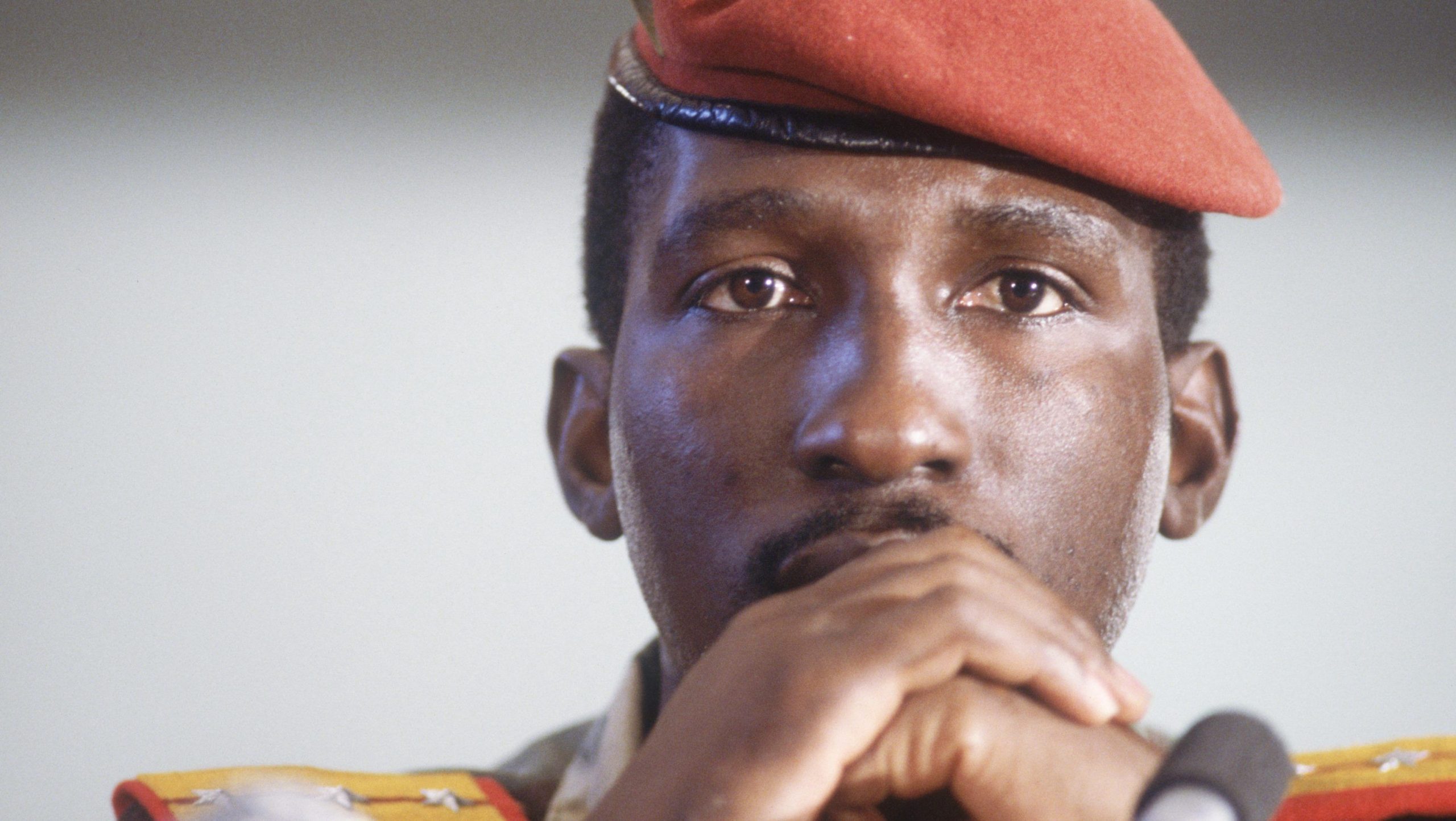
Thomas Sankara, socialist revolutionary and president of Burkina Faso from 1983 to 1987.
Burkina Faso’s single railway line originates in Abidjan, Côte d’Ivoire, on the Atlantic coast and runs northward six hundred kilometers to the capital and largest city, Ouagadougou. The railway was established by the French colonial administration, and its route remained unchanged until Thomas Sankara came to power in Upper Volta in 1983 through a military coup. In 1985, his government began work on extending the rail line northward. Included in this effort was what become known as the “battle of the railways.” Citizen-workers from villages along the planned route competed in squads to clear the roadbed and lay one hundred kilometers of track to connect Ouagadougou with the town of Kaya. The initiative was Sankara’s vision of development by and for the people.
Sankara’s ultimate goal for the railway line was to continue it farther north to Tambao, on Burkina Faso’s border with Niger, where the region’s largest manganese deposit remained largely inaccessible by road and, therefore, unexploited. The revolution to transform Burkina Faso into a truly independent, self-determined nation that cohered socially and politically required capital, and Sankara envisioned manganese as part of the means to that end. The people’s inspired work on the railway line ceased on October 15, 1987, the day Sankara was assassinated and his government was ousted in a coup orchestrated by Blaise Compaoré.
The 2019 film Sankara n’est pas mort (“Sankara Is Not Dead”), part of this year’s New York African Film Festival, tells a story situated in the euphoria of the 2014 People’s Revolution in Burkina Faso that ended Blaise Compaoré’s twenty-seven-year grip on the country. Writer and director Lucie Viver’s film is a beautifully shot and expressively scored portrait of Burkina Faso and its people in this moment of uncertain yet hopeful change. It integrates poetry and travel writing, with splices of Sankara’s speeches and footage of the 2014 revolution to capture people’s experiences in the aftermath of the uprising.