India’s Hindu Nationalist Project Relies on Brutal Repression
The Indian state under Prime Minister Narendra Modi is meting out vicious repression against dissenters to his right-wing Hindu nationalist vision. Yet that constant need to crack down on protests also reveals something: his far-right project is undeniably brittle.
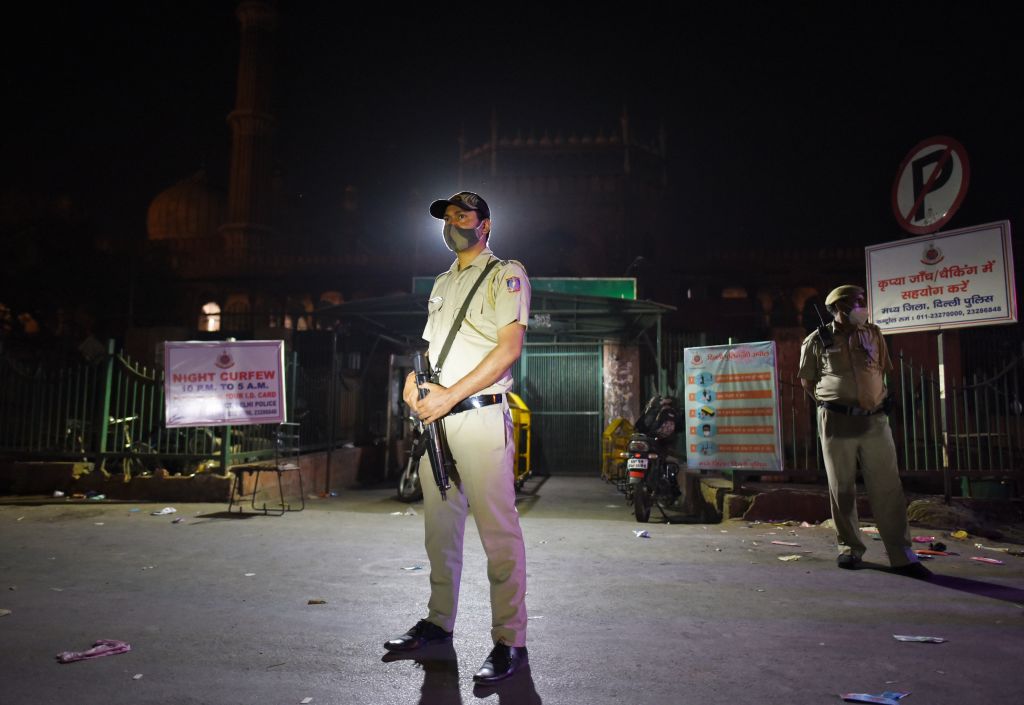
Indian police personnel on April 9, 2021 in New Delhi, India. (Sanchit Khanna / Hindustan Times via Getty Images)
On February 19, the Indian Ministry of Culture sent out a tweet celebrating the birth anniversary of M. S. Golwalkar, the staunch Hindu nationalist who for many decades served as the head of the Rashtriya Swayamsevak Sangh (RSS), or “National Volunteer Organization.” Founded in 1925, the RSS bills itself as a cultural organization, but critics often describe it as a right-wing paramilitary, a nationwide network of well-organized cadres committed to Hindutva ideology, with deep links to the current governing party, the Bharatiya Janata Party (BJP). Indeed, Prime Minister Narendra Modi got his start as a full-time activist in the RSS, and in a book he wrote in 2008, Modi gave a glowing portrait of Golwalkar.
However, not everyone views Golwalkar so favorably, and a closer look at his work reveals the bigotry at its core. In his first book, Golwalkar argued that “the non-Hindu peoples of Hindustan . . . must entertain no ideas but the glorification of the Hindu race and culture . . . [and] may stay in the country wholly subordinated to the Hindu nation claiming nothing . . . not even citizen’s rights.” (In this context, he wrote that Hitler’s Germany was “a good lesson for us in Hindustan to learn and profit by.”) In his second book, clarifying who these “non-Hindu” people might be, Golwalkar points to three “internal enemies” of the Hindu nation: Muslims, Christians, and Communists.
For Golwalkar, these enemies share one characteristic: they threaten to disrupt the supposedly “natural” unity and harmony of the Hindu race and Hindu civilization, which stretches back to time immemorial. Islam and Christianity were seen as dangerous because they were the religions of conquering “outsiders”: the Mughal Empire and then the British. This ignores not only the many divisions of pre-Mughal India along lines of caste, class, region, and religion (totally erasing, for instance, Buddhism’s stark opposition to orthodox religious practices in ancient India) but also the rich, centuries-old social lives of Islam and Christianity on the subcontinent.