How the Deutsch Mark Swallowed Up East Germany’s Economy
- Loren Balhorn
After the Berlin Wall's fall, the introduction of the West German currency was widely presented as the East’s path to prosperity. But the result was a fire sale of East German industry to Western businesses — a massive destruction of jobs and public property whose harmful effects are still felt 30 years after reunification.
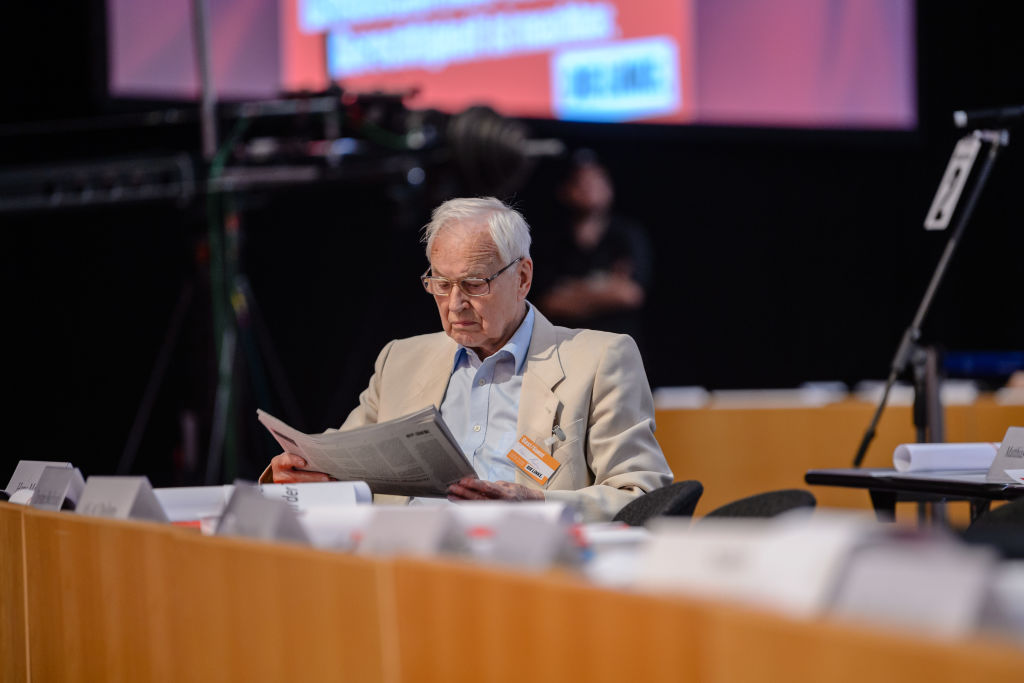
Hans Modrow, former prime minister of the German Democratic Republic, on June 9, 2018 in Leipzig, Germany. (Jens Schlueter / Getty Images)
“The social market economy has turned out to be nothing more than ordinary capitalism.” Just two years after German reunification, erstwhile East German premier Hans Modrow used these words to welcome readers of Offenes Blatt magazine into 1993.
The disillusionment felt by Modrow — the last member of the Socialist Unity Party (SED) to lead the German Democratic Republic (GDR) — hadn’t come from nowhere. As who one Green politician called the “honest administrator” of the initial “transition process in the GDR,” Modrow experienced firsthand how the state’s attempts at reform were nipped in the bud by West German political elites. Critics on both sides of the inner-German border were dismissed as traitors to the cause of reunification.
Later a member of parliament in the reunified Germany, Modrow became one of the sharpest critics of West German chancellor Helmut Kohl’s policies. The Christian Democrat Kohl’s strategy was built around the deutsch mark and the “free market.” But it turned out to have disastrous consequences for all of Germany — ones that continue to be felt thirty years later. Still today, East-West relations in Germany are shaped by relations of inequality and dependency — as we can better understand with a look at the transition of 1989–1990.