The United States Should Not Be Hoarding Its Coronavirus Research
The fact that the United States is recusing itself from pretty much all global cooperation in the search for a coronavirus vaccine does not bode well for equitable distribution of a cure.
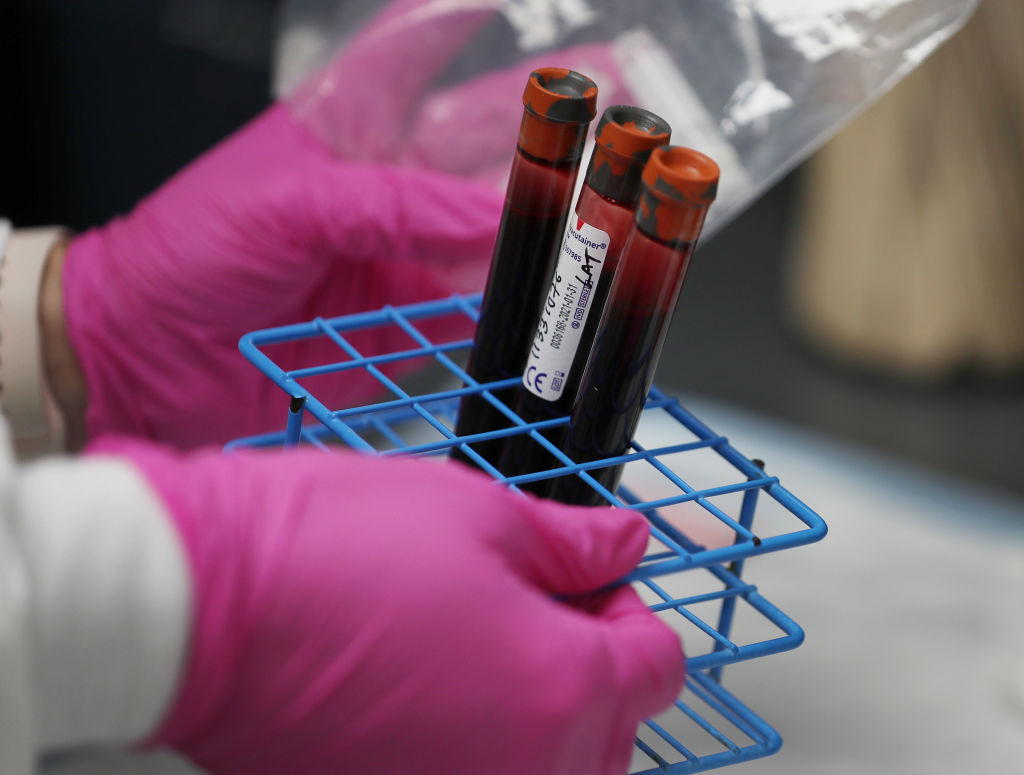
Blood samples during a COVID-19 vaccination study at Research Centers of America on August 7, 2020 in Hollywood, Florida. (Joe Raedle / Getty Images)
In US political discourse, the search for a COVID-19 vaccine is largely framed as an arms race, in which the aim of the United States is to beat out other countries in procuring a vaccine, which will presumably go first to its own people. This vaccine nationalism, as global infections surge past eighteen million and deaths near seven hundred thousand, is playing out along well-worn geopolitical fault lines: Russia, China, and even Iran are trying to steal our vaccine research, US intelligence agencies claim, their warnings dutifully circulated in major media outlets. Yet the fact that US companies and the government are being proprietary over research information and vaccine access is never questioned. In popular discourse, it’s unconscionable to try to obtain research information, but not to hoard it.
Major US media publications have cast the quest for a vaccine as a zero-sum global competition, at times using the language of overt war. A July 7 article in Reuters is headlined, “‘At war time speed’, China leads COVID-19 vaccine race.” It states, “Many other countries, including the United States, are coordinating closely with the private sector to try to win the vaccine development race.” A July 16 article in Forbes warns, “As Coronavirus Vaccines Move Into The Testing Phase, China Begins At The Top.” This spin dates back to the earliest period of the crisis. On March 19, the New York Times ran a piece titled, “Search for Coronavirus Vaccine Becomes a Global Competition.” Its opening line declared, “A global arms race for a coronavirus vaccine is underway.” On May 4, Business Insider put competition in starkly nationalist terms. “US national security officials and global health experts are increasingly concerned China will develop a coronavirus vaccine first,” its headline read.
Of course, there are other possible ways US media outlets could be depicting the search for a vaccine. As Dean Baker, economist and cofounder of the Center for Economic and Policy Research (CEPR), a left-leaning think tank, tells me, “We have this common problem. Why on Earth wouldn’t we be working together to find solutions as quickly as possible? Somehow that got lost. We’re making it proprietary rather than saying, ‘Here’s the knowledge.’”