In Italy, Punjabi Farmworkers Are Treated as Expendable
After decades working the fields in Italy, Balvir Kumar “Birra” was still paid barely five euros an hour. Killed in an accident last month, his story shows how little value Italy’s vast food industry puts on its workers’ lives.
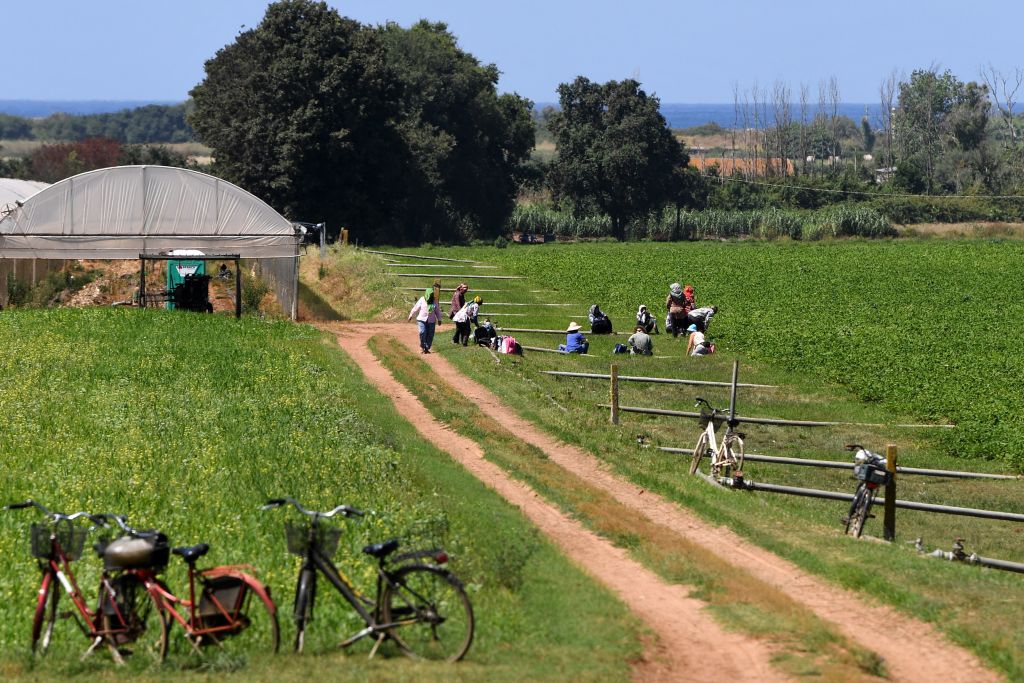
Migrants workers and their bicycles are seen at the fields of Bella Farnia near a coastal city south of Rome on July 1, 2021. (Filippo Monteforte / AFP via Getty Images)
For the second summer in a row, I find myself writing about Punjabis in Italy under the urge of a tragedy. In 2024, it was the horrible death of Satnam Singh, the farmworker left to die by his employer in Latina. This year, it is the July 18 road accident that took the life of Balvir Kumar “Birra,” who was run over by a car while cycling to the fields where he harvested the same zucchini that arrive so cheap and fresh on our tables.
The case last summer had triggered widespread outrage, both due to its bloody details (Satnam suffered severe wounds after an accident with an agricultural machine) and to the cruelty of his employer (who dumped Satnam’s body in front of his house instead of taking him to the hospital, which resulted in his death). It attracted international attention, being featured on global news and inspiring waves of protests, demonstrations, and police interventions in the area and beyond. Birra’s death, in contrast, passed almost completely unnoticed — dismissed quickly as yet another fatal accident on the Via Pontina, “the most dangerous road of the Lazio region.”
Like Satnam, Birra met his death in the Latina province, south of Rome, where the death rate in road accidents increased by 47 percent from 2019 to 2023, and where agricultural labor is mostly performed by migrant workers, a large share of them Punjabis. Yet Birra’s death — rather like Satnam’s — should not be ignored as a mere accident: it could have been avoided, if only the employers and the state assumed the responsibility of protecting their most vulnerable and essential workers.