“Defenders of Democracy” Aren’t Bothered by Its End in Bolivia
A new study is the latest to undermine widespread claims of electoral fraud by Bolivia’s Evo Morales. It isn’t the first such debunking — yet democracy remains betrayed in Bolivia, and “pro-democracy” voices don’t seem too bothered.
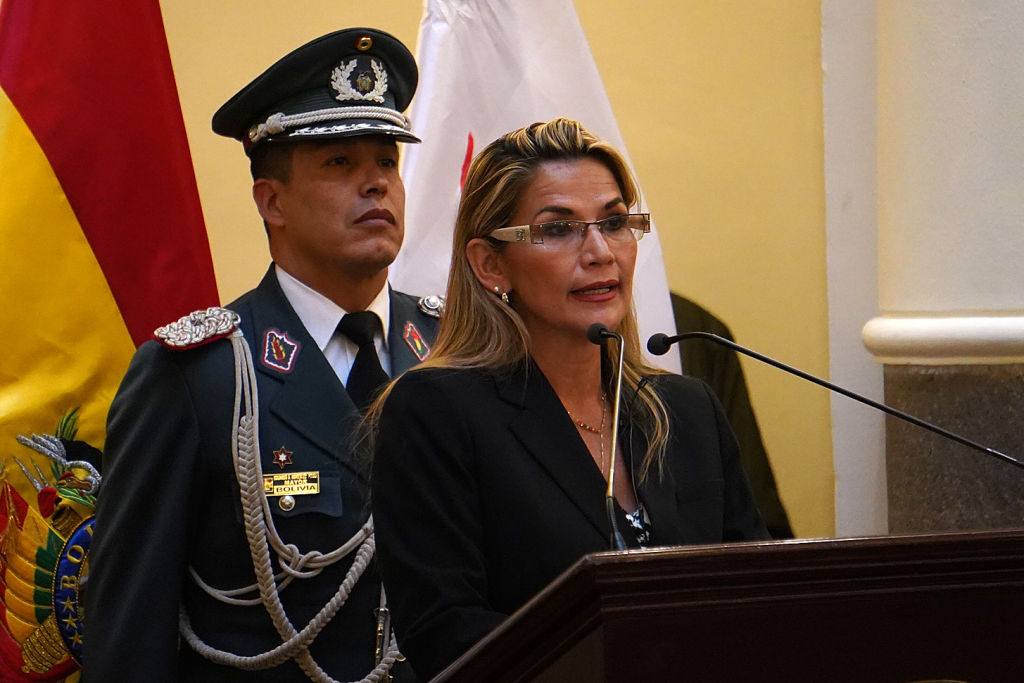
Interim president of Bolivia Jeanine Áñez talks during a conference at the presidential palace on November 13, 2019 in La Paz, Bolivia. Javier Mamani / Getty Images
Mistakes happen. Sometimes you get a number wrong on a government form and are forced through rounds of emails and phone calls to fix the mistake; sometimes you uncritically trumpet false charges of electoral fraud and end up supporting a right-wing coup. We’re all human.
The latest whoopsie-daisy comes care of the New York Times, which recently reported on a new study debunking the central plank of the charges of electoral fraud lobbed at ousted Bolivian president Evo Morales in last year’s election. To recap, in last year’s election, the long-serving Morales looked like he might be forced into a perilous run-off as results trickled in, only at the last minute to jump ahead of the ten-point threshold needed to avoid one. It was this sudden leap that was deemed “inexplicable” by the Organization of American States (OAS), and was widely heralded as evidence Morales had stolen the election.
The new study, conducted by researchers at the University of Pennsylvania and Tulane University, finds the precise opposite: that not only was Morales’s sudden change in electoral fortunes entirely explicable, but was in line with trends in earlier elections in Brazil, Colombia, and even Bolivia itself, which the OAS had signed off on. In fact, it also matches up with something American liberals are far more familiar with: US elections and the Democratic vote.