Julio Anguita (1941–2020)
When former Spanish Communist Party leader Julio Anguita was buried last week, crowds in his native Córdoba broke quarantine to sing the Internationale next to his coffin. The "Red Caliph" saved his party from the doldrums of the 1980s — and helped lay the basis for today's Unidas Podemos.
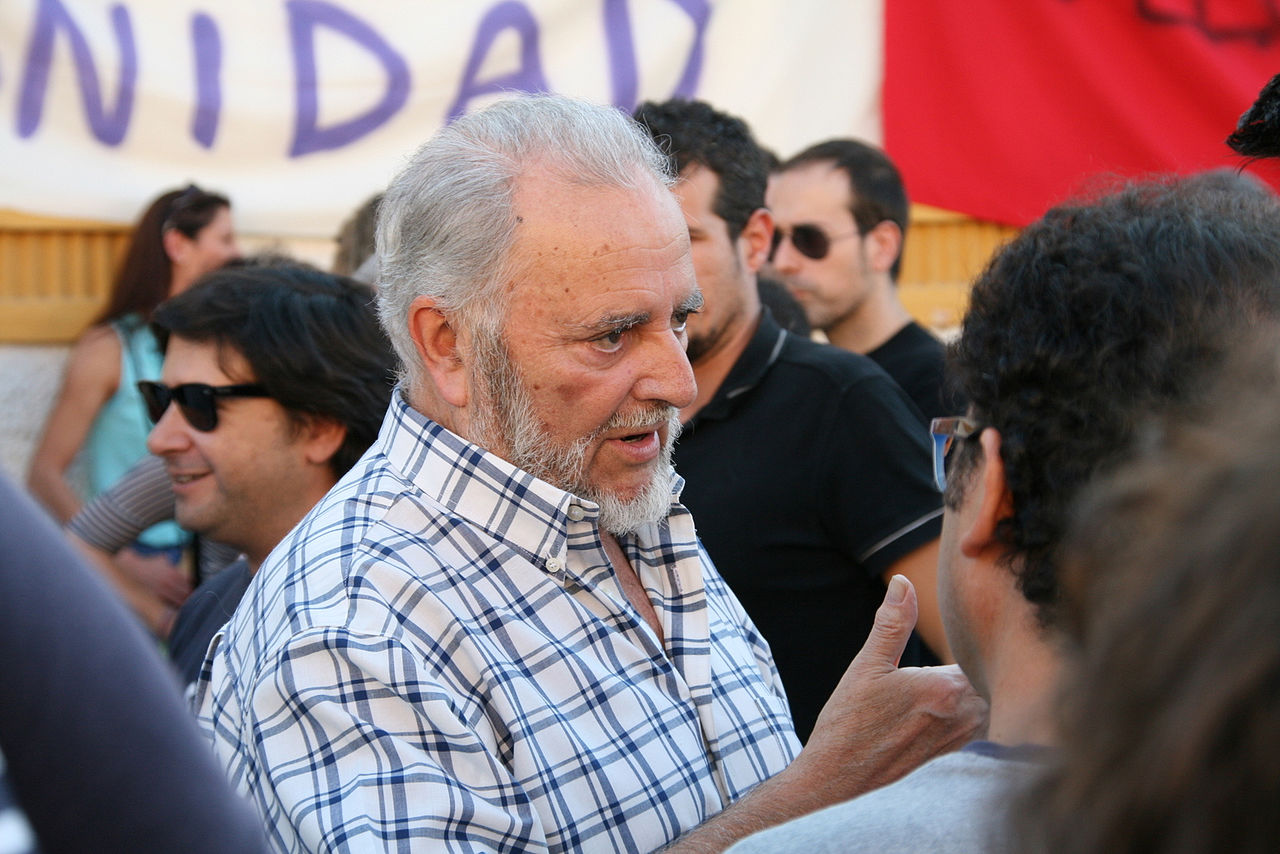
Julio Anguita in Córdoba, October 10, 2013.Javi . Wikimedia
On May 16, Julio Anguita passed away at the Reina Sofia hospital in his native Córdoba, Andalusia, after a third and final heart failure. This was the passing of a giant of Spanish politics, a figure who played a crucial role in the post-Franco “Transition” as well as in the development of the Left. From 1988 general-secretary of the Communist Party of Spain (PCE), Anguita was the founding leader of Izquierda Unida (IU; United Left), today part of Unidas Podemos.
Anguita had withdrawn from active parliamentary life in the early 2000s — a previous health scare, and the tragic death of his war-correspondent son in Iraq, turned him away from front-line politics. Yet in his work as a commentator and author, as in his past efforts as an MP, Anguita was both revered and reviled as the scourge of Felipe González’s Socialist Party (PSOE) and of political backsliders across the spectrum. Detested by the establishment and its press, Anguita remained widely cherished by the Spanish public. This was palpable even after his death, in the three days of mourning in Córdoba, the city of which he was mayor for seven years. The town hall received over 16,000 online condolences and crowds broke quarantine rules to sing the Internationale as his coffin, draped in the red flag, entered the mortuary chapel, amid standing ovations that lasted for almost twenty minutes.
Anguita was particularly hailed as an example of integrity. In later years, rather than accept the MP’s pension to which he was entitled, Anguita generous-mindedly returned to teach history at a secondary school. Yet while the public regarded Anguita as a man of principle, his didactic and sincere approach came into conflict with political culture of a young democracy desperately looking to be accepted into the European fold. Many of the policies today synonymous with Podemos and the indignados movement — uniting left-wing forces under a common program, rejecting the two-party system and corruption, opposing neoliberal reforms, and designing a municipal politics based on popular assemblies and grassroots movements — were in fact first spearheaded by Anguita in Andalusia in the mid-1980s. His passing invites reflection on the advance of those politics — and the transformations in the Spanish left since the return to democracy.