After Corbyn, Socialists Must Continue the Struggle Within Labour
Today’s Labour leadership election is a defeat for the Left. But the real victory for our opponents would be watching the forces we have amassed in recent years scatter to the wind.
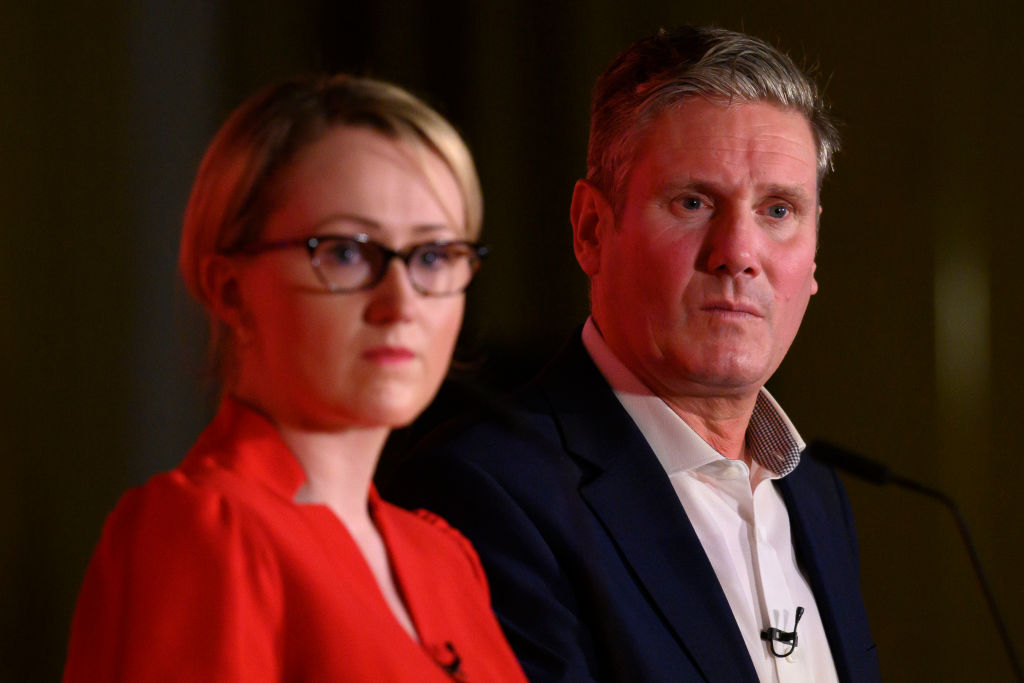
Rebecca Long-Bailey and Keir Starmer at the Labour Leadership Hustings at Cardiff City Hall on February 2, 2020 in Cardiff, Wales. (Matthew Horwood / Getty Images)
Mathieu Kassovitz’s 1995 epic La Haine, tracing the lives of disenfranchised youth in the Parisian slums, begins with the story of a man falling from a great height. “So far, so good; so far, so good; so far, so good,” the narrator assures himself. Then the screen is engulfed in flames. “It’s not the fall that matters,” we are told, “it’s the landing.”
At times in the past five years, the Left has scaled great heights. So much so, in fact, that a socialist Labour government seemed visible on the horizon. There were many achievements along the way — from overturning an austerity consensus that held total sway over British politics for years, to remaking Labour as a mass party with more than half a million members. Thirteen million people voted for a decisive break with neoliberalism in 2017, and ten million voted for a radical left-wing manifesto in December. More than had backed Miliband, Brown — even the last Blair government.
But the general election defeat was, nonetheless, severe. It has chastened the Left, and this newfound timidity was evident in Rebecca Long-Bailey’s leadership campaign. It suffered from many of the weaknesses of Corbynism. It was, in fact, born into the inertia that a lack of succession planning produced. Unfortunately, it had few of Corbynism’s strengths — and could not inspire the kind of movement necessary to beat the odds.