No Beauty in Defeat
The Spanish Civil War ended 80 years ago today with Franco's victory. But for opponents of Spanish fascism, the brutal repression of popular culture and democracy was only beginning.
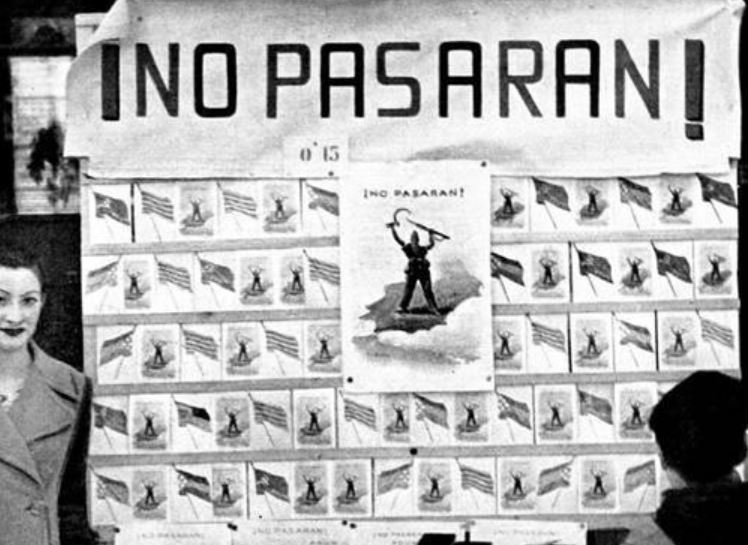
Postcards and posters declaring “No pasaràn” in Madrid, Spain in 1936. Wikimedia Commons
André Malraux had called it a “lyrical illusion.” But the fall of Madrid marked the end of the dream. In his novel Man’s Hope, Malraux had told of the moment in which the romantic revolutionaries believed that they could do anything. But after Franco’s troops came, the aesthetic of resistance lingered on only in the idyllic memory of the banner across the Calle Toledo proclaiming “No pasaràn.” Such fine words had found an insuperable enemy in the more prosaic reality of the steel dropped by the German and Italian planes.
April 1 marks eighty years since the end of the Spanish Civil War. The pain and drama of that tragedy have not changed one iota. For this finale was not the end of things, but the next stage in the cultural and political genocide that had begun with the military uprising in 1936. Franco’s victory was but the beginning of the repression of a more advanced Spain that had been taking its first baby steps — the incipient ideas, consciousness, and morality that had provided an illusion of progress to the popular classes, to women, for culture and the arts.
Still today, we are living amid the moral rubble of that defeat. Indeed, the Francoite dictatorship prioritized the elimination of any trace of progressive mores or dissent. For four decades, national-Catholic culture subjugated freedom, literature, theater, critical thought, and educated thinking. Through this effort, the regime introduced the virus of what we call “sociological Francoism,” still today present in wide layers of Spanish society.