The Move Your Money Hustle
Getting banks under control is a matter of politics, not individual consumer decisions.
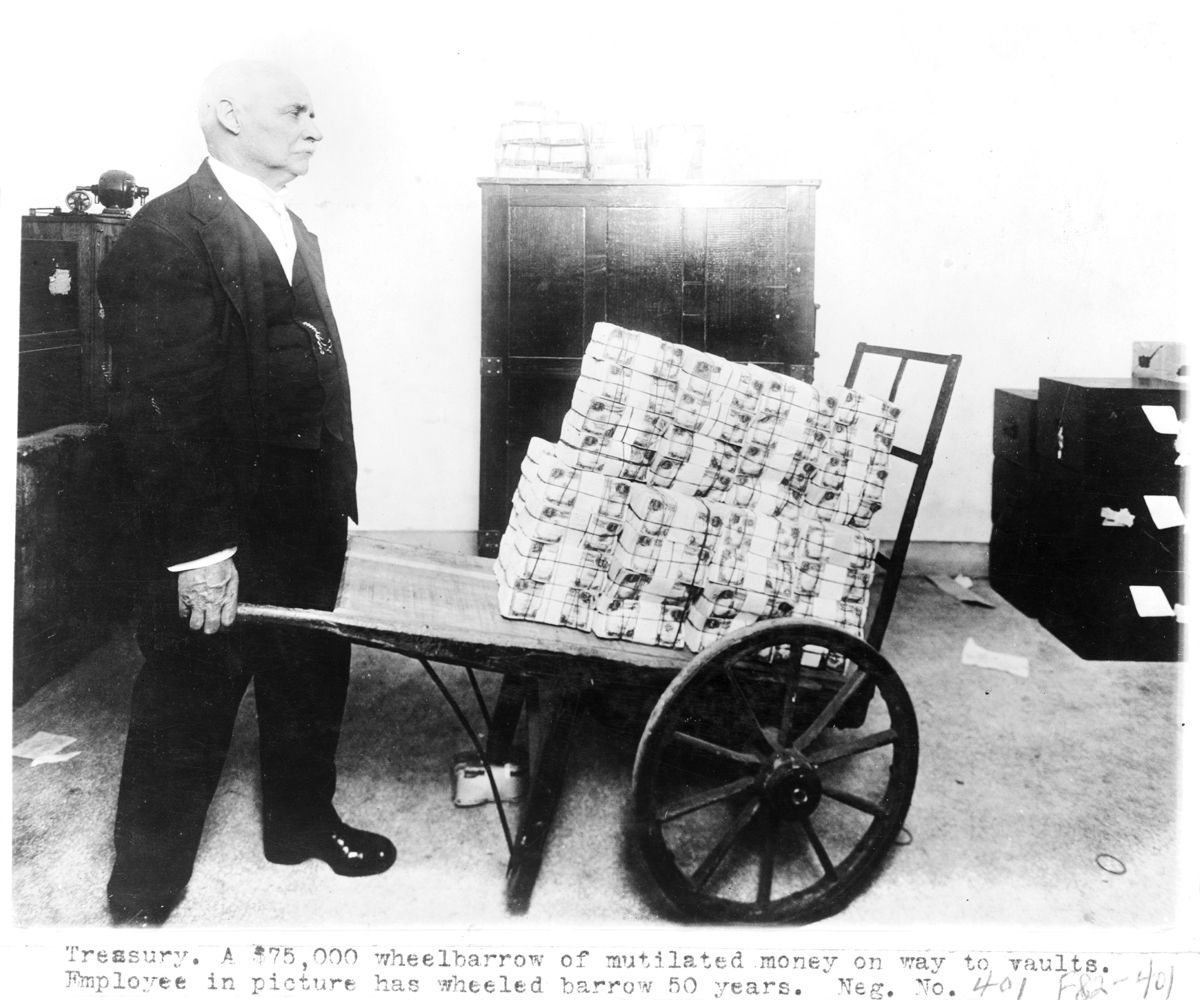
“Treasury. A $75,000 wheelbarrow of mutilated money on way to vaults. Employee in picture has wheeled barrow 50 years.” — National Photo Company Collection / Library of Congress.
There’s a brand of populism, on both the Left and the Right, that sees the problems of capitalism — like the polarization of rich and poor and the system’s vulnerability to periodic crises — as primarily financial in origin. While this tendency has a long history, and pervades a lot of the pseudo-radical tradition in the United States, it always achieves special prominence at the time of financial crises.
To reprise for a moment before taking on a fresh eruption of the syndrome: capitalism is a system organized around money. Almost nothing is under-taken in the realm of production for reasons other than the accumulation of money. As the money accumulates, something must be done with it, which is why financial wealth expands over time. But even though that financial wealth often seems to inhabit a world of its own, it is ultimately connected to what Wall Street calls the “real” sector.
For example, all the mortgage securities that caused the mischief that led up to the 2008 financial crisis were ultimately connected to one of the most basic needs of all, shelter. There is no way to separate neatly the monetary from the real. The social problem emanating from the securitization of mortgages isn’t only the increasingly baroque development of financial assets but also the commodification of the house and its transformation into a speculative asset. Which is why populist financial reforms can’t take you very far: they address symptoms, not pathogens.