The Fate of the Party
The crisis of today’s Italian left has its roots in the transformations of the Italian Communist Party in the 1960s and ’70s.
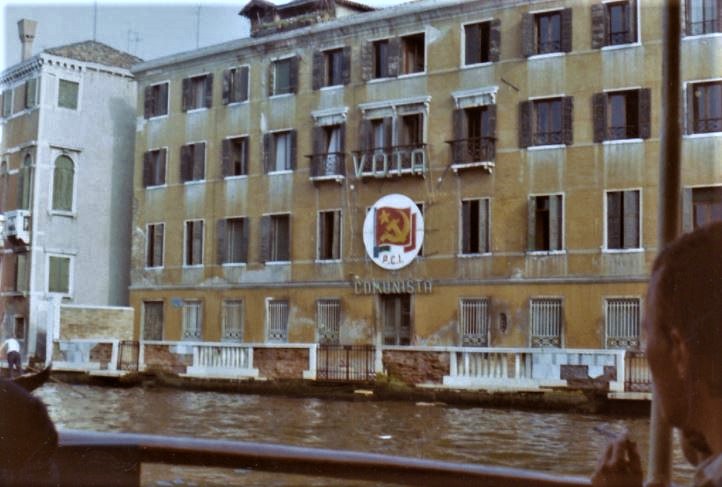
Italian Communist Party (PCI) offices in Venice. (Jeff Hart / Flickr)
At one point in time, the Italian Communist Party (PCI) was the largest communist party in the Western world, hitting 2.3 million members in 1947 and capturing nearly a third of the vote in the 1970s. Born out of a split, led by Antonio Gramsci and Amadeo Bordiga, from the Italian Socialist Party (PSI), the party underwent a clandestine period during the Mussolini regime; played a historic role in the antifascist Resistance; and won the inscription of its values into Italy’s postwar constitution, which states that “Italy is a democratic republic founded on labor.”
Yet its institutional legacy reflects little of the party’s original radicalism. Its 1990s transformation into the Democratic Party of the Left (PDS) was the beginning of multiple splits and rebrandings which ultimately ended in today’s Democratic Party (PD), the center-left party led by Matteo Renzi and committed to liberalizing Italy’s labor relations. What accounts for this trajectory? What was happening inside the party during the long postwar period, from the explosion of student militancy in the “hot autumn” of 1969, to its turn away from the Soviet Union in the 1970s, to its fracturing into the PDS and the dissenting Rifondazione Comunista (PRC)?
To discuss this and more, Simone Gasperin and Bruno Settis spoke with Gian Mario Cazzaniga, who played a crucial role in Italy’s 1960s “New Left,” becoming a prominent figure in the PSI and later the PCI. In 1966 he participated in the foundation of the CGIL Scuola, the communist-socialist trade union for education, and was nominated its national secretary in 1976. He gives us an inside look at the turbulence inside the party as Italian capitalism was transformed, and transformed the PCI’s social base and relationship to society, in the last quarter of the twentieth century.