Who’s Afraid of Title IX?
The attacks on Title IX undermine the struggle against campus sexual assault.
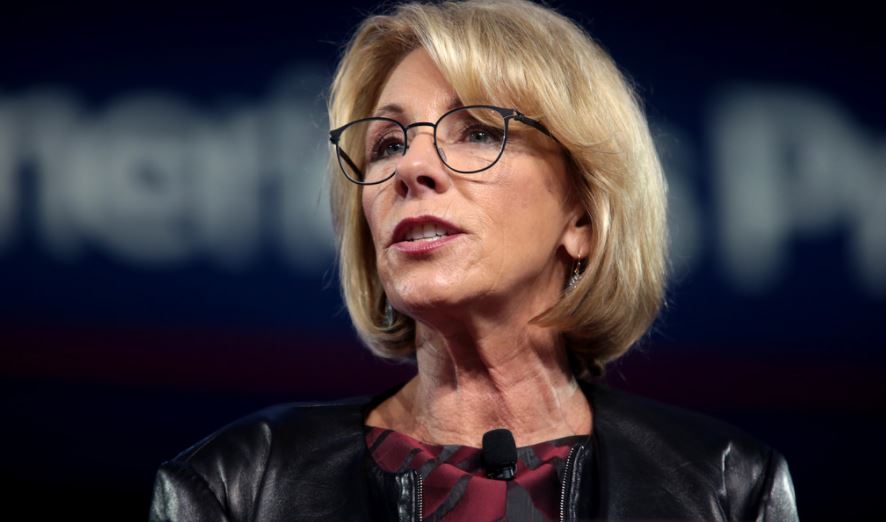
Betsy DeVos on February 23, 2017. Gage Skidmore / Flickr
A few years ago, a student of mine, Natalie Weill, and I won the first expulsion for rape in the history of the University of Wisconsin-Madison. During a harrowing process that ground on for six months, the Wisconsin deans insisted they had an official “philosophy” of not expelling rapists. Natalie and I entered a surreal labyrinth of institutional betrayal, cover-ups and attempts by the deans to silence and stall us. We won the expulsion only by tenaciously appealing to Natalie’s civil rights under Title IX, the landmark gender equity law.
In 2011 the Obama administration, shocked by sexual assault statistics, had sent a “Dear Colleague Letter” to campus administrators on how to comply with Title IX. But in September this year, Betsy DeVos, Trump’s education secretary, moved to rescind the Title IX protections, precisely those rights that allowed Natalie and countless others to continue their education without constantly facing their perpetrators on campus. Dana Bolger, co-founder of Know Your IX, warned that DeVos’s decision would leave survivors “virtually without protections on campus.”
In a trenchant speech, DeVos argued that the Obama administration had used “intimidation and coercion” to force colleges to adopt measures that robbed accused students of their rights. Opponents of Title IX like DeVos persistently claim, without offering evidence, that Title IX is biased against the accused. But as Natalie and I discovered, the Wisconsin process was entirely biased in favor of the accused, the unequal rights codified in Chapter 17. As Dean Kevin Helmkamp admitted: “We are locked into a system that is about the rights of the accused.”