After Disarmament
The leftist Basque group ETA has laid down its arms. What's next for the independence movement?
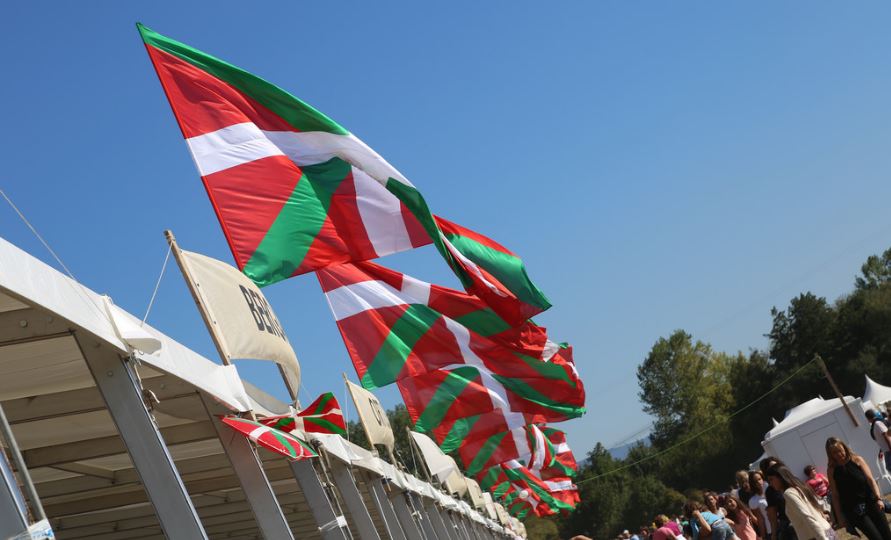
Basque flags at a celebration in 2015. EAJ-PNV / Flickr
On April 8, Euskadi Ta Askatasuna (or ETA, “Basque Homeland and Freedom”) a Basque independence movement put a definitive end to its campaign of establishing an independent Basque state through armed struggle. In a statement bearing the organization’s seal and initials, the group declared itself a “disarmed organization.” It praised the work of Basque civil society and institutions in supporting the peace process and condemned the Spanish and French authorities for what they perceived to be “stubbornness” in delaying the group laying down its weapons. Work has begun on locating the numerous caches of arms and explosives in southwestern France that the Basque group has used in its nearly fifty-five-year-long campaign against the Spanish and French states.
ETA was founded in the late 1960s by members of the youth section of the Basque Nationalist Party (PNV), the traditional political force of the Basque independence movement. Facing severe repression by Franco’s dictatorship, it saw the armed struggle as the most efficient way to destabilize the Spanish state and resist the occupation of Basque lands. Long perceived to be the most dangerous and important internal enemy of the Spanish State, ETA has led an armed campaign of assassinations, bombings, and kidnappings of prominent political and military figures of both Franco’s regime and the post-1978 democratically elected governments of Spain. Over eight hundred victims, among them politicians, members of the military and the civil guard, as well as innocent bystanders and civilians were killed from 1968 until its final ceasefire in 2010.
In the late 1970s ETA formally separated into two distinct factions — military and political. The former maintained the military structure and vision of an independence movement based on the same methods as used during Franco’s era. The latter, while maintaining support for the armed struggle, saw a greater potential in achieving the goal of a Basque state by legitimate political means, taking part in elections throughout Euskal Herria (the traditional Basque regions in Spain and France) and promoting the ideology of the “Abertzal (i.e. patriotic and pro-independence) left within Basque society and its institutions.