The Dynamics of Retreat
The same politics that underpinned the welfare state brought about its collapse.
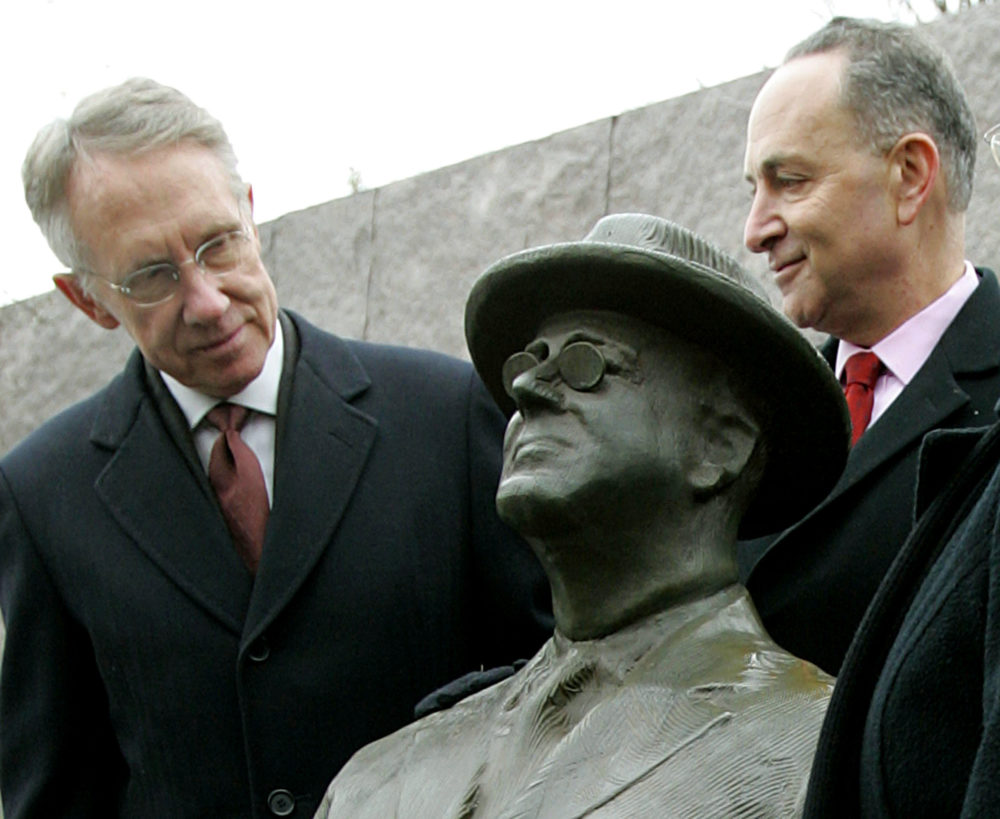
Harry Reid and Sen. Charles Schumer stand near a statue of Franklin D. Roosevelt during a news conference at the FDR memorial on February 3, 2005 in Washington, DC. (Mark Wilson/Getty Images)
In 2016, after decades of defeat, it might seem odd to talk about the limits of the New Deal, much less the expansive welfare states constructed in Europe. In fact, to hear the progressive end of American liberalism tell it, all we need today is a return to that less lean era, when at least many workers felt a sense of security and stability.
Yet the original New Deal settlement was not one tilted entirely in ordinary people’s favor — and it housed contradictions that in time would destroy it. What would a more durable justice have looked like? And what social forces made the New Deal and the postwar “Golden Age” possible in the first place? In late December, Jacobin publisher Bhaskar Sunkara spoke to Robert Brenner, a professor of history at University of California Los Angeles, about the myths and realities of this often-romanticized period.
Bhaskar Sunkara
When people think about the New Deal, there are two main accounts. In one of them, Franklin Roosevelt is the hero, leading a band of workers against the big capitalists who had just driven us into an economic depression. On the other extreme, there are those who make it seem like Roosevelt was acting solely in the interest of elites smart enough to want to save capitalism from itself. Which is closer to the truth?
Robert Brenner