Winning Office Is Not the Same as Winning Power
The Left has made remarkable electoral gains in the past decade. But without a strong labor movement and independent working-class organizations, Vivek Chibber argues, those victories will do little to change the balance of power between labor and capital.
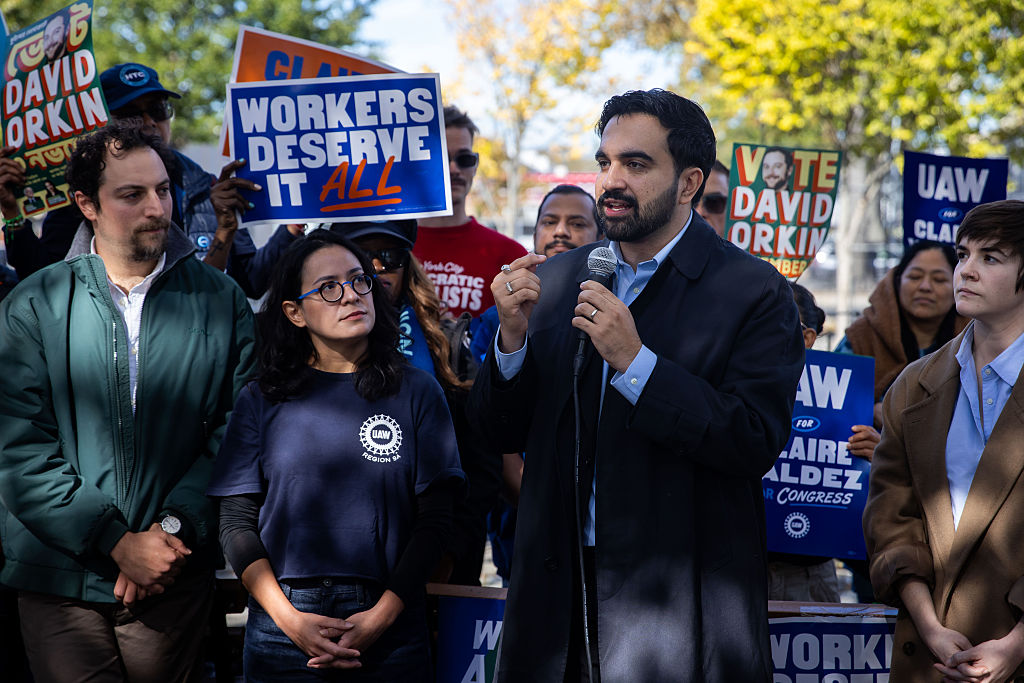
Zohran Mamdani speaks with Democratic Socialists of America–endorsed state assembly candidate David Orkin and US House candidate Claire Valdez at a rally in Queens, New York, on Saturday, October 24, 2026. (Michael Nagle / Bloomberg via Getty Images)
- Interview by
- Melissa Naschek
The Left looks poised to pick up some big electoral wins in the midterm elections. But with virtually all of the Left’s victories since the first Bernie Sanders presidential primary coming through elections, are we at risk of devolving into electoralism?
On the latest episode of the Jacobin Radio podcast Confronting Capitalism, Vivek Chibber and Melissa Naschek examine the structural and institutional pressures facing left-wing politicians and how we can build greater power outside the state.
Confronting Capitalism with Vivek Chibber is produced by Catalyst: A Journal of Theory and Strategy and published by Jacobin. You can listen to the full episode here.
Melissa Naschek
Arguably, this iteration of the Left started with Bernie’s 2016 Democratic primary run, followed by some notable wins like Alexandria Ocasio-Cortez unseating Joe Crowley for a congressional seat in 2018 and Zohran Mamdani’s mayoral win last year. Now, heading into this 2026 midterm, there are quite a few Democratic Socialists of America (DSA) candidates who have won their primaries in safe blue seats or have a really good shot at getting into Congress according to polls. Some examples are Claire Valdez in New York and [nonsocialist fellow traveler] Abdul El-Sayed in Michigan. I think it’s important to examine this strategy more closely given how important electoral politics has been for the Left in the last ten years.
Vivek Chibber
Right now, electoral politics are basically what left strategy is in the United States. Elections have brought about very impressive results on many dimensions, but they also have real limits. It’s worth examining both the achievements of the electoral victories that the Left has had but also what needs to be done to move further along that road.
Why Electoralism Fails
Melissa Naschek
Why do you think electoral politics has been such a key part of the Left’s strategy today?
Vivek Chibber
Historically, electoral politics was only a component of left strategy, never as central as it is right now in the United States. I think the reason is that the primary vehicles working people or ordinary citizens have used to press their claims in the past, including trade unions and other working-class organizations and centers, have all been dismantled. They’re basically all gone now. So what remains is the electoral arena.
And given that elections are all we have until we rebuild the other class organizations, it’s quite remarkable how far and how fast the gains have come in that domain. But make no mistake: it’s basically because nothing else is available. So, if it’s to be a long-term strategy, it should be the first step in rebuilding those other institutions as well.
Now, “left strategy” is kind of a euphemism. What we should be talking about is class politics, class organizing, and class struggle. The word “class” is important in all of those things because it suggests that the class needs to be organized to be able to fight for its interests, and the class we’re talking about here is the working class.
For the working class to be able to pursue its interests, it’s important for it to have independent organizations of its own. That’s important because the capitalist class doesn’t need its own organizations, like trade associations or even explicitly right-wing parties. The reason is that the state is structurally driven to protect the interests of the capitalist class, even when capitalists are not able to do so in a conscious, organized fashion.
This is not true of the state’s attitude toward workers. In fact, the state typically moves to dismantle working-class organizations and tries to atomize and keep the class docile because that’s what it takes to serve capital’s interests.
So for workers to advance their interests, they really have to be organized as a class. That’s what’s missing right now. Leftist candidates are winning elections, but the class itself hasn’t been able to get very far in advancing and organizing around its interests.
Melissa Naschek
What do you think is the difference between the Left using elections as part of a political strategy versus electoralism?
Vivek Chibber
It’s a very important distinction, and the semantics of the distinction are not widely appreciated. People often use the word “electoralism” to mean, “Should we contest elections, or shouldn’t we?” But there’s a difference between using elections as a part of your strategy and relying on them to the exclusion of other things. When we rely on elections to the exclusion of other things, like trade union organizing or like building working-class neighborhood organizations or things like that, that’s what we call electoralism.
The socialist position has typically been that there’s nothing wrong with using elections or relying on elections because you actually have to. In a modern bourgeois political economy, abstaining from elections is just shooting yourself in the foot. We absolutely should take part in elections, but they have to be part of a multipronged strategy in which class organizing is actually the primary thing we’re doing.
Electoralism — that is, elections without the class organizing — is going to face severe limits, and that goes back to the point I raised earlier. Unless working people actually have organizations of their own, specifically in the workplace, it’s very hard for them to advance their interests when those interests clash with those of employers or the wealthy. Electing people into office without the leverage that comes from mass organizing — from a real party that has real roots in neighborhoods, in workplaces — is going to bring about very limited gains. That has to do with how power is wielded inside the state and how the state functions as an organization in the field of class struggle.
Melissa Naschek
When you discuss class organizing and mass organizing as a separate activity from electoral politics, what do you mean?
Vivek Chibber
In traditional Marxist language, elections help you win office, but they don’t help you win power. Now, that’s slightly misleading, in that winning office does give you some power. A lot of power actually: you can get a lot of things done, and by no means should you abstain from it or not participate in it. But once you have office, what you can expect to do with that office depends on the amount of power that the office gives you.
In a bourgeois state, holding office allows you to get legislation through, which is what everyone’s hoping for. But the question is: What kind of legislation?
The basic problem that elected officials face in any bourgeois state is that, in order to pass their favored legislation, they need to be able to fund it. And to be able to fund it at the end of the day requires tax revenues. They require all sorts of budgetary allocations. And those revenues come out of income generation, all of which depends on investment decisions of private capitalists.
The funny thing is, this is an open secret every time a left-of-center candidate is elected into office. If you read the business press, the threats start coming in and all of them are saying the same thing: “If you step out of line, if you do the wrong thing, you’re going to dampen the investment climate or business confidence.”
Melissa Naschek
When Mamdani came into office, there were all of these threats published that business was going to pick up and flee Manhattan.
Vivek Chibber
Yeah, so there are two things business can do. One is that they can actually physically relocate, and the other is that they can start scaling back the levels of investment in plants and equipment, in real estate, and whatever else they do with their money. If they start scaling back investment, this means a slowdown in employment and growth, which means a slowdown in revenues that are coming into the government, which in turn means a shrinking of the budget.
Some leftists will respond, “Okay, but there’s always deficit financing.” There is deficit financing, and that helps you stretch the rubber band. It helps you stretch out what you can do, and it helps stave off the crunch of a budgetary crisis. But you can only do it for so long.
At some point, you do have to worry about trying to pay back the debt that you’re racking up if you’re engaging in deficits. And it’s funny — historically, the most radical left governments in bourgeois states have tended to be pretty fiscally conservative. They always worried about balancing budgets because they knew that trying to stretch it out is simply kicking the can down the road.
Melissa Naschek
Also, where are you borrowing the money from? You’re buying it from financial capital.
Vivek Chibber
Exactly. So it becomes this log-rolling thing, where you’re borrowing money from them and then you’re going to pay it back to them with interest. You’re essentially delaying the reckoning.
So inevitably, because business confidence is such an issue, leftists have to figure out how to get around the preferences of the wealthy and of the capitalist class. If they don’t like your program or the way you’re allocating the budget, or if they don’t like your political priorities, they have weapons at their disposal that can bring any government to heel, or at least make life difficult for it.
There are many such weapons. One, of course, is electoral financing. Capitalists can try to primary you in the next elections, or they can fund the person running against you. Then there’s the issue of business confidence. This sets up real limits on what you can do as an elected official when you achieve power. The limit is that, without any other kind of leverage on your side, you face the problem of what business is going to think when it sees your agenda.
We can think of business attitudes toward three kinds of policies. One is policies that it absolutely supports. Two is policies that it’s neutral toward, meaning business just doesn’t care. And the third is policies that it actively opposes.
Because there’s a clash of interests between labor and capital, a lot of the policies that a progressive is going to want to pass are policies that business might oppose. So whenever working-class candidates or candidates supporting working-class programs are elected into office, many of the policies that their base supports are ones that business is going to oppose. Those become very hard to pass because of the crescendo of opposition and the constant threat in the background of economic dislocation. So, the progressive emphasis will slowly start to get pushed toward policies to which business is neutral, or that it actively supports.
Policies to which business is neutral are going to typically be social/cultural stuff. It’s interesting to think about what’s driving all the culture wars of the past twenty-five years. Since Democrats and Republicans have tacitly agreed to never push the needle to the left on economic policies, the Democrats face a dilemma. How do they differentiate themselves from Republicans when they both agree on these foundational issues? What are you going to fight the elections around if you agree on just about everything economic?
Melissa Naschek
Especially when they cast themselves as the more reform-oriented, progressive party.
Vivek Chibber
So what the Democrats had to do was redefine progressivism exclusively around social and cultural issues, because those are the ones business doesn’t care about. We can have intense arguments about abortion or sexuality or any other social issue, and business doesn’t care who wins. Because whichever side wins, they’re still golden, right?
Melissa Naschek
And it’s not that those issues aren’t important. It’s just that they’re not threatening to capitalists.
Vivek Chibber
Yes. So all progress becomes confined to social progress; there’s no progress on exclusively class or economic issues. The result of that has been the famous disenchantment of working people from the entire political spectrum, because they see that the issues that are fundamentally important to them — which are bread-and-butter issues like being able to pay rent, health care, transportation — are off the agenda. The policies that remain on the agenda belong to two categories: policies to which business is indifferent or those that it supports. This is what is behind working-class dealignment.
That doesn’t mean you can’t do anything. Some policies that business supports might actually be economically progressive. In a city like New York, we could probably find some business support for Mamdani’s promise of fast and free buses, or even some support for universal childcare, because it frees up a lot of the women who are working in the Financial District to be at work more regularly, because it would mean that cost is socialized instead of being borne by the middle-management levels of working-class people.
So, it’s not like business only supports neoliberal or free-market policies. You can propose things that solve problems for business but also further working-class interests.
But the important thing is, for those policies that really alter the balance of class forces, we’re going to come up against business opposition. That inevitably means that no matter how well intentioned the candidate is, they are going to end up shifting in office toward emphasizing this other group of policies.
There’s another institutional constraint. In a situation like we have today, with left-wing candidates taking seats in legislative elections, once they’re in office in city council or the state senate, they are typically a minority faction. If you are in a minority faction, the only way you can pass a legislative agenda is through relying on members of another party who are the least right-wing of the non-working-class candidates.
This means forging alliances with them, and that inevitably means that you have something at stake in their reelection. This means that you try to get your forces to help reelect people who are not themselves socialists or who are not committed to a working-class agenda, but who may not oppose that agenda in comparison to the actual right-wingers in the chamber.
Both of these are gravitational pulls toward the center. One is structural, and the other is institutional — the actual balance of forces inside government.
So, unless you only propose policies that you know will never pass, you will try to whittle your agenda down to the ones that you think you can pass through the filter of business preferences. And then, you still have to try to get votes from your legislative colleagues, who are probably going to be Democrats or independents, but none of whom are socialists. And you will rationally and legitimately turn to your base and say, “Can you also help get these people elected?” which means a gravitational pull toward the center.
If you get people into office without also building something that gives them real leverage within the state and against the business class, you’re stuck in electoralism. And electoralism ultimately limits itself.
Melissa Naschek
You’re talking at an abstract level about the ways in which business interests and capital exert this push away from working-class policies and punish the government so that it is fiscally unable to pass the policies that it wants. Is that just a theoretical power that they have, or are there concrete historical examples of the business class doing this, of punishing actors who tried to pass working-class legislation?
Vivek Chibber
There are two ways in which business can bring an administration to its knees. One is through conscious business organizing, and the other is through individual self-interested decision-making, but both aggregate into a pattern of disinvestment.
If you look historically, there are instances where business actively organized to undermine administrations. One of the most famous examples was in Sweden in the 1970s and ’80s, when business challenged the proposed Meidner plan, which was the most ambitious plan to socialize investment. Business actively organized to actually thwart what the Swedish unions were trying to do.
Another very famous example is the response to Salvador Allende’s government in Chile. There was also an organized business response in India in the years after independence. There was an actively organized investment strike, and a mass campaign to bring down the ambitious plans around redistribution and capitalist planning.
Melissa Naschek
In the Chile example, that was just a straight-up coup, right?
Vivek Chibber
The coup was the military component, but there was also an economic component of organizing, including capital strikes to undermine the economy.
Now, if you look at more atomized, individual decisions, they’re far more common. The most famous one in recent American history was during the first Bill Clinton administration, when he came into office with a moderately ambitious plan for industrial policy and for some kind of redistribution, and the bond market freaked. Who makes up the bond market? It’s basically wealthy people deciding whether or not to buy government paper. And in this moment, they started scaling back their purchases, which meant that interest rates skyrocketed.
That tanked any ambitious plan the administration might have had to rely on debt, because now they had to pay skyrocketing interest rates. Clinton famously said, “You mean to tell me that the success of my program and my reelection hinges on the Federal Reserve and a bunch of f-cking bond traders?” And the answer was, yes, it did.
It’s also happening right now with Donald Trump. In the first six months of the second Trump administration, he pulled back from his chaotic tariff policy for the first time when he saw the interest rates on bonds exploding.
It’s happening again right now. It’s evident that the administration is having intense debates about what to do. They’re debating it behind the scenes, and we’re seeing bits and pieces of it come out, but this is a panic about what options will be available to them in the near future if the interest rates on bonds continue to go up the way they have.
This is capital imposing a kind of structural clampdown on an administration and threatening to punish it, and it’s not actively organized. It’s just bond traders and institutional investors deciding, “We don’t want to fund what this government is doing.”
Those are the outer limits of the ways in which capital disciplines administrations through these sorts of actions. But precisely because the ramifications are so severe and so grave, every politician — mayor, governor, or president — who comes to office knows that this is possible, and so doesn’t wait around for capital to get pissed off. Politicians actively start courting capitalists and trying to placate them the moment they come into office.
The first thing they do is start making calls and issuing statements telling investors, “You don’t have to panic. We’re going to find ways of getting through this. I’m trying to find ways to pass legislation and keep my base happy, but I’m also going to keep you happy.” That’s a tacit recognition of this power employers have.
Melissa Naschek
To underscore what you’re saying, these are structural compulsions because any politician who has even a vague understanding of the relationship between the state and the economy will do as you’re saying. They don’t have to be told to keep business happy, because they don’t want business to react and try to thwart them.
Vivek Chibber
Here’s the challenge for the Left. You want to participate in elections and get your people into office, but then you also have to give them the power, leverage, and wherewithal to actually push through what they promised to do. If you do not do that, you are basically setting it up so that once you elect your candidates, they will renege on their promises.
If you do not have an actual analysis of the state and how it works, if you don’t know how politics is connected to economic forces and that there are real dilemmas that these electeds are facing, you set yourself up to constantly be accusing people of selling out, or of being co-opted, of being impure, or of not being sufficiently left. But after the three-hundredth time you’ve experienced this, you should see that there’s something underneath it.
There are individuals who might continue to fight and go down with the ship after they’re elected because they refuse to compromise, but there’ll be very few of those people. The electeds who moderate are not selling out or compromising on their principles. They’re trying their best in a state apparatus where they really don’t have anything going for them. They have to cut deals. They have to make compromises. This is just being realistic, and if you refuse to recognize what’s actually impelling them to do what they’re doing, you’ll never have a solution. You’ll be a Left that is perpetually electing people and then denouncing them.
The only way to get out of that is to have an actual political analysis of how the state works, what its constraints are, and then how to overcome them, so that your elected officials may actually be able to achieve something instead of constantly being a disappointment to you.
Elections and Class Power
Melissa Naschek
There is a huge history of the Left having successes and defeats within the electoral realm. What are some of the most important lessons that today’s Left can learn from past attempts to use electoral politics?
Vivek Chibber
One of the things we’ve been stressing throughout the course of this podcast is that the twentieth century was a century of tremendous victories and gains on the part of working people across the world in the Global South and in the North. The rise of the welfare state, of social democracy, of redistribution, of all kinds of housing policies, national health care, all these sorts of things — they were unimaginable in the nineteenth century.
Nobody thought capitalism could accommodate these things. But they came about and they came about through a couple of really important developments.
The first one was the rise of the trade union movement, which was the class organizing itself so as to be able to fight for these gains. And the second one was the rise of political parties of the working class, which explicitly had a program that was dedicated to working-class interests. The forward march of working people across the twentieth century moved on these two legs: the parties of the class and the economic organizations of the class.
What sets that era apart from this one is that in this one, neither of those two things exists. There exist parties around the world that are still called “socialist” or “social democratic” or “labor” parties, but they have ceased to be parties of working people. The most left-wing ones are what one could call people’s parties or mass parties or something like that, which entails a heterogeneous coalition of working people, middle-class people, and professionals. And then, of course, there are the right-wing parties. But there are no parties of the working class right now.
The second thing is, in much of the advanced world, trade unions have really taken a step back over the past thirty years. This is overwhelmingly true in the United States, but even in countries like England and Germany, trade union dismantling has gone a long way. So, both sources of class power are now largely either dissolved or domesticated.
From about 1918 or 1920 all the way into the 1970s, these working-class parties were ascendant and formed very tight connections to trade unions. The two worked together not only to generate party programs and policy agendas but also to directly improve the lives of working-class people. They made a whole cultural and social universe of their own, where the parties drew on the class for its leadership. If you look at the people who were party leaders in the British Labour Party or in the social democratic parties of Germany or the Nordic countries from, say, 1920 to 1970, it is pretty remarkable how many of the leaders of the party came out of a blue-collar background.
Melissa Naschek
How many politicians can we name today?
Vivek Chibber
You probably can count them on one hand, right?
Now, politicians coming from the working class is not a panacea. There are plenty of people of a modest background who became quite right wing and passed neoliberal policies, and so I wouldn’t want to say that that’s the key. But when you embed that in a larger strategy where the parties are anchored in working-class neighborhoods and communities, it matters.
Think about how these parties would get their political programs. They would form their program through ongoing conversations in neighborhoods and workplaces through their cadre, many of whom then ran for political election, but many of whom remained in the trade unions. They articulated a plan for what kind of legislative agenda the party would try to push. That plan came out of votes and debates inside the party organs and inside the trade unions that overlapped. The electeds had an idea that if we fight on this platform, it’ll bring out our constituency, and that’s what it did.
From the 1930s to the ’70s, in election after election, social democrats passed legislation that actually improved people’s lives, and that improvement in people’s lives made them loyal to the party and also gave them a kind of confidence in nonparty organizations like trade unions that enabled further building.
Look at the electoral data in that half-century or so, and you see that, come hell or high water, blue-collar workers voted for labor or social democratic or socialist politicians. They stuck with the party because the gains were so enormous, and momentary setbacks or things like an economic recession would only erode the working-class vote around the edges, leaving the voting components of the class as a whole wedded to the parties.
Melissa Naschek
I also think the decline of candidates who come from a blue-collar background is a symptom of the problem of workers being increasingly alienated from politics, stranded without an organization that is both connected to them and actually represents their interests.
Vivek Chibber
Let’s take up both those issues, whether being of the class is what’s key, and then the disenchantment.
Not only was it the case that being of the class was not key; even centrist or conservative parties that got elected into office had to respect the class balance. If you look at the peak of social democracy from the 1950s into the 1970s, what’s amazing is how stable the key components of the welfare state were. Even when conservative parties won the elections, why didn’t they just immediately go to neoliberalism, say, in the 1950s or ’60s?
Let’s take England for example. Harold Macmillan was the conservative prime minister in the late 1950s and early ’60s. Why didn’t he do what Margaret Thatcher did twenty years later? Why didn’t he dismantle the welfare state? It’s because the working class and the trade unions were still too powerful. The Tories couldn’t risk it.
So, it’s not just that you don’t necessarily have to have people of working-class origins in your leadership. You can have blue-blood aristocrats in the leadership, and they won’t dismantle the welfare state if working-class organizations are strong enough on the ground. This means the class identity of the politicians helps, but it’s a secondary issue. What really matters is the balance of class forces within the political economy.
Then there’s the issue of the disenchantment and dealignment that you brought up. That comes about because of the turn inside the political parties, so that they no longer are fighting for these programs that they promised and end up imposing austerity and all kinds of neoliberal policies on their own base. Why does that happen? That happens largely because by the time that these policies are being passed, the organizations of working people are no longer strong enough to be able to fight back.
This tells us that the key to an enduring shift to the left is not whether your party gets elected. It’s whether you’re able to wield actual power against the people who you most have to worry about, which are the people who hold the assets of society — employers.
Now, why is it that the organization of working people is able to wield this kind of power? It’s because the working class is the only agency in society that can actually bring capital to the table. The state can’t bring capital to the table on its own. It has to act, at best, in a partnership with capital, but capital has all the exit options; the state does not.
The working class, on the other hand, creates the profits that give capitalists their investable funds. So, capitalists typically oppose legislation that’s in favor of workers’ interests, unless workers are organized enough to wield a threat to capital.
Think of a strike. What’s a strike for? It’s to get better conditions or better wages at the workplace. Typically, when employees come to the table with these demands around wages and working conditions, the employers just say no, because it’s going to hit their bottom line. Why would they ever agree to better conditions? It’s because if workers are organized, they give employers a choice. They say, “Yeah, your profits might take a hit if you agree to our demands, but we’re giving you a choice between a temporary reduction in your profits and an indefinite stoppage in all profits,” which is what a work stoppage does.
A strike forces capitalists to compare two costs: a hit in their profits that’s going to be temporary versus the complete stoppage of profits for an unspecified amount of time. That comparison of costs is what brings employers to the table.
That example is for workplace-related demands, but you can scale that up nationally too. So consider a left-wing candidate who gets into office and wants to pass legislation that’s very progressive, but employers and funders resist because of the control they have over investment and the economy broadly. If that person elected into office is at the helm of a party that has connections to trade unions and the trade unions have a credible threat to disrupt the economy if this legislation is resisted by the employer class, that changes the calculus of the capitalists. Now they say, “We’re better off allowing some of these things to go through, rather than confronting a well-organized cadre of our own employees on whom we rely for our profits.”
That’s the difference between a candidate who is very well intentioned and wants to pass legislation but has no real link to his own constituency’s economic organizations — in our case, because it doesn’t have such organizations — and a candidate who does and can now not just make the promises but actually pass the agenda. A candidate who does not have any such organizations under him can make the promises but will inevitably have to make the kinds of compromises that end up disappointing his base and potentially even making them dejected and disillusioned with politics.
Melissa Naschek
Often the Left sees a politician who said all the right things during the campaign cycle get into office and then not follow through, and it will resort to these highly personal explanations for why the politician didn’t do what they promised. This is where narratives are painted that people were betrayed or co-opted, whatever. And the point that we’re trying to make is, yes that does sometimes happen, but what really ends up driving whether these electeds overcome whatever personal temptations they face while in office are the class forces in politics right now, which are laying the foundations for them to make these decisions in the first place.
Vivek Chibber
I see these discussions in DSA, which are very understandable, about how if somebody runs on a DSA ticket, we have to be able to hold them accountable. They have to pledge a commitment to our program, and then we need to have some measure of accountability.
Melissa Naschek
And that statement is right.
Vivek Chibber
It is exactly right. A political party that does not try to hold its candidates accountable is just a social club. It doesn’t mean anything.
The problem is trying to hold politicians accountable to promises that they don’t actually have the power to follow through on. If you don’t also give them the power through the kinds of civic and class organizations that I’m talking about, you’re going to end up at constant loggerheads with your own candidates.
What’s going to happen is, they’re going to get into office and cannot pass what they have promised, and you turn to them and call them turncoats. The history of this situation shows they will start ignoring you. They start saying, “This is not something that’s going to happen.”
The other sad part of it is that most of your organization is going to follow them. Unless the organization is filled with ultraleftists, the members are going to see that, actually, it’s true that our candidate cannot pass the policies, because he doesn’t have the votes in the legislature, and he’s going to have to backtrack on a lot of what he said. A lot of the party is going to move with him, and that inevitably means a gradual drift of the party away from its initial radicalism.
None of this is betrayal. It’s simply the basic law of politics that you can only go as far as the class balance allows you to go.
So, I think it’s great that this incipient, growing Left is saying that we must have candidates who are accountable. But it also has to realize they can only achieve what the balance of class forces will allow them to achieve.
That sounds like I’m saying that if you get people elected into office, they aren’t going to be able to do much for you. And yes, that is what I’m saying, but it also gives you your marching orders, which are: It’s not enough to pour all your energies into canvassing or helping people get elected. We really have to see those electoral victories as the first step toward something larger, which is organizing the class.
That means your organization cannot pour all of its energies into the next election and the next election. It’s got to do the hard work in between the elections of bringing people in who are working-class people, of embedding yourself in their neighborhoods, in their workplaces — and in between the elections, building that class base for yourself.
This also means that you use the position of your officeholders to help pass legislation or use resources that will make organizing easier. That’s going to depend on the scale. City council members can’t do all that much; even mayors can’t do all that much. But whatever they can do, they should do.
Ultimately, what we should be looking at is achieving office at those levels of government that actually have some sway and some power over relevant legislation, and once you get into office, pour all your energies into passing that legislation.
Melissa Naschek
When we’re engaging in electoral politics, there is a real danger of rightward drift for the Left as it becomes too enmeshed in status quo politics. There are people who argue that that’s not just a danger, but an inevitability — that once you engage in electoral politics, you will go down a path of reformism away from revolutionary change. Do you think that’s accurate?
Vivek Chibber
I think if all you have is your elections and gaining office through elections, then I’d say, yes. There’s no other way around it. It’s just a matter of time before you become the left wing of the least right-wing parties, like the Democratic Party.
So, what do you do? One answer on the part of the socialist left historically has been to say, “We’ll stay away from elections.” Everywhere that’s been tried, it’s failed. The reason is that in modern bourgeois states, elections play such an important role in directing people’s attentions to the issues that matter.
Melissa Naschek
When most people think of politics, the first thing they think of is elections.
Vivek Chibber
Especially in the United States, because there’s no other way of addressing the issues that matter. In the past, you had your unions or your neighborhood associations to talk about the conditions around you and how to deal with them. But today, it’s the TV, and it’s you, that’s basically it. And social media — all that crap.
So, what is the occasion on which people as a country talk about the issues of the day? It’s the electoral cycle. If you opt out, you become irrelevant.
Look at what Bernie Sanders managed to do in 2016 by entering the primaries for the presidency. He transformed the culture overnight. This is why abstaining from elections would be a mistake.
What’s the antidote to what I said — that, in fact, it’s true that you’re going to move toward the center? You have to figure out how to overcome the obstacles that you confront within the state.
Melissa Naschek
One of the other critiques of the Left’s electoral strategy that’s out there is that it is leading organizations like DSA down the path to becoming, basically, adjuncts of the Democratic Party. Should the Left be running as a completely separate party to avoid that issue?
Vivek Chibber
My feeling is that the Left should have a party of its own. But I don’t think that party can be an electoral vehicle in the American system.
The American system makes it virtually impossible to break into elections as a third party. There’s a general difficulty in all winner-take-all systems, or what are called first-past-the-post systems, to enter as an electoral third party, especially when the elections are privately funded. It’s very hard, because people don’t want to waste their vote. So unless you can come up with gobs and gobs of money of your own, you can’t break into the system and appear to be viable.
In proportional representation systems, it’s a lot easier for smaller parties to break into the system because they just need to reach a threshold of 6 or 7 percent of the vote to be able to get representation in the legislature. Once they’re in the legislature, they get a lot of extra resources. They can build on that; they can become the swing vote on a lot of legislation.
In an American-style system, you need to burst into the system with 30–35 percent of the vote, and how are you going to get 30 percent of the electorate to dramatically switch and vote for you when you have no history and when you have meager resources? There have been dozens upon dozens of attempts at third parties since the Civil War, but not a single one of them has worked.
That should tell you that there’s something deeper going on. But I think, if working-class people simply fold themselves into the Democratic Party, there are just too many obstacles to charting an independent agenda. That means that at least in the short run, we have to accommodate and use one of the existing two parties.
Melissa Naschek
This is what’s called “the ballot line strategy.”
Vivek Chibber
In the future, we might be able to transform one of the parties and maybe take it over or break away from it in some way, particularly when you think that you can take a lot of the people in it with you. In that situation, you will be the second party rather than the Democrats being the second party. So, maybe in the future you can do that, but that’s a process.
Just look at the last ten years. The Left has been able to achieve a lot more through the Democratic Party since 2016 than it was able to achieve between 1970 and 2015 in all the attempts to forge a third party. If you don’t see that, you’re just not willing to look at the facts. So, in the short run, we may be stuck with the Democratic Party for elections.
But if you have a working-class agenda, you also understand that it’s not just about winning elections. So the goal should be a long-term strategy of building working-class organizations, trade unions being at the very center of that, and using them to fight for workers’ interests within the workplace and neighborhoods. Mobilize them. Once you have them mobilized, also use them as a kind of a lever inside the Democratic Party to push for change at the legislative level.
At that point, we’re talking about some kind of socialist party. It is a party dedicated to advancing the interests of working people, in which elections are a part, but also in which you are not just going from electoral cycle to electoral cycle existing as a canvassing organization, which is what’s happening right now.
We need a party of working people, which has some of its energies devoted toward pushing an electoral agenda. It’s going to be either as independents or in some way or form connected to the Democratic Party. We have to be tactically flexible on that, and then use whatever offices we have to help pave the way for further class organizing in the workplace and outside the workplace.
I think it’s very hard to achieve all those things without a separate party of working people. You need it so you can have meetings of your own, platforms of your own, your own autonomous culture. This makes it so you’re not just an adjunct to the Democratic Party electoral machine.
What you’re trying to do, fundamentally, is to use whatever political power you have within the state to build a class. The Democratic Party will never do that because it will never help you build working-class organizations. So you need a party of your own. But I would also say that we shouldn’t have the illusion of thinking we can displace the Democrats electorally until we have real salience and power of our own.
Melissa Naschek
In the short run, the Left does have politicians in office that it helped elect, and it also has a slate of candidates who are very likely to gain entrance to the state. What can they do now to help us make some progress on some of the key issues that you laid out, such as building real connections with the working class and building a more concentrated, politically engaged working class?
Vivek Chibber
I think we have to look at the level of the state to which they’re being elected, because the constraints are going to be different in each one.
Right now, most of the Left’s victories are at the local level. And, of course, they’re more than we could have even imagined twelve or fifteen years ago. One way to address this question is, when we’re winning at the local or municipal level or even at the state level, what can we do?
I think Mamdani has really done a great job in laying out a kind of model of what can be done. Because he’s been out in the open saying what the Left has believed for a long time, which is when you win office, focus on those everyday material things that people are confronting in urban centers: things as boring as garbage collection, potholes, power supply, the quality of schools. Show that a socialist-leaning candidate is going to do things for the material improvement of ordinary citizens.
The people who most benefit from this sort of good governance are working people, because while wealthier people can buy all the amenities that they need, working people rely on public goods and on decent government. And what they’ve seen over the past fifty years is the government basically just sh-ts on them. It keeps raising property taxes, but the actual governance and the quality of services is consistently declining — and understand, for most working-class people, the only asset they own is their home.
Not only does that make them disenchanted with politics; it also makes them feel that government is out to get them or has no purpose. They become vulnerable to right-wing agendas [that say] that the only solution is to just keep scaling back government.
Now, whether or not you think revolution is possible, in the short to middle run, the way we’re going to gain the confidence of the working class is by showing them that the Left is actually going to actually make material improvements in their lives. So, when you have office, you have to use it in workers’ interests.
Then they start changing their conception of what the state should be. Instead of an institution that is crushing them into the ground and taking away what they have, they start seeing it as their institution, their state, and start having expectations of it. And I think the best thing you can do in the short run is to raise people’s expectations about politics. If their expectations are raised, they’ll participate in it.
Once workers start participating in politics, instead of begging people to come out to vote, you’ve got people eager to vote. Once they’re eager to vote, they’re coming out of their homes, and you can start talking to them and bringing them into your organizations.
So, I think the first step is exactly what Mamdani says political parties and electeds should be doing, which is focusing on the small things that actually raise people’s morale and their expectations. Then in the middle to long run, it’s exactly what I said, which is more than just saying, “We have to hold this or that person’s feet to the fire.” That’s just self-congratulatory. What you have to do is give your socialists in office actual power.
So instead of demanding explanations for why these politicians are disappointing you, you have to give them the resources to not disappoint you. You have to give them the resources to actually fight inside the legislature. One [way of doing that] is, yes, get more people elected. No doubt about that. But also, understand that the descent into neoliberalism was carried out by working-class parties that had majorities, that had a great deal of power within the state — far more than the American left has ever dreamed of achieving. Why did they shift toward the right? It’s because real power never resides in the state. It always resides in the capitalist economy, and once labor institutions were dismantled, it was just a matter of time before the state veered to the right, because it reflects the balance of class forces.
All this means that, while we should try to get the electeds to do the small things that raise people’s expectations, that just gives you breathing room. We must use that breathing room to build the class and the institutions of the class.
Mamdani did something great recently. He started this new office called the Mayor’s Office of Worker Power, which is an office dedicated to trying to enliven and get working people organized. But he can’t do the work for you. You’ve got to do the work.
Mamdani is signaling that if the New York left actually starts organizing the New York working class, the mayor will do everything he can to help them. But the mayor cannot use the office to organize workers. That has to be done by the left-wing organizations in the city. So, if you want to hold his feet to the fire, do it after you give him something to work with. Otherwise, all you’re doing is screaming at him, and that’s just not going to help him.