Treasury Market Volatility Is Capital Disciplining the State

As concerns over inflation have mounted, borrowing costs for the US state have risen sharply. The bond market volatility is capital cracking down on the state’s debt-fueled spending spree, and workers are set to pay for the belt-tightening.
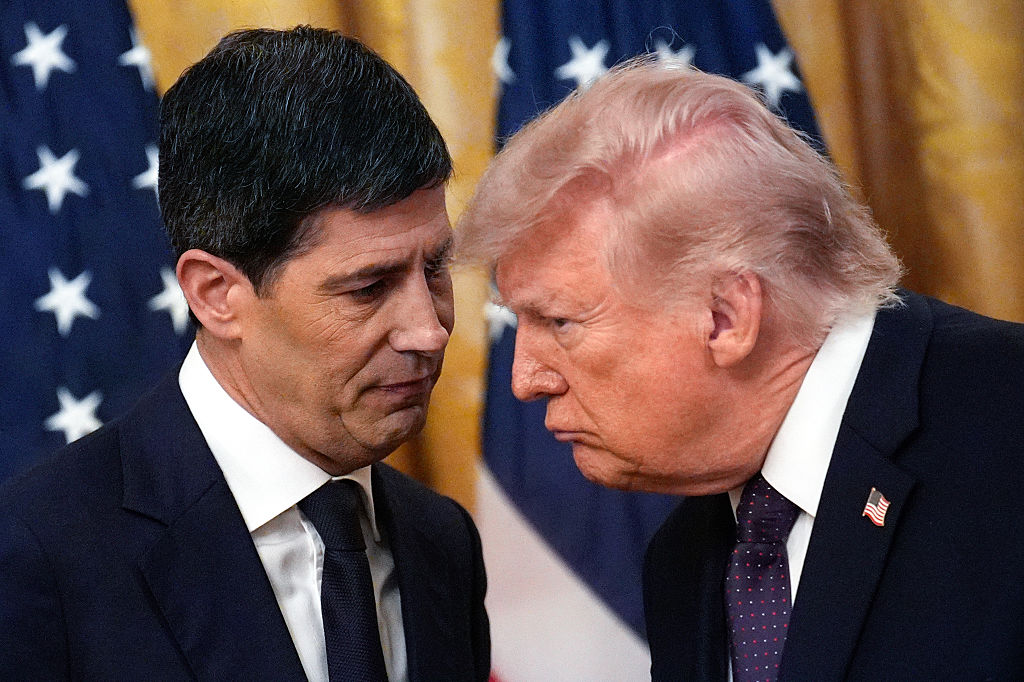
Donald Trump speaks with Kevin Warsh at the White House.

Recent instability in Treasury markets has revealed a striking paradox: a primary foundation of the American state’s financial power has now come to constrain that state, illustrating the limits of its autonomy from capital. (Yuri Gripas / Abaca / Bloomberg via Getty Images)


Since the 2008 financial crisis, American economic policy has rested on the seemingly unshakable conviction that global markets for US government debt were bulletproof. This fact would supposedly allow the state to run enormous deficits indefinitely, financing massive tax cuts for the wealthy even while military spending approached $1 trillion.

The same confidence underpinned the idea that the Federal Reserve possessed virtually unlimited firepower to contain economic crises. Yet in recent weeks, this assumption has begun to look considerably less secure. It turns out that even the American state is subject to the discipline of capital after all.

As concerns over inflation mounted — and, perhaps more important, doubts about the willingness of the Fed to act to contain it grew — borrowing costs for the US state rose sharply. Last week, the ten-year Treasury rate crossed the symbolic threshold of 5 percent, its highest level since 2007. Although Donald Trump continued to loudly demand lower interest rates, the Fed saw little alternative but to raise them, while indicating that further hikes lie ahead.

The move exposed the shortsightedness of suggestions that the era of central bank “independence” has come to an end. Indeed, the requirement that the Fed be able to impose monetary austerity regardless of electoral outcomes stems not merely from institutional rules or political culture but from the structural imperatives of capitalism itself. As Trump’s policies have run up against these constraints, his efforts to subordinate the Fed to his will have crumbled.

Decline of the Petrodollar?

Many will interpret this development as another step in the collapse of the American empire. Iran’s threats to sell oil in renminbi have led to prognostications about the imminent demise of the “petrodollar” regime, often depicted as the culmination of “de-dollarization” initiatives led especially by the BRICS. Yet the idea that the US empire rests on a “hydrocarbon-dollar complex” is a myth.

The dollar’s status does not derive from the fact that any particular commodity is priced in dollars but from its role within the global credit system and the strength of the US economy. Large inflows of private investment into the United States have sustained demand for dollars, even as the dollar’s share of official reserve holdings has gradually declined. Moreover, that the dollar anchors credit markets means that the balance sheets of firms and central banks are tied to dollar obligations and assets. Debt is just as important — perhaps even more fundamental — for fueling global capitalism as fossil energy.

To be sure, raising rates will have little impact on inflation — barring a truly drastic increase sufficient to spark a recession, as with the 1979 “Volcker Shock” that inaugurated the neoliberal period with an iron fist. Raising rates will not reopen the Strait of Hormuz and reverse the surge in oil prices now rippling through the economy. Nor can monetary policy undo Trump’s chaotic tariffs, which have also generated significant price pressures.

Rather, the Fed’s imposition of monetary austerity is necessary to protect the stability of a global financial system that remains deeply dependent on the dollar. With enormous fiscal deficits requiring ever-growing issuance of Treasuries, failing to raise rates risked deepening the bond market sell-off by raising doubts about whether the Fed retained sufficient independence to impose discipline. Because the dollar is world money, this turmoil in Treasury markets would reverberate through credit, funding, and asset markets across the global economy.

That the imposition of monetary austerity is necessary for global capitalism points to the illusory nature of the pro-worker Keynesian alternative imagined by some on the Left. The Fed was by no means faced with a straightforward choice between a pro-worker low-interest-rate policy and a pro-business high-interest-rate policy. Raising interest rates clearly has real costs for workers. On the other hand, had the Fed continued to pursue a more accommodative path, long-term US interest rates would likely have risen still further, increasing borrowing costs while threatening greater stress in Treasury markets. And a serious Treasury crisis — or the emergence of a “doom loop” in which the Fed became the dominant buyer of US debt — would hardly be good for workers. Given the existing balance of class forces, workers would doubtless bear the costs of restoring stability.

Who Pays?

Bond market volatility represents capital cracking down on the American state’s profligacy. The question now is who will pay for the belt-tightening.

Rather than a lack of working-class discipline, at issue today is a macroeconomic regime that has combined tax cuts for capital and enormous military expenditures with war and tariffs. While Trump sought to partly fill the fiscal hole by aggressively slashing Medicaid, food assistance, and other programs for social provision, these cuts could only go so far. As inflation, rising interest costs, and volatility in Treasury markets narrow the room for maneuver, those priorities increasingly come into conflict. Either capital is made to absorb more of the adjustment through higher taxes and a reordering of fiscal priorities, or workers will be forced to pay through some combination of inflation, high interest rates, unemployment, and further cuts to social provision.

The stakes extend beyond the affordability crisis. The same pressures that impose the need for adjustment also bear directly on the ability to address the existential crisis of climate change.

Decarbonization requires enormous investments in energy, housing, transportation, and infrastructure over long time horizons, which are made much more difficult by growing pressure on public finances. Net interest payments have now surpassed military spending, exceeding $1 trillion per year, and are projected to rise rapidly as debt and borrowing costs increase. Yet it is impossible to imagine addressing the ecological crisis without massive expansion of state investment. Raising taxes, shifting budgetary priorities, and monetizing debt can create space to begin this project, but it would be a mistake to underestimate the extent to which capital will vehemently oppose all of this, let alone the extension of state planning a green transition would require.

Achieving a sustainable future therefore hinges on building the power of the working class to take on capital and empire. While stabilizing Treasury markets is imperative in the short run to prevent a broader economic contraction and hold down household borrowing costs, the current turmoil demonstrates how sharply even the American state’s room to maneuver is circumscribed by financial markets.

The episode reinforces the lessons drawn long ago by Marxist state theorists Ralph Miliband and Nicos Poulantzas: the capitalist state possesses real autonomy, but that autonomy remains decidedly relative. For socialists, the contradictions that follow from this fact cannot be escaped simply by choosing better monetary policies. This is precisely why the state cannot simply be wielded by socialists elected to govern it. The challenge, rather, is to operate within a state that is constrained by capitalism while simultaneously building the power necessary to transform those constraints — no small task.

Share this article

Contributors

Stephen Maher is assistant professor of economics at SUNY Cortland and coeditor of the Socialist Register. He is the coauthor of The Fall and Rise of American Finance: From J. P. Morgan to BlackRock with Scott Aquanno and author of Corporate Capitalism and the Integral State: General Electric and a Century of American Power.

Scott Aquanno is assistant professor of political science at Ontario Tech University. He is the coauthor of The Fall and Rise of American Finance: From J. P. Morgan to BlackRock with Stephen Maher and author of Crisis of Risk: Subprime Debt and US Financial Power from 1944 to Present.

Filed Under