Self-Determination Is the Core Palestinian Demand
In Israel’s recent elections, Palestinians in Israel voted in unprecedented numbers — using one of the last remaining means at their disposal to challenge Israeli Jewish politics.
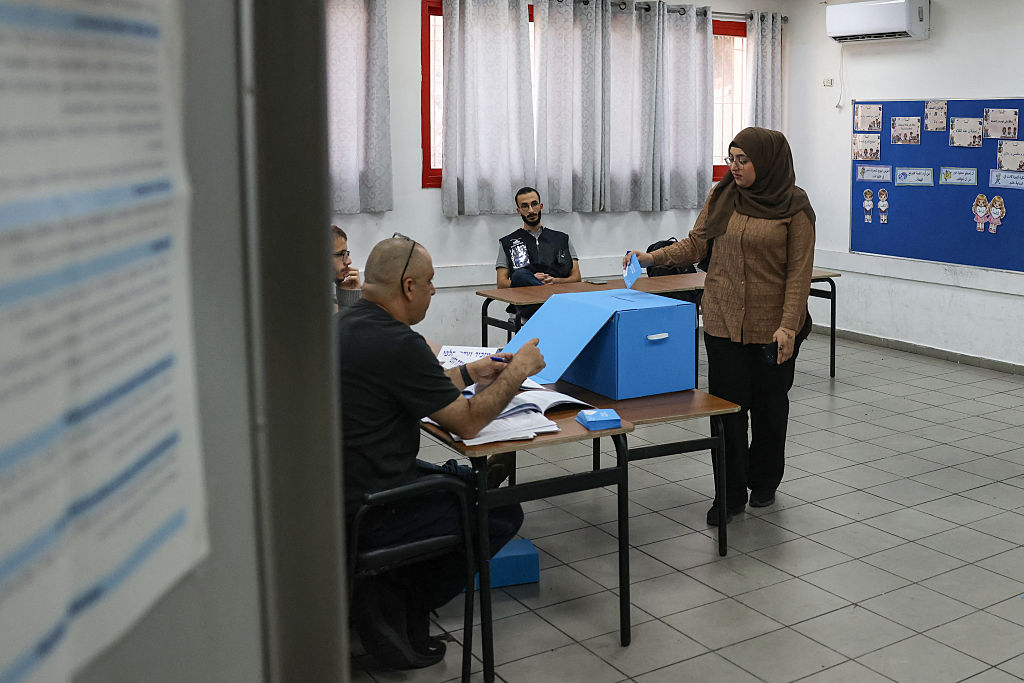
In the recent Israeli elections, Palestinians resoundingly said to Israeli Jews: we are here, we are going nowhere, and you must accept and adapt to that fact. (Ahmad Gharalbi / AFP via Getty Images)
- Interview by
- Ryan Tfaily
The parliamentary elections held in Israel on October 27 failed to produce a bloc with the sixty-one seats required to govern on its own. Although it remains in the lead, Benjamin Netanyahu’s camp has fallen from sixty-eight to fifty-three seats, while the opposition, led by Gadi Eisenkot, has made gains but secured only forty-eight seats. The two Palestinian lists achieved a historic breakthrough, winning nineteen seats, thanks to an unprecedented mobilization of Palestinian citizens of Israel. Coalition negotiations remain deadlocked, however, as the opposition is reluctant to accept any form of cooperation with the Palestinian parties.
How should these results be understood at a time when the genocide in Gaza and ethnic cleansing in the West Bank are ongoing. and as Benjamin Netanyahu and Donald Trump threaten to resume a regional war? Bashir Abu-Manneh, the author of Disposable Palestinians: Israel’s War and Genocide in Gaza, sees these elections as reflecting Israel’s supremacist nature. He argues that militarism and the shift to the right are long-term phenomena that extend far beyond electoral cycles.
Ryan Tfaily
These elections were marked by historically high turnout among Palestinian citizens of Israel. How can this mobilization be explained, and what are the two main political currents representing this community?
Bashir Abu-Manneh
The main reason is a strong political desire to bring down Netanyahu’s government, the most right-wing in Israeli history, and to punish it for several things: First, for its genocidal war and total destruction of Gaza and for its intensifying colonization of the West Bank, which is undergoing “Gazafication” as we speak. Second, for its endless attacks on collective Palestinian life. Third, for its racism, contempt, and systematic humiliation of Palestinians, and for the consolidation of fascist norms in Israel. These are usually referred to as Kahanist, following their most extreme Jewish fundamentalist proponent, Meir Kahane, who was banned from running for the Knesset for his extremist views — views that have now been normalized in Israel by Netanyahu’s government.
There are also more specific factors related to Palestinian society inside Israel: house demolitions by the state, destruction of communities in the Naqab (Negev), Israel’s effective encouragement of crime and mafia killings of hundreds of Palestinians a year, and the deep sense of lawlessness this produces by forcing small businesses and professionals to pay protection money and subjecting them to extortion (a deliberate policy advanced by Itamar Ben-Gvir as minister of national security).
As a result, there is a deep sense of fear and social uncertainty that is compounded by daily incitement and violence against Palestinians in the Israeli labor market, whether they are doctors, nurses, or bus drivers. Some commentators in Israel have openly blamed Ben-Gvir and his endless provocations against Palestinians for their high turnout in the elections. But he’s in reality a crude symptom of government-wide policies.
October 7 also generated a clampdown against political organization, demonstrations, and free speech as part of a policy of delegitimizing Palestinians in Israel — which, most recently, led to the disqualification of Sami Abu Shehadeh from running for the Knesset.
In this ultrarepressive context, the act of voting became the only remaining mode of political expression for Palestinians. First, to affirm Palestinian presence and belonging in their own homeland, however twisted are the means of doing it as second-class citizens in a state that excludes them by its basic laws and definitions. Palestinians resoundingly said to Israeli Jews: we are here, we are going nowhere, and you must accept and adapt.
Second, Palestinians understood the mathematics of voting. The more they come out to vote, the larger the number of votes needed by smaller extreme right-wing Jewish parties to meet the 3.25 percent electoral threshold for entering the Knesset, and the more likely they would block them. This succeeded. Weakening the right wing electorally is a Palestinian achievement.
Third, Palestinians in Israel worry that they are next on the fascists’ list — that if Kahanist Smotrich and Ben-Gvir stay in power, they’ll make good on their promise of Judaizing the Galilee and the Naqab even more intensively, and that this will become a major part of new government policy. This is a realistic worry. Religious fundamentalist activism would have real adverse effects on Palestinian communities in terms of stealing their remaining lands, blocking their access to the labor market, and further degrading their livelihoods.
Most Palestinians voted for either the Joint List or Ra’am. Let me briefly describe their main differences.
The Joint List is a nationalist-left coalition of the Jabha (the Democratic Front for Peace and Equality), an Arab-Jewish left-wing formation closely associated with the Communist Party and led by Yousef Jabareen; Ta’al (the Arab Movement for Renewal) led by Ahmad Tibi; and Balad (the National Democratic Assembly) led by Sami Abu Shehadeh.
Its broad platform has historically been to end the Israeli occupation of 1967 and push for equality in Israel. But because of wanting to halt the growing degradation of Palestinian life in Israel and to shoo out this extremist right-wing government, its campaign has focused on civic demands and its willingness to do everything in its power to end Netanyahu’s chaotic and dangerous reign.
I do find the singular focus on Netanyahu a problem, though, because it could end up justifying compromises that are politically unacceptable. One should distinguish between blocking Netanyahu from continuing his Kahanist policy and actively supporting an opposition that, on most Palestinian national and on regional issues, is quite like him. There are limits to electoralism, and Palestinian politics in Israel cannot be reduced to influencing government civic policy at the expense of equal national and political rights.
But those limits are not impediments for the second strand of Palestinian politics, Ra’am (the United Arab List led by Mansour Abbas). This religiously and socially conservative Palestinian strand in Israel has intentionally excluded the Palestinian question and collective national rights from its platform. I see it as a Palestinian “Shas,” the religious party that represents Mizrahi Jews. Like Shas, Ra’am has avidly joined Israel’s electoral horse-trading business, and all it seeks to get is funding and state budgets to spend on local constituencies, while also trying to address Palestinian civic concerns over crime and house demolitions.
In an atmosphere of fear and shrunken political horizons, Ra’am’s shameless opportunism does get support precisely because it feeds on cynicism and narrow self-interest. But the price of its policy of wielding influence at any cost is a denationalization of Palestinians and the inflation of religion in civic and political life. To facilitate acceptance by Zionist parties in any future government negotiation, Abbas has also appointed a Jewish Zionist legislator as number two on his list. This brazen maneuver, in which you compel your supporters to vote for a Zionist politician with a law enforcement background, just shows how low Abbas is ready to go for Zionist crumbs, all in the name of resolving the crime wave that the state itself has created.
Ryan Tfaily
Does the marginalization of Palestinian parties by the majority of the anti-Netanyahu bloc, alongside the fierce accusations leveled against them by the pro-Netanyahu bloc, not demonstrate the unequal nature of Israel’s political system?
Bashir Abu-Manneh
The hate campaign waged against the Palestinian parties is hardly surprising.
Does anyone really believe that Israel is a normal liberal state? How can you, when ethnonational Jewish supremacy is codified as basic state law? You can see how the state has conducted itself since its forcible foundation in Palestine: dispossessing, expropriating, and denationalizing Palestinians.
Even the requirements of eligibility to run for the Knesset (such as the prohibitions on rejecting Israel’s Jewish and democratic mantra and on supporting armed struggle by Israel’s enemies) are ideological and Zionist. Since Sami Abu Shehadeh’s disqualification from running for the Knesset, these criteria have evolved. It now also means writing one article that is deemed insensitive to Jewish feelings in Israel after October 7 and being uncritical of (rather than supporting) Palestinian armed struggle.
I must say that I find Abu Shehadeh’s apologetic discourse in front of the Israeli Supreme Court to avoid disqualification unacceptable. It sets a very bad political precedent for the Palestinians in Israel. Here you have the leader of a Palestinian nationalist party apologizing for one article in which, even under Israel’s restrictive laws, nothing illegal is said. Abu Shehadeh did so in front of the same judges who have aided and abetted Israel’s genocide in Gaza and its brutal occupation policies for decades.
Since Abu Shehadeh insisted on going to the court when the outcome was preordained, what he should have done was use the global limelight to expose Israel’s crimes of conduct and the court’s own pathetic clampdown on one speech act in an era of Israeli state genocide and rife genocidal incitement.
Let’s be clear: Israel is a democratically racist state — what David Ben-Gurion called during the days of Jewish labor-led colonization “a dictatorship of the Hebrew worker.” Winning seats in its house of representatives does not change its basic ethnonational character. Embarrassing it by saying “look, it is not a liberal democracy” is missing the point.
What the Palestinians in Israel have achieved by voting in unprecedented numbers in these elections (close to 80 percent) is using one of the last remaining means at their disposal to challenge Israeli Jewish politics and push for change. The pressure should now be on the Israeli Jewish opposition to develop a new policy toward Palestinians that doesn’t compel them to deny who they are as a ticket of entry. Eyes should be on Israel’s opposition to do better than running on a ticket that denies Palestinian rights and affirms Jewish supremacy and apartheid.
This is a longer process than one election. But the Palestinians have made a huge contribution to it by teaching Israeli Jews a lesson in real democracy.
Ryan Tfaily
How would you describe the areas of convergence and divergence between the anti-Netanyahu and pro-Netanyahu blocs regarding policy in Gaza and the West Bank, and, more broadly, regional issues (Lebanon, Syria, Iran, and the Abraham Accords)?
Bashir Abu-Manneh
For any progressive or democrat, this is the real problem. The opposition shares the government’s extremist agenda over national security, the key issue in Israel. The differences are marginal, though not insignificant for Palestinians inside Israel over crime and civic peace or for how the legacy of the 1967 conflict with Palestinians is managed.
Let’s take some examples. Gadi Eisenkot (the leader of the largest opposition party, Yashar) is the ex-head of the army and author of the Dahiya doctrine, which is the deliberate targeting of civilians in an indiscriminate and disproportionate way as collective punishment for acts committed by militants and in violation of international law. Eisenkot ran on a ticket of personal integrity, national and personal sacrifice (his soldier son and two soldier nephews died fighting in Gaza), and a state inquiry into October 7. His campaign was strong in emphasizing Netanyahu’s failure to provide security to Israelis and his being unfit to lead Israel.
Yet his views on Iran, Gaza, the West Bank, and the region are hawkish and basically like Netanyahu’s. The one main difference is epitomized in his vocal criticism of soldier Elor Azaria’s conduct back in 2016 for killing a wounded and immobilized Palestinian militant in cold blood with a bullet to the head. In addition, in the context of what some army leaders see as settler rioting and disorder in the West Bank (in which army commanders also participate), Eisenkot believes in the sole right of the Israeli army to injure and kill Palestinians. This statist emphasis also pertains to settlement policy, which, Eisenkot believes, should be less chaotic, provocative, and friction-seeking, and should be organized by the state. During his campaign, he did thus suggest that he would clamp down on Jewish settler terror in the West Bank (rather than fueling it like the Netanyahu government) and that he would rein in the settlers.
What he doesn’t support is changing the fundamental character of the occupation or granting Palestinians any rights beyond disaggregated and autonomous enclaves under Israeli sovereignty. In Gaza, Eisenkot is committed to achieving Israel’s war aims, which he shares with Netanyahu, and destroying Hamas. In essence, that means more war and more risk of expulsion and forcible removal for the Palestinians.
This policy is supported by other opposition figures like Naftali Bennett, Yair Lapid, and Avigdor Lieberman — who plan to continue Israel’s genocidal policy in Gaza. Most opposition parties have also voted in the Knesset against establishing a Palestinian state.
No doubt removing Ben-Gvir as a government minister would alleviate the daily torture of Palestinians in Israeli prisons, who are subject to a cruel regime of repression, punishment, and systematic health degradation. An opposition government might, thus, take the extreme edge off some of Israel’s post–October 7 practices while sustaining the underlying state policies that would still constitute a threat to the existence of Palestinians in their homeland.
Ryan Tfaily
Likud remains Israel’s largest party, and Netanyahu’s bloc has held its ground despite losing seats. What is the sociological composition of the Likud electorate, and how can we explain this enduring loyalty to Benjamin Netanyahu despite the various legal cases in which he is involved?
Bashir Abu-Manneh
Likud has cannibalized its right-wing partners as the bloc shrank from sixty-eight to fifty-three seats. Without scalping support from the opposition camp, Likud cannot secure the sixty-one seats needed to form a government. The basis of its support is peripheral towns and communities across the country where it receives a significant percentage of the vote (with a higher percentage among non-Ashkenazi Jews).
Likud voters are quite tribal. Support for the party by economically marginalized communities is rewarded by transfers of state funds for investment and development. Settlements also play an economic role here in providing cheap land, mortgages, and handouts in ’67-occupied areas.
But you cannot discount the effect of Likud’s anti-Arab racism that succeeds in inciting hatred and contempt for Arabs precisely because they are seen as competitors with Mizrahim over jobs in the labor market. If the heyday of the Labor Party gave a more Ashkenazi and kibbutz aura to the state, Likud has changed that by being the political home of marginalized Mizrahim who need state support and remain tribally loyal to the party. Netanyahu’s Likud thus aims to protect Mizrahim from the exact same neoliberal policies it institutes. An economic dependency sits at the base of this electoral loyalty as neoliberalism is alleviated by Israeli colonialism. Israeli historian Guy Laron makes this link in a recent Catalyst piece.
Ryan Tfaily
In your latest book, Disposable Palestinians, you use the concept of “disposability” as a key analytical framework to describe the restructuring of the Israeli colonial regime in the aftermath of the Oslo Accords. How do you explain, over the long term, the dehumanization of Palestinians within Israeli society and the broader rightward shift of Israeli society?
Bashir Abu-Manneh
To put it briefly, the Oslo deal and regime produced an economically disposable Palestinian population living under Israeli occupation. Palestinians were cut out of Israel as cheap labor and subjected to closure and curfew. Separation was also merged with continued domination and colonization. In a word, Israel in Oslo transformed Palestinians from being exploited black South Africans to dispensable Native Americans, weakening their leverage to challenge their subordination. I chart this development through the concept of disposability and its intensifying forms in colonization, warfare, and genocide.
Since 2000, the Israeli army has turned the Oslo process into a war process against the Palestinians and has unleashed one war after another, not just to crush Palestinian society but also to discipline Israelis and return them to the war mentality of 1948. This has succeeded.
Since then, Israel’s wars have had overwhelming support in Israeli Jewish society, up to horrific percentages of 95 or 96 percent. War thus turns Palestinians from being economically disposable to being morally disposable and a killable population, a process culminating in the Gaza genocide.
The question of the moral disposability of Palestinians is an important one. The Israeli army, in its increasingly permissive rules of engagement, fueled the killing of civilians as a deliberate policy. In the eyes of Israeli soldiers from 2000 onward, Palestinians became people to be killed with impunity — mainly because of the way the army organized war by systematically offloading its costs from Israeli soldiers to Palestinian civilians.
You must step back and imagine what this does not only to a conscript army but to the society it returns to and calculate its effect generationally. It boosts Jewish supremacy and ethnic narcissism in Israel and consolidates the fundamentalist, rightward shift of Israeli society. Palestinians become unpeople, less than human. Come the catalyst of October 7, Palestinians become mass-killable now. I spend time on explaining the roots, catastrophic nature, and effects of October 7 and the genocide that has followed.
Ryan Tfaily
The religious-nationalist parties led by Itamar Ben-Gvir and Bezalel Smotrich have also retained seats. How can we explain the rise of this messianic current in Israeli society, and should we expect it to grow in the coming years, particularly among young people?
Bashir Abu-Manneh
This is another big story: the growing power of religious Zionism as a direct outcome of the 1967 occupation and its colonization project. Bezalel Smotrich and the Iraqi-descended Ben-Gvir represent a new strain of activist, messianic Zionism that is openly fascist. It advances settlement expansion and wars, utilizes the state to promote settler interests, and actively turns Palestinians into unwelcome guests in their own homeland. The message to the Palestinians is that everything in Eretz Yisrael belongs to the Jews (even your olive trees), and that Israeli Jews are overlords who must be obeyed. Because of Netanyahu (and Bennett before him), this worldview is now a core part of Israel’s governing bloc, and it advances extremely aggressive policies against the Palestinians — seeking their dispossession, annihilation, and expulsion.
To survive politically, and because he believes this ideology, Netanyahu has played a crucial role in boosting religious nationalist power and its hold over state ministries, including the economy, security, and the civil administration of the West Bank. In fact, he has turned the Likud into a Kahanist party that utilizes its rule to instill authoritarian norms in Jewish society and to undermine the rule of law. Indeed, to stay in power (and to resolve his own personal legal problems), Netanyahu has unleashed a judicial overhaul that is a cover for his increasingly thuggish rule. There is no doubt that Netanyahu is Israel’s most successful Machiavellian politician and a global master in cynical manipulation. Everything is twistable in his acrobatics for power.
Ryan Tfaily
Benjamin Netanyahu has severely damaged Israel’s image abroad, first among public opinion and then, gradually, among certain European leaders. In the event of a change of government, should we expect a recalibration of Israeli policy toward its allies? What implications would this have for the emerging international pressure on Israel?
Bashir Abu-Manneh
Yes. But that is no reason not to wish him out. My perspective here is that there are benefits that are not insignificant to his departure from government, and that wishing him to stay because Israel might be worse off in international public opinion is perverse. It ignores the costs for Palestinians of his continued rule. If he stays, worsening conditions are guaranteed and will constitute an existential emergency for Palestinians, both those occupied in 1967 and made citizens in 1948.
This outcome is not a guarantee with Eisenkot. And some of his statements seem to acknowledge the fact that Palestinian presence, though not national, should be accepted. He might also be more susceptible to external pressure and might stymie the rabid, messianic forces that did everything to prolong the war and genocide in Gaza — the reason why he himself left Netanyahu’s war cabinet in June 2024.
European state behavior might also be more susceptible to the growing support for the Palestinian cause in the West. It is, therefore, not just up to Israeli politics. The US November midterms are a good example. They might well be more consequential in determining Israel’s regional behavior than its own internal politics.
My fear is that war on Iran will resume, with Israel joining in again, and that this becomes an occasion for a national unity government in Israel, thus prolonging Netanyahu’s reign. Netanyahu is hoping for that. He’s great at running forward to resolve contradictions. This might be a good chance for him to come out of the stalemate of the elections and hope for a better chance at victory down the line. His sole aim is to stay in power and advance his agenda.
Another round with Iran is a good opportunity to increase his support. But that depends on the Trump administration, where the Iran file sits. Because of its regional ramifications for US dominance and primacy, Iran is not and never has been in Israel’s own hands to determine for itself. To think otherwise is to believe the Israel Lobby twists and distorts American policy against US interests — which has no empirical basis.
The Iran issue is not the Palestinian issue, where the US is only ever keen to support and protect its ally. To read US Mideast policy through the Palestine prism is to misread it, as the Palestinians have no strategic significance for the United States, nor a Strait of Hormuz to leverage regionally and globally. That is why Donald Trump endorsed Netanyahu: to tell the Iranians that a bigger blow is in the cards. Even though the attack on Iran has broad support across the Israeli political spectrum, it is indelibly connected with Netanyahu and is seen as Bibi’s baby. Trump knows what it means to endorse him now.
Ryan Tfaily
Since change is not going to come through these elections, what would it take to make a peace based on justice possible?
Bashir Abu-Manneh
The challenges for anyone seeking justice and peace are massive. I’ll name two.
First, to roll back Israel’s permanent war society and disposition to use force at every opportunity. That should involve an Israeli opposition, for example, that argues for shrinking the army in Israeli national life, not one doing the opposite and seeking to recruit ultra-Orthodox Jews to the army (who are vehemently against that proposal) in the name of the equal sharing of the national burden. You cannot want peace and continue to increase army conscription and army budgets. To end Israel’s wars, you must weaken the Israeli army’s hold on society. After all, Israel is the most militarized society in the world.
The only way to get there is through the second issue I want to raise: the occupation. The lever to changing Israel as a settler-colonial state and forcing on it a new political reality is ending the occupation of the West Bank and Gaza. It is by activating the new and enormously significant International Court of Justice decision on the illegality of Israel’s occupation. To restore international legality, numerous forms of sanctions against the Israeli state should be activated, as the court states.
It must also involve a new Palestinian liberation struggle that puts democratic mobilization at the heart of the confrontation with Israel. To get there, catastrophic Palestinian elite failures like indiscriminate violence and subservient negotiations in contravention of international law must end, precisely because they accelerate rather than stem disposability.
The Palestinian struggle after the Gaza genocide is a long one that involves essentially rebuilding the Palestinian national movement from scratch. By putting Palestinian politics everywhere on a new democratic foundation and activating huge assets like international law and global solidarity, the aim is to overcome today’s national emergency and end Palestinian disposability in Palestine.
What is now clear is that the nature of Israel must change structurally to allow for Palestinian self-determination. Self-determination (upheld by the International Court of Justice decision and international law) is the core Palestinian demand that should sit at the center of both Palestinian and global solidarity politics. Anything else is simply a distraction. Or worse, it could undercut effective political work and prolong Palestinian disposability.