Israel’s Election Offers a Bleak Future for the Palestinians
The rival blocs contesting Israel’s general election differ over many questions, but they converge in their opposition to a Palestinian state. Even if Benjamin Netanyahu loses power, the occupation will continue.
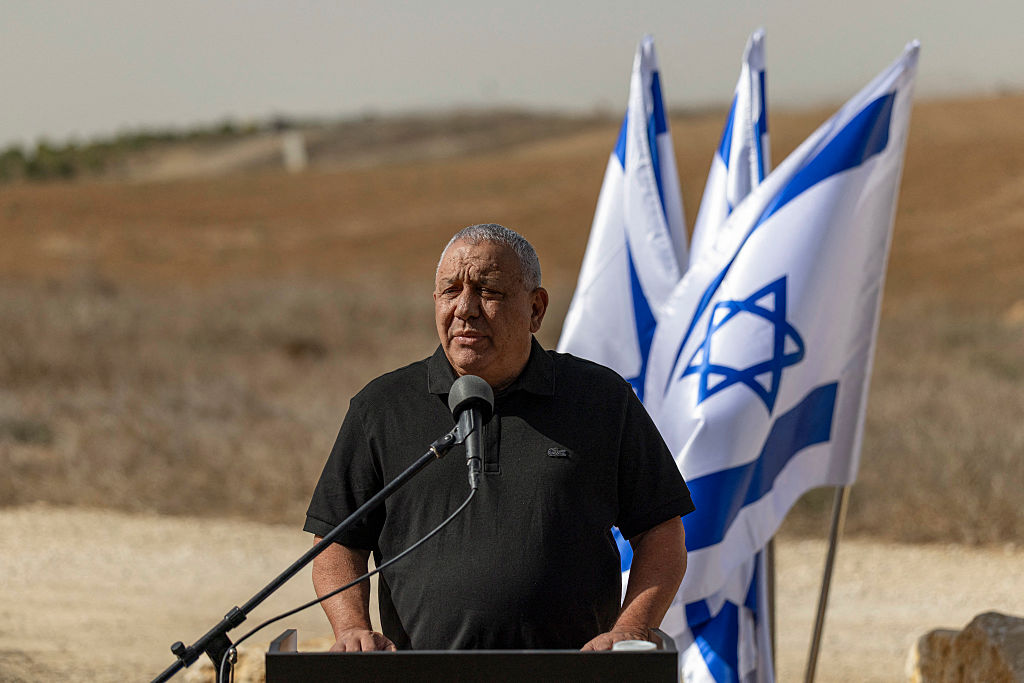
Gadi Eisenkot, the leader of Israel’s opposition coalition, has been very clear about his opposition to Palestinian self-determination. As Eisenkot stressed in August this year: “No Palestinian state will be established under the government we form.” (Ilia Yefimovich / AFP via Getty Images)
Israel’s parliamentary elections are fast approaching on October 27, with Benjamin Netanyahu facing a challenge from the opposition leader Gadi Eisenkot. Netanyahu is backed by a coalition of religious ultranationalist parties, while Eisenkot advocates a more liberal or secular form of Zionism, pledging to achieve what his party describes as a Zionist goal: “to make Israel, by 2048, a prosperous model state — a source of pride, built on partnership, fellowship and mutual responsibility.”
But what would a victory for either bloc mean for Palestinian society in the West Bank and the Gaza Strip? Unfortunately, whoever wins the election, there is not going to be any change to Israel’s denial of basic rights to the Palestinian people. Whatever else may divide them, the two rival coalitions share common ground in their staunch opposition to a Palestinian state and their insistence that Israel’s security must be further strengthened.
A Democracy for the Jews
Since its establishment, Israel has defined itself as a democratic state surrounded by enemies and fighting for its survival. However, while Israel has extended rights of citizenship and political participation to Jewish immigrants, Palestinians who already lived on the land have been subjected to mass displacement and denied equivalent rights under Israeli rule.
Since 1967, Israeli governments have maintained a military occupation of the West Bank and the Gaza Strip. This has effectively created a single territorial space under Israeli control, in which Jewish Israelis enjoy the full rights of citizenship, while Palestinians remain subject to military occupation and its extensive restrictions.
Israel has advanced the de facto annexation of Palestinian territory through colonial practices of occupation. Its consequences are stark: the creation of a blockade that Human Rights Watch recognized as a crime against humanity in a 2024 report; the perpetuation of daily violence by approximately 730,000 Israeli settlers living as full citizens of Israel in the West Bank; the systematic restriction of Palestinian freedom through the establishment of hundreds of checkpoints, road blocks, and other barriers.
Israeli leaders have long justified the colonization of Palestinian territory and the systematic oppression of the Palestinian people by reference to two overlapping narratives: the need to securitize the state and the religious imperative to establish Israeli sovereignty over Palestinian land they regard as part of the biblical inheritance of the Jewish people. While much of the Israeli left and center has traditionally favored the first rationale, the Israeli right embraces both, openly advocating the annexation of Palestinian territory.
The election of Netanyahu’s government in December 2022, on a platform explicitly supporting annexation, illustrates the extent of domestic support for the occupation among Israeli voters. However, Gadi Eskenot has accused Netanyahu and his allies of failing to achieve its stated goal of ensuring Israel’s security since October 2023: “Three years on, and the war’s objectives have still not been achieved. Hamas, Hezbollah and Iran are already preparing for the next round.”
The political program put forward by the opposition does not address the near-total destruction of Gaza’s social, economic, and political fabric, or the accusations of genocide brought against Israel before the International Court of Justice. Still less does it offer a path toward realizing the Palestinian people’s right to self-determination. As Eisenkot stressed in August this year: “There is no Palestinian state, and no Palestinian state will be established under the government we form.”
In fact, once again echoing a long-standing pattern in Israeli politics, the opposition’s electoral platform centers on national security. It pledges to “develop and implement a new national security doctrine,” strengthen the Israel Defense Forces (IDF), reinforce security along the borders — without specifying which borders — and turn Israel into a regional power while enhancing its standing on the world stage. The most significant proposed departure, however, lies in the commitment to integrate “ultra-Orthodox and Arab communities” into the IDF.
The contest between the two coalitions in the upcoming elections is a contest between political forces that offer no prospect of change in the approach to the Palestinian question, reflecting widespread indifference among the Israeli public toward the plight of the Palestinians. This is further illustrated by the categorical rejection by representatives of eight parties — Likud, Yashar, B’Yachad, Religious Zionist, Reservists-Economic Party, Yisrael Beiteinu, Otzma Yehudit, and Amcha Yisrael — of the idea that a Palestinian state should exist.
The responses range from “hell no” to “we’ll fight it . . . it’s wrong, it’s stupid, it’s against God, and it’s dangerous.” Yet the persistent emphasis of the candidates on the need for security suggests that a pervasive sense of anxiety and fear exists within Israeli society, even as Israel continues to deploy extensive military force in Gaza, killing large numbers of civilians. In turn, this sense of fear provides political elites with fertile ground for mobilizing public support.
A striking manifestation of this is the continued tendency to sacralize military power. The Smiling Soldiers Project, launched in the aftermath of October 7, illustrates this tendency, portraying soldiers as united by a spirit of brotherhood. The inclusion of soldiers’ photographs on social media pages devoted to Israeli culture, such as “Israel Picture,” similarly reflects the prominent place that the military occupies in the country’s national imaginary.
The Politics of Fear
The sense of vulnerability among Israeli citizens has provided political elites across the spectrum with fertile ground upon which to construct a rhetoric of fear, amplifying public anxieties to mobilize support for political and economic interests. Menachem Begin, prime minister of Israel from 1977 to 1983, offered a typical example of such rhetoric in 1968: “The enemies of the Jewish state, who surround it on every side, are plotting to destroy the returnees to Zion, the survivors of the German campaign of extermination.”
We can find the same kind of language being used today. In September, Netanyahu’s Finance Minister Bezalel Smotrich described Gaza’s two million Palestinians as “2 million Nazis,” claiming that generations had been raised to harbor a deeply antisemitic hatred of Israel. Statements of this kind tap into collective anxieties and channel them into support for practices of oppression that are framed as inevitable and fundamentally necessary. In doing so, they deflect responsibility for Israel’s conduct and cast the state as the sole victim of the conflict.
A particularly striking visual expression of this dynamic came in a 2013 poster produced by StandWithUs, an international organization that describes its mission as defending “the civil and human rights of those who align with our mission of supporting Israel.” The poster juxtaposed Israeli soldiers with images of concentration camp prisoners. The montage drew on the collective memory of the Holocaust to frame Israeli soldiers as harmless victims and Israel’s security concerns as the outcome of an existential threat hanging over the state.
As the electoral platforms of the two main contenders demonstrate, the Palestinian right to self-determination does not feature in the political vision being presented to Israeli voters. While Netanyahu insists that continuing the wars launched under his premiership is essential to strengthening Israel’s security, Eisenkot promises to introduce new reforms to the country’s security and military establishment. He does so without spelling out how he would address the devastation in Gaza, settler violence in the West Bank and southern Lebanon, or the war with Iran.
In The Wretched of the Earth, Frantz Fanon argued that colonialism not only deforms the lives of the colonized; it also transforms the minds of those who sustain it. The violence of colonialism, together with the anger and fear that violence naturally produces, reaches beyond its immediate victims, reshaping the political imagination of the society that perpetrates it.
Such dramatic dynamics have extensive psychological and, consequently, social and political reverberations. On the one hand, they leave the Palestinians no choice other than living without human, let alone political, rights. At the same time, they breed racism and trauma within Israeli society, fueling intolerance and a relentless pursuit of security that erodes democratic pluralism within Israel’s own Jewish-majority democracy.
This is evident, for instance, in the assaults on freedom of speech in Israel over the last two decades, in demonstrations targeting Palestinian citizens of Israel, where marchers have chanted “Death to the Arabs,” and in government threats to revoke the citizenship of the Israeli filmmakers of NAZA, a documentary featuring interviews with soldiers who have served in the war over Gaza in recent years. Colonial domination does not leave the colonizer untouched. The colonizer may conquer the land, but, in turn, colonialism also conquers the mind.