Inflation Is About Resources — and Power
Inflation policy is a fight over real resources: who controls them, who gets access to them, and who pays when prices rise.
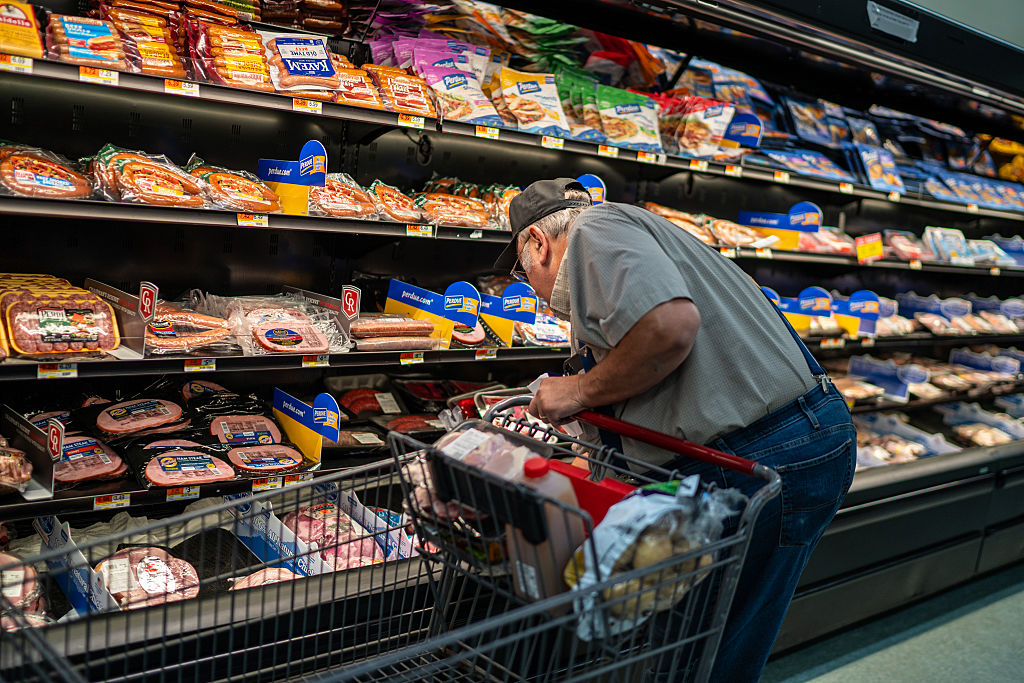
Inflation rises when demand runs into shortages of labor, energy, or materials. Austerity may curb demand, but it also undermines productive capacity and leaves households vulnerable to higher bills, wage freezes, and cuts to public service. (Robert Nickelsberg / Getty Images)
After prices began rising and rising in the wake of COVID-19 and Russia’s invasion of Ukraine, some blamed welfare and public spending for the inflation. Yet in many economies, weak demand and falling public investment after 2008 held back investment and productive capacity. Austerity can also weaken productivity and future growth. In the United States, changes to trade policy during Donald Trump’s first presidency added to uncertainty about the economic situation. Trade policy uncertainty between 2017 and 2018 may have lowered investment by 1 to 2 percent. During the pandemic, automakers canceled orders and halted production. Demand returned before factories, suppliers, and transport networks could restart. The Cleveland Fed documented how factory shutdowns, parts shortages, and shipping delays during the pandemic disrupted supply chains. The oil crisis of 1973 is a reminder of how a real supply shock can also become a lasting case for austerity.
Joe Biden’s American Rescue Plan expanded the child tax credit. Child poverty fell from 9.7 percent in 2020 to 5.2 percent in 2021, then rose to 12.4 percent in 2022 after Congress let the expansion expire. From 2019 to 2023, low-wage workers’ real pay grew by 13.2 percent. Real manufacturing-construction spending rose by 85 percent from January 2021 to a six-decade high in part as a result of new investment laws. These gains helped poor families, workers, and industry, though they cannot all be attributed to Biden’s policies.
US inflation also fell earlier than in the eurozone. Consumer price index (CPI) inflation peaked at 9.1 percent in June 2022 and fell to 3 percent by June 2023, while eurozone inflation was still 5.5 percent. Global supply pressures eased, energy prices fell, and the Federal Reserve raised rates sharply. Still, stronger wages and public investment can coincide with falling inflation. The gains for poor families, however, can disappear when that policy ends.
Sweden brings the question into focus in 2026. In its March 2026 forecast, the Swedish Agency for Financial and Public Management projected a general government deficit of SEK180 billion for the year. The International Monetary Fund (IMF) describes the fiscal policy as expansionary but expects headline inflation to remain below target. Inflation can rise when spending meets shortages of labor or natural resources, limited production, or firms with the power to raise prices. But spending and higher purchasing power do not cause inflation by themselves. The result depends on resources, production, prices, and import dependence. The deficit forecast and the IMF’s outlook show why.
Production Is Power
Imagine a low-paid worker with rent due and a child to feed two weeks until payday. A pay raise may help, but it cannot create affordable homes or medicine. When the costs of essentials rise faster than incomes, people with little room in their budgets absorb the shock first. Inflation policy decides who loses purchasing power, whose costs get protected, and whose prices remain beyond public control.
A government that issues its own floating currency creates money as it spends and withdraws money from the private economy through taxes. But it still faces real limits: labor, technology, materials, energy, and ecological capacity. Reliance on imports, foreign-currency debt, and exchange rate pressure can tighten those limits. If spending exceeds what producers can supply, prices may rise. A deficit alone cannot tell us where that point lies. An economy with available workers and room to raise productivity can absorb spending without necessarily generating inflation.
Banks create money when they lend. Each loan creates a matching deposit; as the loan is repaid, that deposit money disappears. But money cannot summon nurses, electricity, medicines, homes, or skilled workers. Private credit can sustain demand when wages and public spending lag, but households and firms cannot increase debt indefinitely. When borrowers repay loans more quickly than banks issue new ones, this bank-created money contracts. Austerity can exacerbate this fall in demand. If households and businesses try to pay down debt at the same time, a financial crisis can ensue.
Globalization gave rich countries access to abundant goods and helped keep some prices down, but it tied factories to long shipping routes and distant suppliers. Military power can protect routes, resources, and property rights, but it also depends on domestic industrial capacity and state support for its industries. Japan, South Korea, and China built technical capacity through public investment, industrial policy, directed credit, protection, and managed trade, while many Western economies have become dependent on finance, services, and imported goods. This has weakened the West’s ability to sustain the military power that keeps globalization in place.
Globalization also exposed the costs of weakening domestic industry. Trade shocks left factory workers with lasting job losses and lower incomes. Research has linked layoffs to far-right support, unequal exposure to economic shocks to racial animus and right-wing voting in the United States, and local trade shocks to authoritarian values.
A company that dominates its market sector can raise prices with less fear of losing customers. Across industries in fifteen European economies, the average market share of the four largest firms rose from 26 percent in 2000 to 32 percent in 2019; average markups rose about 7 percent. A US manufacturing study found that mergers were associated with higher markups and little evidence of higher plant productivity. Firms can also use monopsony power to hold down wages and hiring. In a study of French labor markets, a 10 percent increase in labor market concentration was associated with nearly 0.9 percent lower wages for new hires and 12.4 percent fewer hires.
Shocks Give Price-Setters Cover
COVID caused real supply problems. Lockdowns disrupted production. Households saved more, while spending shifted from services to goods. Auto demand plummeted in 2020, causing carmakers to cut their chip orders. In turn, chipmakers shifted production to other customers, and when auto demand returned, they could not quickly meet carmakers’ renewed need. Shortages can make it easier for powerful firms to raise prices. When rivals face the same shock and customers expect increases, price hikes can spread even without a cartel.
In 2022, profits rose faster than production across the eurozone and accounted for the largest share of price increases. Real cost shocks, like those associated with the recent US wars of 2025–26, can nonetheless coexist with wider margins. In food markets, financial speculation and stockpiling can drive price rises beyond what shortages alone would explain, especially when war creates expectations of shortages.
When COVID arrived, manufacturers expected a prolonged recession and cut production, capacity, and orders. Demand and employment recovered faster than expected, leaving shortages of semiconductors, lumber, and other inputs. Fiscal expansion did not invent these bottlenecks; it revealed them. Repeated periods of weak demand can close factories, disperse skilled workers, and delay investment, making supply slower to recover.
In the 1960s, large industrial firms had built capacity but struggled to sell everything they produced. Some responded by buying unrelated businesses, selling off or outsourcing production, and relying more on short-term finance. This shift away from production gave financial markets greater influence over industrial decisions. In the decades that followed, private debt could temporarily sustain productive capacity despite weak wage growth, but when borrowing slowed, spending and sales fell. Debt-led crises also enabled investors to buy distressed property, companies, and assets from poor households cheaply, at a high social cost.
Debt and Austerity
Some Mesopotamian rulers in antiquity periodically canceled debts, freed people from debt bondage, and restored property, in part to check mass indebtedness and land concentration. These measures were episodic, not part of a regular, universal system. Debt was contested in Ancient Greece too, as seen in Solon’s reforms. Rome faced recurring credit crises and public-land conflict. Debt crises and land struggles shaped the politics of the late Roman Republic.
The two world wars showed that markets could be governed. During World War I, the US War Industries Board coordinated production. After the war, advocates of austerity in Britain and Italy promoted balanced budgets and hard-money policies and accepted high unemployment as ways to restore economic hierarchies at labor’s expense. During World War II, the United States used price ceilings, rationing, taxes, wage policies, credit controls, and resource allocation to restrain inflation, raise revenue, and direct production toward the war effort.
One historical estimate put the price level more than 30 percent below where it would have been without general price controls. Controls did not abolish scarcity. Many goods were rationed or simply unavailable, but alongside public management of demand and physical resources, the controls worked. World War II was one of the few times that the US came close to full productive capacity. During the war, labor shortages and stronger unions also improved many workers’ bargaining position.
A study of 166 elections in 16 OECD countries from 1980 to 2016 found austerity associated with increased electoral abstention and support for nonmainstream parties. Austerity weakens workers’ bargaining power and public services, reduces demand and investment, and can undermine social stability.
The late 1990s surpluses, combined with the trade deficit, pushed the US private sector into record deficits. Household debt grew much faster than income as Washington paid down public debt. Levy researchers later linked private sector deficits to the global crisis of 2008. Post-COVID inflation had different causes, including supply bottlenecks, a shift toward goods, and energy shocks.
Lessons From Past Shocks
Inflation was already rising in the United States before the 1973 oil shock. The US chose to escalate the Vietnam War. The war diverted workers, fuel, and materials from civilian production and sent dollars abroad. In 1971, Richard Nixon ended the dollar’s convertibility into gold. The dollar continued to serve as a major world currency without a promise of redemption in gold. Fiat money still faces real limits: the availability of oil, labor, materials, and productive capacity.
During the Yom Kippur War, Arab oil states imposed an embargo and cut production. Separately, the Organization of the Petroleum Exporting Countries (OPEC) raised prices. Iran’s shah, a US ally, pushed for higher oil revenues to finance the country’s military buildup. Nixon had promised to sell him the arms he wanted. A contemporary account argued that Washington encouraged Middle Eastern producers to raise prices from 1971; Washington had earlier accommodated the shah’s push for higher prices, but during the crisis it opposed the Arab embargo and resisted OPEC’s proposed 100 percent price hike.
The United States did not create the whole crisis. But US leaders accepted higher oil revenues for a strategic ally. Meanwhile, oil companies, banks, and arms firms gained from the new flows of money, while workers and households paid higher prices. Leaders later used the crisis to attack welfare and full employment, even though the oil shock did not prove that public spending caused inflation.
The shift toward policies that tolerated high unemployment, wage restraint, and public spending cuts was a political choice, not an automatic result of the oil shock. Naomi Klein has traced disaster capitalism to Milton Friedman’s argument that crises can open the way for sweeping economic change. She shows how leaders and businesses have used this approach repeatedly, from Chile and post-Soviet Russia to the Iraq occupation and Hurricane Katrina, to push privatization and expand corporate control.
This selfsame policy choice — the choice between using inflation to justify austerity, or addressing its causes and effects — is reflected in Sweden’s response to the latest energy shock.
The Swedish Case
The war in the Middle East disrupted shipments through the Strait of Hormuz this past year, raising Swedish motor fuel prices by 25 percent. Yet Eurostat’s November release put Swedish inflation at just 0.6 percent, compared with 4 percent in the eurozone. On the Riksbank’s target measure, which holds mortgage interest rates fixed, Swedish inflation rose from 0.7 percent in August to 1.5 percent in September before easing to 1.1 percent in October. Excluding energy, it was just 0.1 percent in October.
Some measures that widened Sweden’s deficit also lowered prices. The November budget projected a 2026 deficit of SEK158 billion, or 2.3 percent of GDP. After Sweden halved the value-added tax (VAT) on groceries in April, food prices fell 5.5 percent that month; a government review found that retailers passed on most of the cut. The government also subsidized half-price monthly transit passes from July through December. The Riksbank estimates that without the temporary measures’ direct effects on prices, September inflation would have been 3.0 percent, twice the actual rate.
Growth continued alongside low inflation. Real GDP grew 1.6 percent, and the European Commission raised its forecast for 2026 growth to 2.8 percent. Household spending, investment, and net exports also lifted growth. The available figures give no separate estimate of how much the relief measures added to output or productivity.
The labor market recovery has been slower. A labor force survey put trend unemployment at 8.7 percent in the third quarter, even as employment rose. Sweden has also cut support for people in employment programs for more than 300 days. The government expects the cuts to speed up the return to work. But when households on tight budgets cut their spending, local businesses lose sales; and if financial pressure pushes people into jobs that make poor use of their skills, productivity could suffer. Sweden’s 2026 figures do not yet tell us how large these effects are.
The Riksbank expects inflation to exceed 2 percent in 2027 as the recovery strengthens and higher energy and import costs feed through. The government forecasts 2.8 percent in 2028 when the grocery VAT is due to return to 12 percent. Further disruption in Hormuz, the war in Ukraine, and new trade barriers could also raise costs and weaken demand for Swedish exports.
Sweden can issue kronor, but what it can buy depends on the fuel, labor, and equipment available. Higher interest rates can slow spending and hiring, but they won’t bring another tanker through Hormuz. Cheaper fares leave commuters with more money in their pockets today, and better public transport gives them a way to use less imported fuel tomorrow.
A state cannot buy resources that do not exist. But concentrated firms may raise prices before resources run out, while austerity can destroy demand and productive capacity. Inflation reflects pressure on real resources, but power determines who controls them and who pays when prices rise.