The Oil Crisis That Became a Weapon Against Welfare

War, dollar chaos, and soaring oil prices fueled the inflation of the 1970s. Workers and the welfare state took the blame. As war sends oil prices soaring again, that story still limits what we think society can afford.
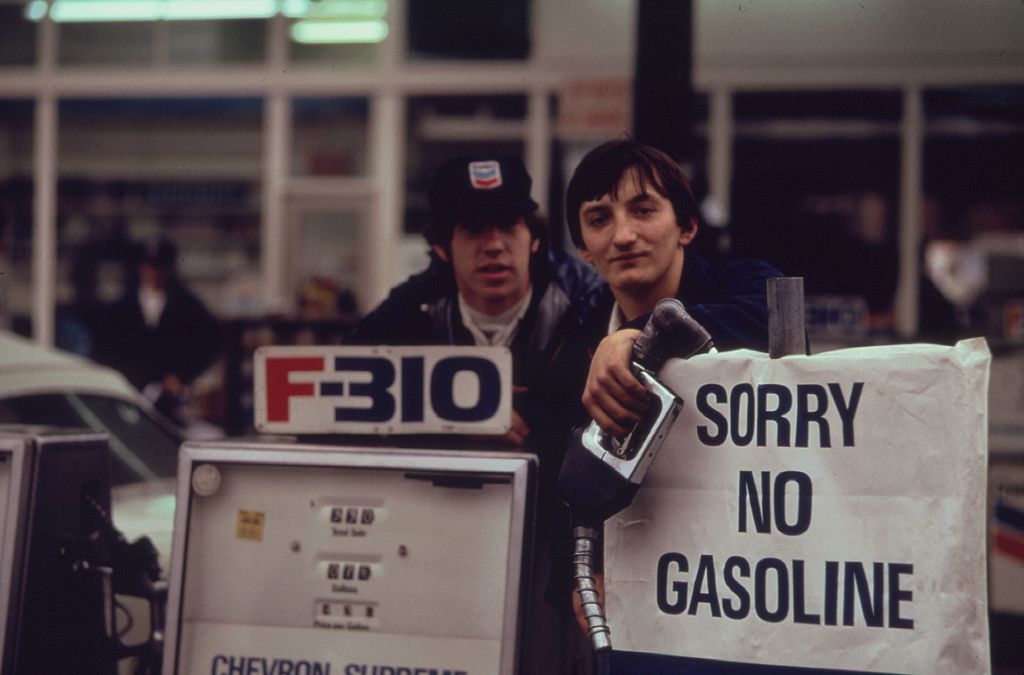
Gas station attendants peer over their "Out of gas" sign in Portland, one day before the state's requested Saturday closure of gasoline stations in 1973.

In the 1970s, war and oil shortages spurred inflation. A crisis of material scarcity was presented as a problem of excessive public spending. That myth lives on whenever governments claim there is no money for health care, housing, or pensions. (Smith Collection / Gado / Getty Images)


On August 15, 1971, Richard Nixon appeared on American television to announce a drastic reordering of the postwar economy. He closed the so-called gold window, ending the convertibility of dollars held by foreign central banks into US gold. Other central banks were no longer allowed to exchange their dollars for American gold. With a short speech, he brought down the monetary order that had underpinned the world economy since World War II: the Bretton Woods system.

The United States had put the dollar at the center of the system. The country promised to redeem dollars for gold at a fixed price. Other states tied their currencies to the dollar. But the Vietnam War drained resources, drove up spending, and sent new dollars out around the world.

The decision to abandon the dollar’s gold link was driven in large part by these pressures. As the decade came to an end, the United States attempted to finance both the war and growing Great Society programs without fully paying for them through taxation. Congress did eventually enact a temporary income-tax surcharge in 1968, but widening deficits and expansionary monetary policy had already contributed to inflation. The war also diverted labor, steel, fuel, transportation, and other real resources from the civilian economy, helping to overheat the economy and send additional dollars abroad. From 1965 to the spring of 1968, the American presence in Vietnam grew from about 24,000 military personnel to about 550,000.

The United States also had also passed up alternatives to war. Early on, Ho Chi Minh sought cooperation with the United States and drew inspiration from the American Declaration of Independence. But Washington ultimately supported French recolonization, thereby pushing the Vietnamese independence movement closer to the Soviet Union and China. The United States thus chose a conflict that later helped to undermine its own currency system.

As foreign banks increasingly tried to obtain gold for dollars, the contradiction was exposed: the United States had issued more dollars than it could redeem at the official price. Nixon therefore suspended convertibility in an attempt to stave off domestic austerity. The decision allowed for greater monetary freedom, but the resulting dollar depreciation ate away at the purchasing power of oil producers’ revenues and added to pressure for higher oil prices.

Of course, the United States did not start the Vietnam War to break the gold standard. The causal connection was this: the war worsened deficits, increased inflationary pressures, and made Bretton Woods unsustainable. Washington understood the connection but allowed the war to continue. When the system broke down, it used the crisis to build a more flexible dollar-based monetary regime under its own control.

However, Washington was not content merely protecting its gold reserves. In a 1974 meeting with Henry Kissinger, Assistant Secretary of State Thomas Enders declared that a stronger role for gold would benefit Europe, which held a larger share of the world’s gold reserves. The United States instead wanted to shift the system to the International Monetary Fund (IMF) and Special Drawing Rights, an international reserve asset created by the fund. The discussion reveals a struggle over geopolitical power, not simply a technical currency reform.

Quadrupling the Price of Industrial Society’s Lifeblood

Two years later, the October War broke out between Israel and a coalition of Arab states led by Egypt and Syria. Arab oil producers reduced production and imposed an embargo on countries that supported Israel. Within months, the price of crude oil skyrocketed.

Oil was the lifeblood of industrial society. Then as now, it powered trucks, factories, agriculture, and ships; heated buildings; and served as a key input in plastics, chemicals, and fertilizers. As oil prices soared, the cost of almost everything rose. Businesses raised prices. Households lost purchasing power. Oil-importing nations ran growing trade deficits.

The oil shock turbocharged an inflation that was already underway, primarily in the form of a cost shock. It did not occur because teachers taught too few children, nurses cared for too few patients, or retirees received pensions that were too generous. War, expensive energy, falling currencies, and shortages of essential resources pushed prices upward.

During and after World War I, prices had also surged — roughly doubling between 1914 and 1920 — as the war effort sucked up resources, destroyed productive capacity, and created civilian shortages. World War II brought sharp price pressures of its own, although strict rationing and price controls dampened much of the wartime increase. When these controls were lifted in 1946, they released a short but violent wave of inflation, triggering price increases approaching 20 percent for 1946–47. However, this was seen as a normal and manageable postwar phenomenon — not as a permanent systemic failure. The United States therefore had ample historical experience of wars producing inflation.

Yet the political right increasingly told a different story. It claimed that the welfare state had grown too large, workers too powerful, and the state too generous. Oil helped create the crisis. Political storytelling shifted the blame.

The United States was happy to portray itself as a victim of Arab oil producers. But Washington’s role in the price increases was more complicated than the Right’s narrative allowed.

Shah Mohammad Reza Pahlavi’s Iran was one of America’s most important allies in the Persian Gulf. The shah wanted to turn Iran into a regional superpower and buy huge quantities of American weapons. To do so, he needed higher oil revenues. Nixon and Kissinger therefore had strong reasons to accommodate at least some of his demands for more expensive oil.

Powerful American interests also profited from the price increase. Oil company profits soared, and banks in New York and London gained access to huge flows of oil money. The arms industry acquired new customers. Although expensive oil did damage to the broader economy, it enriched strategic and commercial interests and reinforced US-Iran relations.

Saudi Arabia periodically attempted to staunch price increases. The shah, meanwhile, pressed to keep them high or pressed for them to become even higher. Washington’s response fluctuated. It resisted the embargo and did seek lower prices but was also averse to confronting Iran. In an article from the time, “We Pushed Them, ” V. H. Oppenheim claimed that the United States had encouraged Middle Eastern oil producers to raise prices in 1971.

The United States did not create the oil crisis. The war, the embargo, the Organization of Petroleum Exporting Countries’ growing power, and the self-interest of oil producers all played crucial roles. But US leaders reinforced the trend and accepted the damage, and strategically important industries reaped the benefits. US leaders did not need to have planned every step of the crisis to understand and exploit the resulting opportunities.

The Rise of the Petrodollar

After Nixon broke the link to gold, the United States needed to reinforce its existing position as the world’s principal reserve and trade currency. Oil gave the country a new anchor.

In 1974, Washington secretly made a historic agreement with Saudi Arabia. The United States agreed to buy Saudi oil and provide the kingdom with military aid and equipment. The Saudis, in return, agreed to reinvest their dollar surpluses in US government securities. Other oil producers followed suit, also investing large portions of their income in US banks, government securities, and arms purchases. The system of petrodollar recycling took shape.

Because oil was priced mainly in dollars, all oil-importing countries needed access to dollars. They had to earn them through exports, draw down their reserves, or borrow dollars from banks. The United States, on the other hand, issued the currency in which oil was priced. It could therefore pay for imports and borrow abroad in its own currency — special privileges not available to other states.

The petrodollar did not replace gold as formal backing for the dollar. But it reinforced a different form of structural power. Gold had constrained countries through a scarce monetary anchor. The new petrodollar system required countries buying oil to obtain dollars, while oil producers recycled much of their surpluses into US banks and government securities. Oil helped entrench the dollar’s existing position as the world’s reserve currency.

That order pressured countries, especially poorer and indebted countries, to chase export earnings, borrow in dollars, and adapt their policies to American interest rates. It also gave the United States an incentive to defend the dollar’s global position with sanctions, alliances, and, not infrequently, war.

But the United States did not need monetary hegemony based on oil to remain immensely rich. American labor, natural resources, technology, and productive capacity would have been sufficient to sustain tremendous prosperity. It nevertheless chose dominance instead of a more equal international system.

The Stagflation Alibi

The oil crisis popularized a relatively new word: stagflation. Prices rose while growth slowed and unemployment increased.

This challenged a simplistic postwar reading of the Phillips curve, which economists use to represent the relationship between inflation and unemployment. Many economists had understood this relationship as proof that governments could accept some inflation in exchange for lower unemployment. However, in the 1960s, Milton Friedman and Edmund Phelps had argued that the state could not push unemployment below a supposedly “natural” level without creating rising inflation.

When the oil shock came, Friedman and his followers declared that they were right, and John Maynard Keynes was wrong. But they changed the question. Stagflation may have justified their warning that the Phillips model could not serve as a permanent bill of fare for policy options. It did not show that full employment, public investment, or welfare had become impossible. A simple model had failed to explain a global energy and currency crisis, but Keynesianism as a whole had not been disproven.

Trade unions in Britain, for example, chose to try to compensate their members for the oil price shock by demanding higher wages. The government responded with price and wage controls, negotiations with unions, and cuts to public spending. Wage demands could create price increases throughout the economy, but they didn’t create the oil shock. Governments chose not to adapt Keynesian policy pragmatically to the circumstances (e.g., through coordinated wage settlements, temporary price controls, or increased taxes). Instead politicians across the spectrum chose to prioritize low inflation over full employment and good wages.

Keynes had never promised that the state could buy unlimited amounts of oil, labor, or raw materials without price increases. His core idea was that the state could mobilize idle resources when private demand failed. The oil crisis presented a different problem: it hit the economy’s supply side. It required temporary regulation of energy policy, price controls, investment, restructuring, and a fair distribution of the unavoidable costs. It did not require permanent austerity.

From Factories to Finance

The crisis also presented a choice about what to do with the productive power of postwar industry. According to business historian Alfred Chandler, large corporations had become so efficient in the 1960s that overproduction depressed prices and profits. That productive capability could have been redirected toward social needs. The state could have financed industrial restructuring in return for secure jobs and broader social objectives, as in Sweden after 1931. A similar bargain might have even used the energy crisis as year zero to begin a green transition.

Instead, squeezed profits and the oil crisis strengthened finance capital’s demand for quick returns. Rather than put this productive capacity to socially useful ends through democratic planning, firms attempted to restore profitability through plant closures, layoffs, suppressed wages, and a turn toward finance. The lesson had been learned: scarce supply could keep prices and profits up.

Anthropologist David Graeber has shown how pointless bureaucracy disrupts operations, while neuroscience journalist David Rock has explained how constant pressure and hierarchies impair focus, judgment, cooperation, and problem solving. More intense work can therefore reduce real efficiency and at the same time discipline employees. The cult of ever-harder work served an economic function even as it failed to produce more.

Critics of Keynesianism turned stagflation into an ideological weapon. The combination of war, oil scarcity, and currency turbulence became evidence that the welfare state had failed. Instead of adapting Keynesian policies pragmatically to changed circumstances, low inflation became the overriding objective, rendering full employment and rising wages “impossible.”

More recent research has further weakened the claim that low unemployment automatically drives inflation. The aftermath of the Covid pandemic reiterated the point: inflation emerged from disrupted production and supply chains, energy shocks, and failures to expand productive capacity. It was not a simple matter of people having jobs or too much economic security. Indeed, what were described as “wage-price spirals,” were just as often “profit-price spirals.”

Two Faces of Counterrevolution

The United States used not only trade, loans, and the dollar to strengthen its power, but also the Central Intelligence Agency (CIA), economic pressure, and support for military coups.

The clearest example is the Chilean coup of 1973. Chileans had elected the socialist Salvador Allende as president. He wanted to take control of the copper mines and pursue an independent economic policy. US President Richard Nixon feared that a successful democratic road to socialism would inspire other countries to follow Chile’s example.

Nixon ordered the CIA to make Chile’s economy “scream.” The United States stopped aid and credit, funded opposition parties and media, and used the CIA to destabilize Allende’s government. The crisis deepened as strikes and conflicts shook the country.

On September 11, 1973, General Augusto Pinochet seized power. The military overthrew Allende and imposed a brutal right-wing dictatorship. The United States helped create the conditions for the coup. Pinochet then opened the economy to neoliberal experiments that favored powerful private interests.

Chile was not exceptional. In 1954, the CIA overthrew Guatemala’s elected government after president Jacobo Árbenz’s land reforms threatened land barons and the United Fruit Company. In the mid-1960s, Washington supported the Indonesian army’s destruction of the Communist party and the left-wing labor movement, connected to brutal mass killings. In the 1980s, the United States armed and supported the contras in their war against Nicaragua’s Sandinista government.

The United States has repeatedly opposed governments that tried to control their own economies and escape its political orbit. The oil crisis might not have created the machinery of empire, but it gave it powerful instruments. As petrodollar lending and debt denominated in dollars expanded, Washington was free to combine financial pressure, covert action, and military power to defeat independent development projects and draw countries more tightly into its sphere of influence.

Coercion was just one aspect of the project. Market liberals did not have to invent their story in 1973. They had been preparing it for decades.

Friedrich Hayek, Milton Friedman, and others formed the Mont Pelerin Society as early as 1947. Business interests funded think tanks, professorships, books, and campaigns. These organizations trained politicians and provided the media with simple messages: the state is the problem, taxes are an obstacle, and unions drive up prices.

The crisis gave these networks their breakthrough. They pointed to queues at gas stations and said that welfare had gone too far. They pointed to inflation and said that workers had been given too much. They pointed to deficits and pretended that a state with its own currency was functioning like an indebted household.

The message obscured the crucial difference. A household must earn or borrow money before it can spend it. A monetary sovereign state issues the currency it uses. A state may run short of nurses, electricity, steel, housing, or medicine. It cannot run out of its own currency in the same sense.

Inflation sets one real limit. Nature sets another. But the empty treasury is often a political narrative, not a material fact.

Enter Paul Volcker

In 1979, Paul Volcker took over the US Federal Reserve. He pushed up interest rates to 20 percent to crack down on inflation. He sought to defeat inflation by crushing demand.

The method produced bankruptcies and mass unemployment. When people feared losing their jobs, they had less power to demand higher wages. When unions lost members and the power to strike, power shifted to employers. The fight against inflation therefore also became class politics.

But interest rate hikes often attack the symptoms rather than the original causes of inflation. When prices are driven upward by supply shocks, delivery problems, or war, higher interest rates do not produce more oil, electricity, housing, or food. People still must buy what they need. Instead, high rates reduce borrowing and investment and raise unemployment. The economy is forced to absorb the shock through lost jobs, lower wages, and shuttered businesses — all without actually repairing the shortages that drove prices skyward.

The Volcker shock also caused the dollar to rise in value, as higher returns attracted more capital to the United States. It decimated factories across the US industrial belt. It hit Latin America and Africa even harder. Many states had borrowed the petrodollars that Western banks pumped out in the 1970s. The loans were generally in dollars and often carried variable interest rates. When the United States raised interest rates and the dollar appreciated, their debt burdens exploded.

In 1982, Mexico announced it could no longer service its debt. The IMF and the World Bank offered new loans but demanded cuts, privatizations, lower public sector wages, and open markets. The debt crisis gave these institutions the leverage to dismantle entire social models and disrupt the nascent industrialization that had begun in the Global South during the postwar development era.

In many countries, IMF and World Bank adjustment programs contributed to poverty, deindustrialization, and disintegration. In Yugoslavia, debt, unemployment, and welfare cuts weakened federal cohesion. The economic straitjacket did not single-handedly cause the civil war and genocide in Yugoslavia, but it exacerbated the insecurity and regional antagonisms that nationalist leaders turned into an explosive political force.

Ronald Reagan spoke of the state as the problem. At the same time, he increased military spending and ran large budget deficits. The United States used public research, defense procurement, and industrial policy to boost aviation, computers, and new technologies.

Many indebted countries, on the other hand, were told that they had to cut spending. European countries increasingly imposed similar discipline at home. Japan, South Korea, and Taiwan were allowed — and sometimes encouraged — to use state banks, tariff protection, and targeted credit as long as their development served the US strategy during the Cold War. Market discipline thus applied most strictly to those who lacked the power to say no.

In Sweden, the Right, particularly in the form of the Employers’ Association, ran a long and expensive campaign to depict the international crisis as an argument against unions, working conditions, social insurance, and public welfare. The oil shock did not actually prove that the welfare state — the folkhem — had failed. But it gave bosses a golden opportunity to turn the balance of power away from workers and elected institutions toward companies, capital owners, and private markets.

The Afterlives of the Wrong Lessons

Workers toil in factories, warehouses, transport, restaurants, and care services. Teachers, social workers, journalists, researchers, and communicators face the same logic in a different guise. Organizations lack staff and time. Managers still demand that individual workers become more flexible, positive, and efficient.

Many people still want good health care, secure pensions, higher unemployment benefits, reasonable rents, and functioning schools. Yet most established parties, bereft of ambition and political imagination, continue to undermine these very systems.

The overworked teacher is pitted against the person on sick leave. The nurse against the unemployed. The worker against the migrant. Everyone is told that resources are exhausted and that someone further down the social ladder has taken their share. The underlying conflict between labor and capital disappears from view.

When left and center-right parties promise security but deliver austerity, democracy loses credibility. Voters tire of different versions of the same policies and choose the one that promises to overturn the table.

Authoritarian leaders give people enemies instead of security. They attack migrants, minorities, journalists, cultural workers, courts, and unions. At the same time, they protect the largest fortunes and corporations that profit from the unequal order.

They promise systemic change. But they direct the revolt downward.

Half a century later, the parallels are hard to miss. The pandemic threw production and supply chains into disarray; the Ukraine War increased energy costs; and now the war with Iran and the imbroglios disrupting oil traffic through the Strait of Hormuz have sent prices skyward once again. The circumstances may differ; the political responses do not. Inflation resulting from war, shortages, and obstructed production is blamed on wages, public spending, or regular people supposedly living high on the hog. Over and over again, workers are told they must absorb the cost of crises for which they bear no responsibility.

The world of the 1970s was beset by war, currency chaos, and a dramatic increase in the price of its most important energy source. The United States contributed to the upheaval, profited from the petrodollar, and used its new monetary freedom to finance war and sustain global hegemony. Yet ordinary people were taught that their own prosperity and security had caused the disaster.

That myth lives on every time a government says it has run out of money for health care, schools, housing, pensions, or climate change. A country may lack personnel, electricity, materials, and natural resources. These are real limits. But a state with its own currency does not have to wait for billionaires or banks to create its money.

Moreover, the prescribed medicine — suppressing private demand and tightening public budgets — can itself damage production. Market liberals can then cite the resulting difficulties to justify still more austerity. In times of crisis, policies that transfer wealth and power further upward can be presented as unavoidable and necessary.

The state must govern according to the economy’s real productive capacity. It should dampen demand when resources are insufficient, preferably by placing more of the burden on the richest. But when people become unemployed, factories stand idle and social needs grow, it can use its monetary capacity to put idle resources to work.

The oil crisis was not just an economic shock. The Right turned it into a narrative that democracy could no longer control the economy. From that narrative came fifty years of cuts, deregulation, privatization, stress, and inequality.

The Right’s greatest victory wasn’t that it solved the oil crisis. It was making the world remember the crisis in the wrong way.