Economics Needs a New Approach to Inflation
The question isn’t whether the mainstream economic consensus on inflation is right or wrong. It’s clearly wrong. The question is, can we do anything about it?
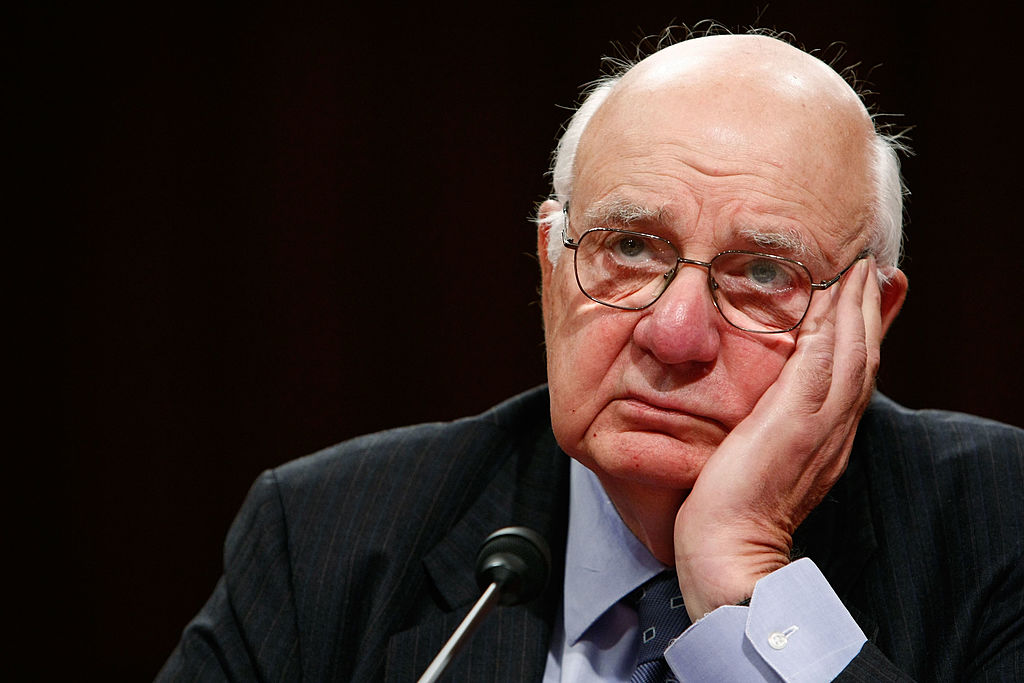
Former Federal Reserve Chairman Paul Volcker testifies before the Joint Economic Committee on May 14, 2008, in Washington, DC. (Win McNamee / Getty Images)
Four years have passed since the COVID-19 pandemic’s inflation in the wake of the American economy’s reopening hit its peak, and the American business cycle is today in a strange way. Wanting to slow the rise in prices that accompanied the reopening and construction boom, the Biden administration and the Federal Reserve cut social spending and raised interest rates. Nonresidential construction has been falling since late 2023. Residential construction investment collapsed in early 2023, then rose briefly in 2024, but has been falling for over a year now. As the unemployment rate crept up slowly throughout the second half of the Biden administration, economists and journalists consistently warned of the risk of a recession. Yet despite falling construction spending and creeping unemployment, the recession never came.
Instead, nearly two years into a change in management, the American economy in the summer of 2026 was again seeing accelerating inflation. Having fallen from 9 to 3 percent during the Biden administration and stabilizing below that through the presidential election and the chaos of the new tariffs of “Liberation Day,” the annual rate of the change of the Consumer Price Index (CPI), the monthly report most commonly used to measure inflation, rose from 2.4 percent in February to 4.2 percent in May. Driven by petroleum products — motor fuel, fuel oil, and natural gas, primarily — the course of prices has closely followed the Iran war: slowing considerably with news of the sixty-day Memorandum of Understanding in June and July.
The August inflation report, released September 11, maintains this brisker pace of 3.4 percent. With all eyes in finance waiting to see what action the Federal Reserve takes in response, the news reinforces expectations for an increase in short-term interest rates at its policy meeting next week. Data center construction has been propping up the construction industry, and that has rested on a credit boom that may become more difficult to roll over if interest rates increase further. While the stock market continues to boom, as last year’s top-end and corporate tax cuts leave more money for the wealthy to invest speculatively, median wage growth has fallen so far that even the 3.4 and 3.3 percent inflation of recent months means workers’ income is falling in real terms.