Neukölln, the Berlin District Where the Left Broke Through
Neukölln is a working-class, multicultural district of Berlin that embodies the turnaround in the German left’s fortunes. This has also made it the target of efforts to demonize socialist party Die Linke and disqualify its Muslim voters.
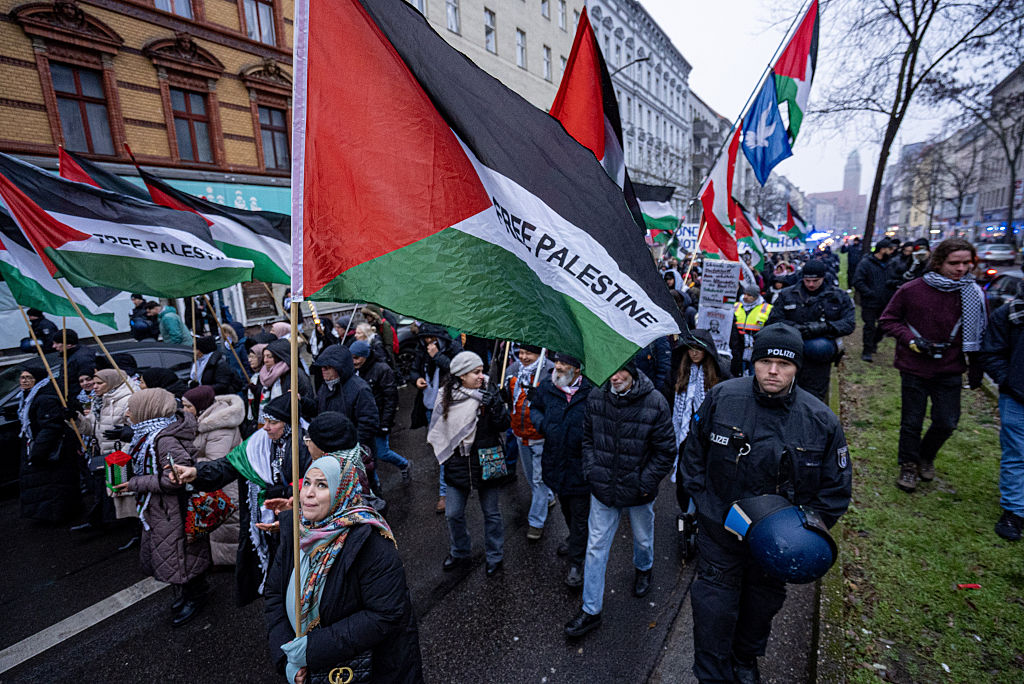
Protesters march in support of Palestinians after gathering in front of Neukölln City Hall in Berlin, Germany, on December 27, 2025. (Ilkin Eskipehlivan / Anadolu via Getty Images)
Amid resounding recent victories for the Alternative für Deutschland (AfD), on September 20 Germany’s socialist party Die Linke bucked the trend with a spectacular victory in Berlin. It dominated the campaign with its program of ending cuts, capping rents, and socializing housing companies, leaving other parties to respond to the popular demand that Berliners had confirmed in a 2021 referendum. The monster victory for the AfD in Saxony-Anhalt further galvanized Berlin’s diverse urban working class to express opposition to the fascists.
Die Linke’s doubling of its vote in Berlin, winning 25.7 percent support, was no blip. The February 2025 federal election, when Die Linke enjoyed a comeback after years of stagnation, crisis, and splits, already saw a turn to the left in urban centers, among young people, women, migrants, and the Muslim community. At that point already, Die Linke won 20 percent of the vote, with striking gains in inner-city areas of Mitte, Friedrichshain-Kreuzberg, and Neukölln. In the September 20 Berlin state election, it did even better.
This victory didn’t just come from the party’s media profile or even its policy agenda. Its result follows a groundswell of coordinated campaigning by local Die Linke branches, whose membership in the German capital has grown from 7,200 members in 2023 to over 19,000 this September. During this campaign, members and sympathizers were visible across the city, on stalls, rallies, and street events, and knocking on doors.
Importantly, local activists have been rooted in various struggles and, in mobilizing a vote for Die Linke, could build on already-existing relationships and address local grievances. Across swathes of the inner city, the party has worked to gain trust among parts of the working class that tended toward political cynicism and that had long voted for the Social Democrats (SPD) or Greens without expecting much, or even anything.
Take the Rollbergviertel in Neukölln, for example, one of the poorest areas of Berlin. Here apartment blocks belong to public housing corporation Stadt und Land, which has raised service costs and left the buildings to dilapidate and rot while cutting janitors and ignoring complaints. Local Die Linke candidate Philipp Dehne organized a rally in the block with volunteers at the neighborhood canteen Kiezanker, gathered photos of problems, and raised tenants’ demands with Stadt und Land management.
Activists knocking on doors could build on this record, while proposing political solutions like a rent cap and the socialization of private housing corporations. They could also address fears of the AfD by referring to successful actions like the one on September 2, when AfD officials planned to take allies from Austria’s far-right Freedom Party (FPÖ) on a tour of the multicultural adjoining main street, the Karl-Marx-Straße. Left-wing groups and Die Linke activists got wind of the plans and followed them in the street chanting “All of Berlin hates the AfD!” forcing them to leave under police escort. The 25 to 30 percentage point gains in blocks like the Rollbergviertel, where Die Linke reached shares up to 55 percent, cannot be explained without reference to such sustained efforts.
However, the increasing strength of Die Linke Neukölln and the party’s left wing is also the reason that attacks are now being concentrated on this Berlin district. Their resolve under intense pressure should be an inspiration for the entire party not to give in but to fight for the real change Berliners voted for.
Turnaround
Die Linke’s activity in Neukölln offers a window into the turnaround in the party’s fortunes.
Die Linke was founded in 2007, when the eastern-centered Party of Democratic Socialism merged with a left-wing split from the SPD called the Labor and Social Justice – the Electoral Alternative (WASG). At the time, the Neukölln branch of Die Linke numbered around two hundred members. Operating in a district of what was once West Berlin, the Neukölln branch had little weight in the Berlin party compared to the large ex-PDS branches in the former East Germany, where membership numbered in the thousands and Die Linke could count on a huge share of the vote.
It’s important to realize that Die Linke has been in the Berlin government before, albeit as a junior partner. The eastern branches made up the constituencies of the politicians who formed the SPD-PDS/Die Linke governments in Berlin from 2001–11 after the post-reunification fiscal crisis and the Berlin banking scandal of 2001. These governments took measures like the firesale of 70,000 council homes of the public housing corporation GSW and slashing the pay of Berlin public sector workers. Such moves haunt the Berlin party still. The ensuing disillusionment led to the net loss of more than three thousand members between 2001 and 2011 and halved the 22.6 percent vote share the PDS had reached in Berlin, even though it made gains elsewhere in Germany.
The Neukölln district party made a point of being critical of the neoliberalism and austerity in which the party had engaged in government. Here the founding of Die Linke in Neukölln involved dozens of revolutionary socialist activists — mainly from Marx21, a reformation of Linksruck — joined a few years later by the Sozialistische Alternative (SAV). The anti-Stalinist Marxist groups in the Berlin WASG brought with them their experience from social struggles against the neoliberal reforms of Gerhard Schröder’s SPD-led government, the anti-Nazi street blockades of the 1990s, and the student strikes against tuition fees, leading the branch into the social movements.
The district party set up four local branches (Basisorganisationen, BOs) which all elected branch organizers. The BOs started organizing regular paper and flyer stalls and regular meetings for prepared discussions on current events, strategy, and theory.
Members would and still do prepare their own input or would arrange for an external speaker from a local campaign, strike, or movement. During discussions, a moderator ensures time limits, encourages women and inter-, transgender, and nonbinary people to speak, and can award priority on the speakers list.
“Basisorganisationen” as Drivers of Socialist Activism
The BOs also plan a wide array of activism. Members coordinate their presence at demonstrations and visits to picket lines, but also educationals, reading groups, and conferences. Throughout the 2010s, they also devoted time to signature drives for referendum campaigns like Deutsche Wohnen & Co Enteignen (resulting in the 2021 popular vote to nationalize the big landlords) or 100% Tempelhofer Feld, alongside Palestine, Greece, and refugee solidarity work. Die Linke gained members by being supportive and effective: politicizing the issues but being careful not to co-opt existing campaigns.
In cooperation with the Neukölln board, BOs also mobilize for major direct actions in Germany like blockades of AfD party conferences; climate actions at lignite mines; protests against antiabortionist marches by fundamentalist Christians; and demonstrations against NATO or G7 summits.
At the same time, Marx21 comrades less involved in the branch played a leading role in the Ver.di union’s drive at the Vivantes Klinikum Neukölln, culminating in the massive hospital strike of 2021. Other practical-minded Die Linke members focused on organizing tenants in the south of the neighborhood around their issues.
Die Linke in Neukölln became a training ground for all-around socialist activism attuned to Marxist theory and regular practical discussions. This alternative model was notably attractive to an anti-capitalist milieu in Berlin that had recently learned to be wary of political parties. Importantly, the branch calls frequent meetings of the district assembly (MVV) every three months or so, where all members can attend and discuss the way forward, while electing a board and delegates to Berlin and national party conferences. In the spirit of full democracy, ample time is devoted to discussions, proposing amendments, and putting motions to a vote.
Steady Growth
The overall result was a steady growth of the Neukölln branch, from 230 members in 2008 to 600 in 2020, with the percentage of women also rising from 26 to 38 percent. The party’s vote here also rose, from 5.6 percent in the 2009 Berlin elections to 14.3 percent in 2021, surpassing Die Linke’s Berlin average for the first time. These federal elections saw much higher results in Neukölln, up from 13.9 percent in 2009 to 18.2 percent in 2017, a clear indication of discontent of Die Linke voters with the Berlin government. The gains were concentrated in the urban, multicultural north with lesser success in the more conservative suburbs in the south.
The Crisis in Die Linke Nationally
The late 2010s to early 2020s saw a long crisis in Die Linke, with a conservative, sovereigntist faction around leading member Sahra Wagenknecht eventually splitting away. Die Linke’s federal vote share sunk to 4.9 percent in the 2021 federal elections — almost enough to knock it out of parliament — and it suffered heavy losses also in Neukölln (down to 11.9 percent) and Berlin in general (11.4 percent). Die Linke’s membership shrunk by 20 percent federally and by 10 percent in Berlin between 2017 and 2023.
Revolutionary organizations in the branch also experienced ruptures. The Sozialistische Organisation Solidarität (Sol) split from SAV in 2019. A significant number of central, founding members of the Neukölln branch first left the Marx21 network to found Sozialismus von Unten (SVU) and then left Die Linke in the course of 2024, leading up to the expulsion of the Palestinian-German SVU member Ramsis Kilani despite the protest of Die Linke Neukölln.
Still, the branch maintained its membership and level of activity. The fact that Wagenknecht split away also opened the door for anti-racists, LGBTQ activists, ecologically minded people, and people worried about Wagenknecht’s Russia-friendly stance. The anti-capitalist foundations of the Neukölln branch, too, helped members focus on the long-term strategic goal of building the branch and the movements rather than despair at the lack of immediate electoral success.
Palestine Solidarity
After the October 7 attacks and Israel’s turn to all-out genocide, Palestine solidarity became central, also for the many new members in Die Linke Neukölln. The district is home to the biggest Palestinian diaspora in Europe and many others from the entire Middle East and North Africa, as well as mostly young Israeli and non-Israeli Jews. As riot cops raided Neukölln’s Arab shopping streets and went after the Palestine solidarity movement with full force, the government announced blanket bans on demonstrations. Amnesty and Human Rights Watch issued worried reports about worsening democratic rights in Germany.
Palestinian school children were humiliated for wearing keffiyehs or the Palestinian flag. One seventeen-year-old reported at a local Die Linke meeting that her teacher ripped her red-green-black wrist bracelet off and threw it away in front of the entire class, claiming, “Palestinians don’t exist.” School protests were banned, like at the Ernst-Abbe-Gymnasium on the Sonnenallee. The Berlin government sanctioned schools to ban signs of Palestinian identity and funded the classroom distribution of the revisionist pamphlet Mythos#Israel1948 by the Zionist group Masiyot.
Die Linke Neukölln already had good relations with the Palestinian community, having — unlike much of the German left — long proven its solidarity. The Neukölln council fraction, headed since 2021 by Palestinian-German civil rights lawyer Ahmed Abed, successfully pressured the mayor to retract the Mythos#Israel1948 pamphlet from schools.
Since 2024, the Neukölln branch has also continued to intervene in Die Linke nationally to start a campaign to stop weapons exports to Israel and to call out the genocide. In defiance of ever more vicious smear campaigns in the national press and politicians from all other parties, Vedi Emde (now a Die Linke member of the Berlin parliament) organized what turned out to be huge public meetings on Gaza and Berlin’s biggest Palestine solidarity demonstration, with 70,000 people, on September 27, 2025.
Comeback
At the same time, the national party abruptly found its way back from the abyss. In summer 2024, Friedrich Merz’s Christian Democrats (CDU) broke a previous taboo by seeking majorities together with the AfD to combat migrants and asylum seekers, prompting a huge wave of protests. Die Linke was now able to catch a wave of progressive, anti-fascist indignation, prompting a wave of young, often female and increasingly also migrant members showing up to meetings.
Olaf Scholz’s SPD-led coalition government fell in November 2024, leading to snap elections Die Linke was hardly prepared for, in Neukölln or anywhere else. But Die Linke Neukölln saw a chance to put the party’s first ever directly elected candidate in the Bundestag (parliament) in the former West Germany, Ferat Koçak, through a massive door-knocking campaign. The ad hoc campaign group mobilized over two thousand party members and sympathizers, reaching 139,000 doors, and was a wild success with 25.2 percent of the party vote and 30 percent for the individual candidate. By the end of February 2025, Neukölln branch had doubled its membership to over two thousand, winning a thousand mostly young, mostly female, and ever more diverse members over the course of months.
After the election, the Neukölln board and local district-level groups were overwhelmed by the growth in new membership and invested huge efforts into contacting them all, organizing welcome and orientation meetings, and resorting the existing structures. They involved new members in preparing meetings and actions, mapped the issues and forms of activity that members were most interested in, and got people started in their group.
This year, the branch has grown further to 2,600 members and ten self-organizing BOs. The district party has grown younger as well, with half of the increasingly multiethnic membership under thirty-five and achieved gender parity in 2025. The election campaign was better prepared and managed to integrate the door-knocking campaign with flyer stalls, rallies, and street events. Actions were organized by each local candidate’s volunteer teams and local BO structures and supported by two full-time staffers hired for campaign logistics and coordination.
The result was an unprecedented 33 percent of the vote, verging on an absolute majority in the northern half of Neukölln. That is a powerful confirmation of a desire for a real change and a break with the politics of austerity for the sake of militarism, and of official appeasement of the fascists. It is also a vote of trust in an organization that is widely known by now as a mass socialist activist party not afraid to stick to its principles despite sustained smear campaigns.
After the Election
This September’s election victory in Berlin caught the ruling classes and the media off guard, prompting them to go on the warpath against Die Linke in a way that dwarfs the outrage over the AfD landslides just two weeks prior. Die Linke Neukölln has been a primary target, with Green national coleader Franziska Brantner saying on election night that her party wouldn’t govern with “antisemites from Neukölln.” The fabricated accusations of Jew hate, mixed up with wild conspiracy theories about Neukölln Bundestag member Ferat Koçak’s unfortunate minor contacts with a Lebanese crime boss, further increased pressure on the branch and hurt Ferat’s standing.
More attacks of this kind can be expected in the attempt to derail Die Linke and put it on the defensive during coalition negotiations. At the last district assembly this past Tuesday, Die Linke Neukölln made clear that it will not be intimidated and will not give in to the attacks. The membership unanimously passed a motion defending all members caught in the crosshairs, including the newly elected Berlin parliament member Vedi Emde, Neukölln Councilor-elect Basem Said, and the national speaker of the Die Linke Palestine working group, Hannah Bruns, against whom expulsion procedures are underway.
However, this past Friday, the Berlin-wide Die Linke leadership chose to cave in to the slanders against the Neukölln branch by approving a joint declaration with the SPD and Greens affirming Israel’s “right to exist” and the International Holocaust Remembrance Alliance definition of antisemitism while banning the Boycott, Divestment, and Sanctions (BDS) movement. The text blandly conflates Israel, Zionism, and Jewish life in Berlin. The parties also agreed to ramp up secret-service surveillance and policing to “recognize and combat antisemitic threats early” while not sparing one word for the violence, virulent racism, and outright pariah status that Palestinians experience in Berlin, nor indeed the countless Jews fed up with being used as a prop for a genocidal apartheid state.
This declaration is an act of self-humiliation. There was no objective reason for it, other than to use the situation to discipline the left flank of Die Linke and facilitate a neutered coalition government. The now publicly confirmed threats to exclude Emde, who gained 46.2 percent of the candidate vote alongside 50.2 percent for the party-list vote in her district, prove the point. The leadership is trying to appease the SPD and Greens by forcing us in Neukölln to humiliate ourselves and destroy our solidarity with the Palestinian community. They would rather decimate the party and its roots in communities and movements than risk an escalation of the fight by defending our massively successful branch.
Rather than be a Bally Bagayoko — the France Insoumise mayor of Saint-Denis, who used his own body to protect protesting high schoolers from the police — party leaders are throwing the pesky kids under the bus. Oppositional motions on the Berlin board of Die Linke were rejected by a majority this past Friday. But this isn’t what the Neukölln branch, the left wing of the party more widely, or countless new, mostly young members signed up for. We campaigned for real change, to challenge the ruling classes, and for the right to protest. The fight for the soul of the party is on. And with the threat of fascism looming large, we cannot mess this up.