Berlin’s Election Can Make Socialized Housing a Reality
It’s been five years since Berliners voted by referendum to expropriate the big corporate landlords. The ruling parties blocked the move, but next month’s state elections could produce a left-wing government that can finally honor the vote.
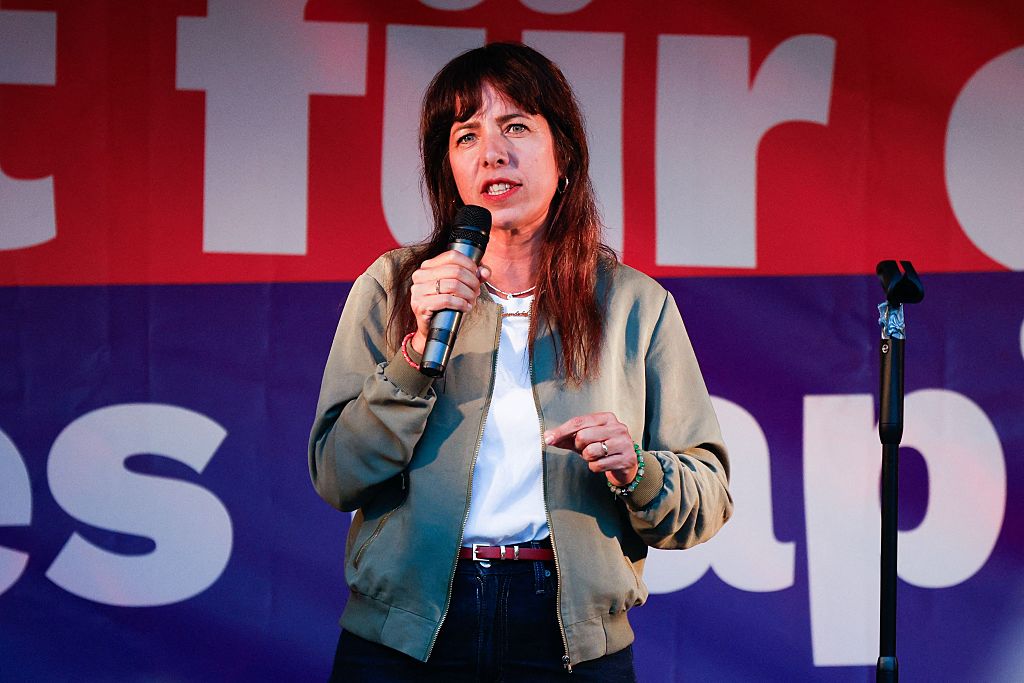
In 2021, Berliners voted to nationalize the big corporate landlords’ housing stock. The ruling parties refused to implement the decision; yet ahead of September’s Berlin election, the issue is pushing socialist party Die Linke to the top of the polls. (Carsten Koall / picture alliance via Getty Images)
On September 20, Berliners will elect a new state parliament in a contest that has already become a referendum on a referendum.
Five years ago, 59.1 percent of the city voted to socialize the holdings of Berlin’s largest for-profit landlords. Following a long campaign to force a vote, the referendum gave a nonbinding but overwhelming mandate to take the city’s housing back under public control. Yet the governing parties never delivered. Now the question of whether that vote will ever be honored is again the defining issue of a Berlin election.
There is indeed hope that it will be honored, because one serious contender in this race is democratic socialist party Die Linke, which is running on a detailed bill that would automatically expropriate any housing company holding more than three thousand apartments in the city, converting roughly 240,000 to 260,000 units into public ownership. It is, in other words, promising to actually do what Berliners already told their government to do in 2021.
Mounting Shortfall
That the city needs such a measure is not seriously disputed even by its opponents. Berlin’s population has grown faster than its housing stock for over a decade, and city estimates put the shortfall at tens of thousands of apartments per year, relative to actual demand.
This gap has persisted under a series of governments, including the current ruling coalition made up of the Christian Democrats (CDU) and Social Democrats (SPD). Its target of building twenty thousand units annually has repeatedly gone unmet. The rents asked for Berlin homes are moving far faster, and have since 2015 risen at one of the steepest rates of any major German city, while wages have crawled forward at a fraction of that pace. The corporations at the center of this fight have not suffered, either. One major landlord, Deutsche Wohnen, alone paid out over €350 million in dividends in a single pre-referendum year — roughly €2,100 per apartment, extracted directly from tenants and routed to shareholders.
The mechanics of that delay are instructive, because they show how a governing class can honor the letter of direct democracy while gutting it in substance. The 2021 vote did not mandate a specific law; it merely instructed the Berlin Senate to “introduce all measures necessary” for socialization under Article 15 of Germany’s Basic Law — the constitutional provision, inserted decades ago at the SPD’s own initiative, that explicitly permits transferring land and means of production into common ownership “for the public good.”
Rather than draft that law, the SPD-led Berlin Senate under then-Mayor Franziska Giffey spent nearly two years commissioning a panel of legal experts to determine whether socialization was constitutional at all. In June 2023, the commission delivered a 150-page report: yes, it is constitutional, and yes, compensation to landlords can legally be set below market value. Giffey never introduced a bill. By the time the report landed, she had already lost the mayoralty to the CDU’s Kai Wegner, whose coalition with the SPD has spent the years since producing a “Socialization Framework Law” (passed this March) that sets out general conditions for future transfers into common ownership, without transferring a single apartment. It does not take effect for two more years, specifically so that the Federal Constitutional Court can first review it.
This is not an accident of bureaucratic caution. Rather, it shows how the SPD — a center-left party formally meant to champion affordable housing — has functioned for years as a brake on this movement.
In the immediate aftermath of the 2021 referendum, the Senate under Mayor Giffey quietly welcomed the merger of Vonovia and Deutsche Wohnen into a single European real estate giant, even as it postponed drafting the socialization law that this same giant was supposed to fear. The pattern is now repeating: the SPD’s top candidate in Berlin for the September 20 election, Steffen Krach, has stated flatly that “there will be no expropriations with the SPD,” even as his own party’s platform pays lip service to the 2021 result. The CDU has been more consistent, if no more sympathetic to renters. Mayor Wegner has said repeatedly that “expropriations cost billions we don’t have” and “prevent the housing we urgently need.” His new lead candidate, Finance Senator Stefan Evers, has called the socialization demand “populist.” What CDU and SPD jointly offer voters, then, is a law engineered to look like compliance with 2021 while functioning as its opposite. There is no automatic threshold for the number of apartments, no timeline that survives beyond a single electoral cycle, and a built-in two-year delay for judicial review that conveniently outlasts the next Senate’s term.
Wegner’s insistence that “expropriations cost billions we don’t have” is not a throwaway line but in fact points out what is really at stake. Under Article 15, socialization is not confiscation. The state must compensate owners, and the size of that compensation is precisely what CDU and SPD have weaponized to make the whole project look unaffordable. The Senate’s administration has floated a compensation level as high as €36 billion if landlords were paid close to market value.
The grassroots campaign that forced the 2021 referendum, known as “Deutsche Wohnen & Co. enteignen,” as well as Die Linke’s bill built on it, reject that premise outright. Their draft proposes paying well below market value — in the range of 40 to 60 percent, disbursed as long-term bonds rather than cash — with some campaign leaders having floated a purely symbolic payout of €1 per apartment. Which number is legally defensible is genuinely contested; the expert commission convened by Giffey concluded that below-market compensation is constitutional but did not fix a figure.
In practice, this arithmetic dispute is the single argument the German right has found durable enough to carry the debate for five years. It claims not that the referendum was illegitimate, and not that housing corporations don’t extract obscene rents, but that any expropriation cheap enough for the state to afford is, by definition, a taking too unjust for a court to uphold. On this reading, any expropriation generous enough to survive a court is, by definition, too expensive for the state to attempt. It is an argument built to make the referendum’s outcome permanently unenforceable, regardless of who wins Berlin’s state election next month.
From New York to Berlin?
Into this vacuum has stepped Elif Eralp, Die Linke’s fortysomething top candidate, whose campaign has explicitly and repeatedly invoked Zohran Mamdani’s victory in New York City. When Mamdani won the NYC mayoralty, Die Linke Berlin posted a video, translated into English, addressed “from Berlin to New York,” and told reporters, “If a leftist can win in New York, he can win in Berlin too.” Die Linke cochair Ines Schwerdtner traveled to New York to watch Mamdani’s campaign firsthand; party officials from Germany joined delegations from France and Britain touring the operation for lessons transferable to their own elections. The parallel is not superficial. Both candidates are children of immigrant families entering city politics from relative obscurity — Eralp’s parents fled Turkey as socialists and trade unionists — running on the explicit promise of a city “you can afford to live in.” Both campaigns center a single, legible demand: rent relief funded by taxing capital rather than labor.
Call it the Mamdani Effect: the sense, newly plausible after last November’s NYC result, that an unapologetically redistributive campaign can win in a global capital rather than merely protest within one. It has measurably buoyed Die Linke’s numbers. Polling this summer has the left-wing party leading or narrowly trailing the CDU, on roughly 20 percent support. It’s a remarkable score for a party that had for years suffered seemingly inevitable decline before a turnaround in the February 2025 federal election. Yet the political upheaval cuts both ways in Berlin, as the same crisis of affordability and institutional distrust that helps Die Linke has lifted the Alternative für Deutschland (AfD) nearly as high, with some polls putting this far-right force within a point or two of Die Linke and well clear of the SPD.
Berlin, a city that likes to think of itself as an island of cosmopolitan tolerance in a country trending rightward, now offers one of the starkest illustrations anywhere of the continent-wide hollowing of the political center: the AfD, formally shunned by every other party as a coalition partner, nonetheless polls as a top-three force in the capital, while the SPD — the party that once defined the city — is down in the low teens.
None of this is happening in a vacuum insulated from federal politics: and here the parallel to New York becomes almost too literal. Just as New York’s political and business establishment mobilized against Mamdani by propping up other candidates, Berlin’s federal government — which is also a coalition of the CDU (plus its Bavarian sister party) and the SPD — moved this July to preempt the entire debate. Its parties agreed to draft a federal law that would bar German states from passing any socialization laws for private rental housing. The stated rationale, familiar from every major city where the ownership class feels threatened, is that even discussing expropriation “damages investor confidence” and “sends a fatal signal” to capital markets — this from an industry that, by its own trade association’s public accounting, invests hundreds of millions annually in “maintenance,” even while the funding shortfall it complains about persists into its second decade. Should that federal law pass before a new Berlin Senate can act, the entire fight over the 2021 referendum would become moot by fiat of Berlin’s political masters, in the same coalition currently running the city.
This is what the September 20 vote is really about. In truth, even assuming that no coalition includes the AfD or Sahra Wagenknecht’s party (hovering around the 5 percent threshold for representation), it is not clear that Die Linke coming in first place would be enough to ensure that it leads the government and enacts its plans. The Greens and SPD, its potential partners in a “red-red-green” alliance, may in any case choose to throw in their lot with the CDU. Ultimately, though, this election is about more than just which party tops the polls and picks the mayor. It is about whether Berlin’s electorate will again have the chance to force the major parties to implement a democratic mandate that they have spent five years slow-walking into irrelevance.
Elites in both Berlin and Washington share the instinct that renters’ rights are negotiable whereas landlords’ property rights are not. In imposing this assumption as unchallengeable, they want to foreclose the whole issue. This is what they must not be allowed to do.