To Win, Germany’s Left Has to Keep Changing Itself
In the 2025 German election, socialist party Die Linke rallied round and defied predictions of its demise. Its membership has doubled, yet the buildup to this weekend’s party congress shows that many older cadres are stuck to the German left’s worst habits.
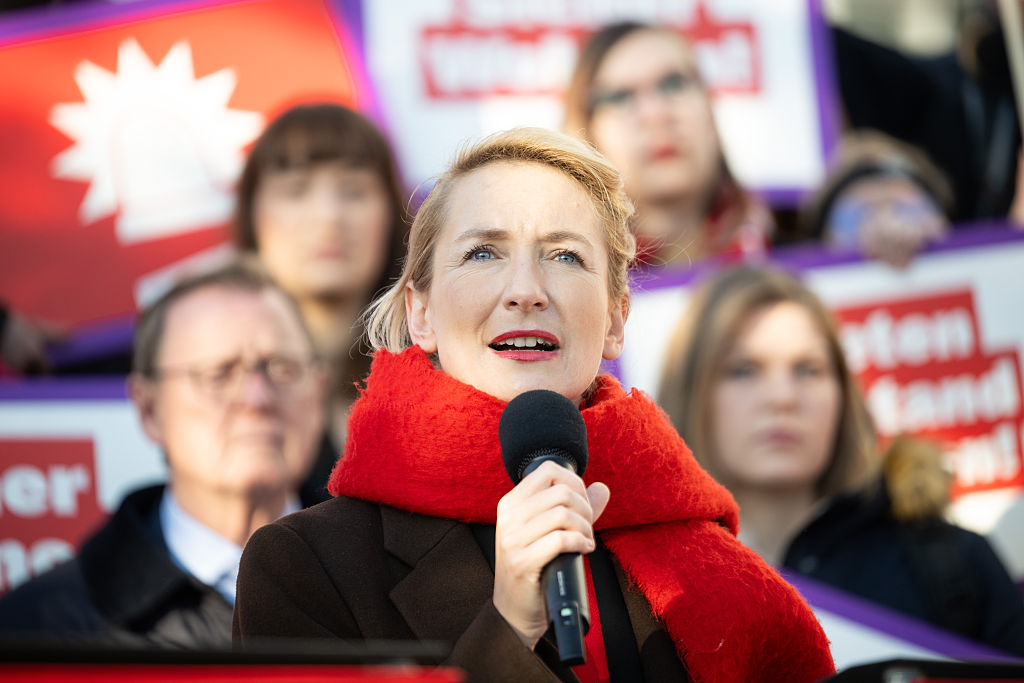
Socialist party Die Linke is a major opposition force in Germany but is far outpaced by the rise of the far right. To resist the rise of the Alternative für Deutschland, it needs to reach new voters and not just the existing liberal-left space. (Sebastian Gollnow / picture alliance via Getty Images)
It’s been nearly two years since Jan van Aken and Ines Schwerdtner — formerly editor of Jacobin’s German edition — took over as cochairs of Germany’s democratic socialists, Die Linke. The duo won a large majority at a party congress in October 2024, arguably less a reflection of their universal support than of the party’s dire state at the time. With its polling numbers hovering at around 3 percent and the breakaway formation Bündnis Sahra Wagenknecht looking set to drive the party out of parliament, no one else seemed up for the job. When snap elections were announced a few weeks later, its fate appeared sealed.
Things couldn’t look more different today, ahead of Die Linke’s party congress this weekend in Potsdam. With a renewed emphasis on economic populism, vastly improved social media outreach and aggressive door-to-door campaigning, the party defied expectations In the February 2025 federal election by capturing a number of strongholds both old and new while more than doubling its membership. Its crop of young, charismatic leaders like Heidi Reichinnek and Schwerdtner became breakout stars online, helping to establish the party as the most popular force among young voters.
The turnaround represents a glimmer of hope in an otherwise grim political climate, as reflected in the slogan “organizing hope.” But hope only gets you so far. Though Die Linke continues to hover at around 11 percent (no small feat for a party that was on its deathbed two years ago), recent state elections saw it fail to pass the 5 percent threshold, its first electoral setback since the federal election, and eerily reminiscent of its string of losses in western Germany in the early 2010s. If that weren’t bad enough, even though the Social Democrats (SPD) continue to bleed support after joining yet another government led by the Christian Democrats (CDU), their decline has merely propelled the far-right Alternative für Deutschland (AfD) to first place in most national polls.
Nevertheless, if Die Linke is stagnating, it does so at a considerably higher level than ever before. Despite that, following a year of internal peace, a number of voices have emerged in de facto opposition to Schwerdtner, who is running for reelection together with MP Luigi Pantisano after van Aken withdrew his candidacy, citing health reasons. The criticisms range from an overly simplistic rhetoric or alleged missteps in foreign policy to broader accusations of consolidating a top-down structure that runs roughshod over democratic debate. While emanating from various corners, the critics have one thing in common: none put forward a comprehensive alternative, as symbolized by the absence of opposing candidates at this weekend’s congress. So what’s the fuss about?
Half the Way With JvA
There is no denying that the path Die Linke embarked upon in late 2024, emphasizing focused campaigning around hot-button issues like rent control and a renewed focus on building party organization at the grassroots level, has delivered results. A relentless focus on affordability and deft use of social media, sometimes faulted as one-dimensional, have established the party as an effective thorn in the government’s side and given it ownership over the issue. The postelection rollout of door-knocking campaigns, also focused on affordability, has helped to direct local activity in an outward-looking direction, albeit arguably at the cost of sorely needed political education.
There is also no doubt that the party is changing as a result. In the eyes of some of its more enthusiastic supporters, the influx of new members means Die Linke has been “de facto refounded,” its potential to become a mass party more palpable than ever before. Still, detractors like Berlin MP Katalin Gennburg deride an alleged “cultural revolution from above” and warn against “narrow dogmatism and ideologization on the back of a renewed and rejuvenated mass organization.”
The presence of thousands of young activists, largely politicized not in the traditional left but in protest movements (or on TikTok), has shifted the tone of debates around issues like Palestine or climate change. The old guard, represented in last year’s campaign by the three “Silverlocks” (so named for their gray hair) Gregor Gysi, Dietmar Bartsch and Bodo Ramelow, no longer enjoy the same level of deference from members, particularly when it comes to foreign policy, where the eastern party’s pragmatic approach clashes hard with the morally charged anti-imperialism shared by many new members.
Further up the ladder, however, greater continuity persists. Rather than a palace coup, the election of Schwerdtner and van Aken represented a genuine team effort — arguably the first in years. It was thanks to the new cochairs’ strategy that the party’s fortunes improved, but everyone could take some credit. Even if only two of the Silverlocks won their constituencies, their faces were prominently associated with the campaign. Existing power centers within the party were integrated as much as possible, simultaneously co-opting them as well as giving them oxygen to sustain future internal disputes. Moreover, as in any political apparatus, most full-time staff are salaried employees with permanent contracts, meaning they carry over from one administration to the next.
Thus, even if Die Linke has grown more dynamic, it is structurally, but also in terms of personnel, largely the same party as two years ago. This now seems to be coming back to haunt the new leadership. Had the party proved less successful last year, the exodus of elected officials that began in 2023 likely would have continued, giving them more of a blank slate to remold it in their image. Instead, with the party’s existence now secured, it seems more than a few functionaries would like to return to business as usual. As sections of the party apparatus chafe against the leadership’s (rather modest) changes and fear the loss of more influence in the future, they haphazardly throw up roadblocks to slow them down, while at the same time being careful not to appear opposed to the positive changes that have already occurred.
Old Wine in New Bottles
Because of this reluctance to appear overtly oppositional, it’s difficult to parse what exactly the opposition’s criticisms of the current leadership are. Yet a narrative has begun to develop, expressed in particularly sharp terms by figures like the aforementioned Gennburg, which faults Schwerdtner’s leadership for importing a centralistic culture that emphasizes disciplined organization over Die Linke’s allegedly more pluralistic traditions. Her oft-cited role models, the Communist Party of Austria (KPÖ) and the Workers’ Party of Belgium (PDVA/PTB), are viewed suspiciously as economic reductionists with a penchant for populist sloganeering. The Democratic Left, a new current that emerged from the party’s old pragmatic wing, goes further, deriding “a rhetoric in which the term ‘class’ is merely a code word for fundamentalism and remasculinization.”
In practical terms, the critiques tend to converge around the mass-scale door-knocking successively deployed in last year’s campaign and since integrated into day-to-day work. No one denies its role in renewing the party’s fortunes, but they insist that the party can’t only knock on doors. At the launch event of a new current called morgen:rot, pieced together from the remains of the now-defunct Movement Left, one founding member explained that the party can’t just knock on doors, but really has to listen. Recently elected MPs Jan Köstering and Donata Vogtschmidt observe in the party’s member magazine Links bewegt that “door-to-door canvassing is a method and not yet a political strategy” — a statement few would disagree with. “The door cannot only be a space of mobilization,” they explain “but the starting point of political strategy.”
What, then, does that strategy entail? That’s where things start to get murky. According to Köstering and Vogtschmidt, “A left-wing party. . . . cannot only formulate slogans,” but “must at all times have an added value for people. It must be useful in the best sense: as a site of solidarity, a tool of political self-empowerment, a bulwark against atomization, organized counterpower and practical assistance in everyday life.” The explanation doesn’t get much more concrete than that, but ultimately they sketch out a political practice that appears more or less limited to parliamentary business and office hours for citizens.
Thus, while criticizing the current leadership for lifting its ideas from other left parties, all the opposition has to offer is what the party has been doing for the last twenty years: a little bit of everything without clear priorities, all in the name of “pluralism.”The problem is that precisely this pluralism is what eroded the party’s base over the last decade. It can be seen in Brandenburg, where after two terms in government Die Linke is no longer represented in parliament, or in Berlin, where only years in the opposition and a pivot toward working with other social movements helped it turn the corner. Even in Thuringia, often held up as a model for success, Bodo Ramelow governed the state for ten years, not without some success — but party activity had withered by the end of his time in office.
Yet this meager balance sheet does not show up in the current debate whatsoever. Instead, intellectuals from the pragmatic wing, like Benjamin-Immanuel Hoff, argue against the vision of a “left-wing cadre party,” contrasting it with a “socialist people’s party,” the contours of which are so vague that one could project practically anything onto it — except, obviously, a cadre party. In terms of medium-term horizons, Jan Schlemermeyer of the Democratic Left puts forward the goal of forming a center-left government. That Die Linke already campaigned on that theme in 2021 with disastrous results gets no mention, nor are we told why it would work better this time around.
The leadership, however, also shies away from open criticism, presumably in order to win over as much of the party as possible. This means that no really open dispute over the correct strategy takes place. Debates are instead conducted in the form of potshots from the sidelines, perhaps leading to a few more compromises over wording at the congress.
Party and Parliament
The real stakes of this weekend’s congress are perhaps best illustrated by what has turned out to be the most polarizing debate, around a proposed cap on parliamentarians’ salaries. Schwerdtner and van Aken led by example, announcing prior to their election that they would not earn more than the average skilled worker. This generated little opposition at first — after all, it didn’t look like Die Linke would be sitting in parliament for much longer anyway — and it made for good PR. But now that the party is back in parliament, a number of functionaries have begun to express their doubts, most notably parliamentary cospeakers Heidi Reichinnek and Sören Pellmann, whose letter to the party executive in April was recently quoted extensively in Der Spiegel. Meanwhile, Bodo Ramelow has repeatedly aired concerns that the rule would violate Germany’s constitution.
Opponents of the cap are keen to insist that it’s not about the money, but about some other vaguely defined issue. “We don’t know any MPs who want to personally enrich themselves with their mandate,” Köstering and Vogtschmidt insist. Reichinnek and Pellmann reassure the party that “None of us want to enrich ourselves with our mandate.” The problem is rather the lack of trust the cap implies. As a socialist, one has to ask: Shouldn’t that be expected of elected officials in a socialist party that seeks to become the political representation of the working class? Moreover, the salary cap proposed at the upcoming party congress is already several hundred euros higher than the €2,850 a month announced in 2024, and contains a number of exceptions for MPs with dependents or other extenuating circumstances. Even after the cap, MPs would earn significantly more than most workers.
So if it’s not about the money, what is it? It seems that for some MPs, the cap symbolizes the parliamentary group’s subordination to the democratically elected party leadership. Since its founding, Die Linke MPs have used their roles in parliament to push back against positions they disliked. None did so as prolifically as Sahra Wagenknecht, who used her perch as parliamentary cospeaker to undermine the leadership of Bernd Riexinger and Katja Kipping and ultimately found her own breakaway party, but she is by no means alone. Ramelow and Gysi in particular have repeatedly criticized their party in the media over the last year, particularly attempts to bring its position on the genocide in Gaza more in line with the international left.
Moreover, even if being a Die Linke MP won’t make you a millionaire, it does provide you with numerous opportunities for networking and personal advancement. No one embodies this better than Andreas Büttner, who repeatedly denounced his own comrades as antisemites before leaving the party earlier this year. After failing to enter the Brandenburg state parliament as a candidate for the Free Democrats (FDP) and working as an office director for the Israeli lobby group The European Leadership Network (ELNET), the erstwhile young conservative decamped to Die Linke in 2015 just in time to get elected, serve as a state secretary in a state government, and ultimately be appointed Brandenburg’s antisemitism commissioner — despite never having been meaningfully involved in left-wing politics.
Büttner may be a particularly egregious example of a bad-faith actor who used Die Linke for his own personal advancement, but there is no reason to think he will be the last. Due to the party’s lack of a binding ideological line, a legacy of its post-1989 “break with Stalinism as a system,” the leadership has few mechanisms to expel members on political grounds. This makes the salary cap all the more important — not only as a symbolic act but also a concrete measure to keep crass opportunists at bay. Whether it passes will be a telling indicator of Die Linke’s trajectory: toward a more unified political force, where parliament and party work hand in hand, or back to the incoherent cacophony that nearly sank it a few years ago?
Compromise Has Its Downsides
The outcome of Die Linke’s congress is particularly relevant given the political circumstances in which the party now operates. Die Linke languished in the 2010s, while many of its European sister parties were racking up historic wins. The 2020s, however, have so far proven to be a much more volatile time in German politics. Ongoing price rises, threats to the country’s industrial sector, and not least Chancellor Friedrich Merz’s mounting attacks on the welfare state are feeding what could be described as a delayed populist moment, some ten years after its initial peak. Trust in the mainstream parties has reached historic lows, a situation from which primarily the populist right tends to profit. Reversing that trend is the key challenge for Die Linke.
If the left-populist experiments of the previous decade can offer Die Linke any strategic lessons, then these are probably in what not to do: namely, prematurely form a center-left government following an electoral fluke. Whether in Greece, Spain, or Portugal, the far left — even in cases where the government delivered real improvements — soon saw its support dip, as voters either returned to traditional social democracy or abandoned the Left entirely. Lacking durable structures outside of parliament, parties like Syriza and Podemos are now on organizational life support and electorally largely irrelevant.
The fate of Europe’s left governments suggests that, at least for now, the primary focus of the Left should be less on the details of parliamentary procedure than on the building of an opposition movement capable of harnessing the populist mood and channeling it in a progressive direction. The oft-cited example of Belgium’s PTB, or even France Insoumise, show that this can be done. Though neither command something like a popular majority, they have gradually built up their forces to the point that they now pose a real threat to the political establishment.
The critics of the current leadership are right about one thing: Die Linke will not be able to import winning formulas from abroad wholesale. Like all large organizations of a certain age, it has too much of its own history and traditions that inevitably influence its strategy. They’re also right when they say that there are no clear-cut recipes for what a future socialism will look like. But in reality, no one is claiming otherwise. Die Linke’s cochairs consistently strive to include the party’s various currents and situate their policies within party traditions. The choice facing Die Linke today is therefore not between a communist cadre party and democratic socialism, but rather whether to continue the (successful) strategic consolidation of the last year and a half.
So far the leadership has managed to pursue this consolidation without alienating significant portions of the old guard. But if the debates in recent weeks are any indication, there will be many contentious issues after the party congress that will require clear answers. Does it primarily see the Social Democratic Party (SPD) and Greens as political competitors to be overtaken, or as partners in a “progressive” or even “anti-fascist” government? Are working people mostly seen as potential voters or as the core of party building? On what basis should Die Linke politically train its tens of thousands of new members and form a coherent identity?
So far the answers to these and other critical questions are vague outlines at best, due at least in part to the compromises on which the party’s current strategy rests. If the current path is to bear fruit in the long run, however, there will sooner or later have to be an open debate and, above all, a deeper vision of what a socialist party can actually achieve in a capitalist democracy — and how.