First We Took Manhattan, Then We Took Berlin

On Sunday, Germany’s socialist party Die Linke won the Berlin elections for the first time. Like New York’s Zohran Mamdani, it beat the establishment parties by offering Berliners concrete action on rents and the cost of living.
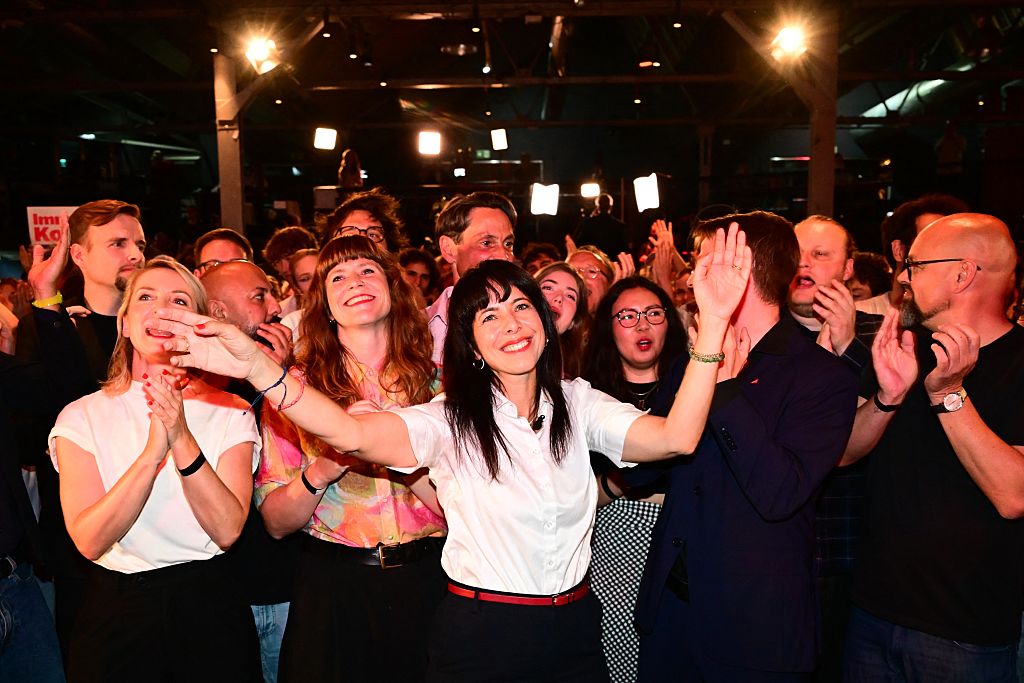
Elif Eralp (Die Linke), the party’s lead candidate and deputy chair of the Left Party caucus (M), waits with supporters and party members at a Berlin Left Party election party in the Kreuzberg Ballroom for the projected results of the House of Representatives election on Sunday, September 20, 2026.

Germany’s socialist party Die Linke came first in Sunday’s Berlin election with a huge vote among young Berliners and the multiethnic working class. Now its lead candidate, Elif Eralp, hopes to become Berlin’s new mayor. (Sebastian Gollnow / picture alliance via Getty Images)


Ok, Berlin doesn’t have a socialist mayor quite yet. But left-wing Die Linke, which won Sunday’s Berlin state election, is in a strong position to lead its next government. Even as the far right rises across Germany, Die Linke has distinguished itself with a strong stance in defense of multiethnic society and a constant focus on the cost of living and housing. For this, it was rewarded by many Berliners.

The result is vindication for a party which was on life support just two years ago, after messy internal conflicts. Many of the conditions for its growth were already then in place. Berliners had long seen their rents rising; the establishment center left has for decades cut back social protections and labor rights; the call to mobilize against rising nationalism is hardly new either. Yet only more recently has Die Linke become an outward-facing force, able to galvanize resistance to the current reactionary drift in German politics.

Die Linke’s campaign centered on the cost of living and specifically on rent. West Berlin was historically cheaper than the Federal Republic’s main cities, and even after reunification the capital boasted much empty space. Yet the sell-off of the public housing stock to private profiteers in the 1990s–2000s, plus a lack of new builds, has pushed up costs. While Berliners voted in a 2021 referendum to renationalize the housing stock, the city government didn’t make good on the result. In this election, Die Linke promised that it would do so.

Getting coalition partners to agree may be tougher. The previous “red-red-green” coalition in 2021–23, where Die Linke and the Greens backed a government headed by centrist Social Democrat (SPD) Mayor Franziska Giffey, didn’t deliver. Indeed, polls suggest Die Linke’s success on Sunday owed much to broadly leftish Berliners moving across from the Greens and SPD, as well as to first-time voters. If it’s easy to imagine Berlin as a progressive fortress, in fact all these parties added together only cornered 52 percent of the vote.

Shifts within this electorate were important. Germany’s softer-left parties have routinely governed with conservatives, today subordinate budget policy to military spending, and side with Israel. Die Linke has done better than these nominal progressives in defending basic humanitarian principles. No wonder it scored massively in a multiethnic district like Neukölln 2 (on 53 percent) and among all twenty-five-to-thirty-four-year-old Berliners (48 percent). This stand, too, explains the renewal of its activist base over the last couple of years, and its ability to become an attractive force speaking to a broad electorate.

Government Setback

Die Linke was among the favorites for Sunday’s election, but its result surpassed all the polls. Headed by mayoral candidate Elif Eralp, it took 26 percent of the vote, more than doubling its score in the previous contest in 2023. The incumbent coalition was punished, as the conservative Christian Democrats (CDU, 19 percent, down 9) and center-left SPD (12 percent, down 6) each shed votes.

The CDU-SPD duo, which also heads the current federal government under conservative Chancellor Friedrich Merz, is slumping across Germany. Beyond Merz’s tone-deaf comms, his government’s promises lack broad appeal: he pledges to raise the pension age, to increase copayments on prescription drugs, and to compete with China by cracking down on sick leave. Previous talk of revitalizing the economy through the green transition has now faltered.

This is part of a broader, structural decline of what were once called mass parties. While throughout postwar decades up until the 2008 crisis, these two forces rallied the large majority of Germans, today not even one in three voters support either of them. A parallel contest yesterday in the northeastern state of Mecklenburg-Vorpommern saw Merz’s CDU fall under 5 percent support, thus failing to reach a state parliament for the first time in the Federal Republic’s history.

The main challenge to these parties at the federal level is the far-right Alternative für Deutschland (AfD). In Mecklenburg-Vorpommern, it edged out the ruling SPD for first place, with 38 percent of the vote. This is the AfD’s third state election win thus far, but it has yet to take power anywhere, and the SPD will probably cling on in this northeastern state. The nationalist party’s better chance of forming a government is in Saxony-Anhalt, where it scored a more emphatic victory in the September 6 election. While the AfD’s highest percentage ratings are in the former East, and yesterday in Berlin it was third-placed at 16 percent (plus 7, compared to 2023), most federal-level polls have it around 30 percent, easily the largest party nationally.

Worryingly, while many far-right parties around Europe have eked out successes in the context of falling voter participation, this is less true of the AfD. Some recent state elections have seen it rack up an outright majority vote among new voters, and yesterday’s elections saw turnout greatly increase. The AfD vote is strongest in rural areas and small towns; among young-to-middle-aged men; and among those who say they’re struggling financially. But even in Berlin, it was first-placed among blue-collar voters, on 30 percent, compared to 26 percent for Die Linke. While other parties still refuse to govern with it, there is no doubt that the AfD’s melange of nationalist identity politics, pro-family welfare measures, and tax cuts — plus an end on sanctions on Russia — has enthralled large sections of German society.

Next Steps

Die Linke again represents a hopeful force in German politics, and current federal-level polls have it at around 12 percent. Still, while its popularity is rising across voter groups, and it is becoming more competitive in western states, it is not yet able to compete with the AfD across Germany as the main opposition force. While in the 1990s–2000s Die Linke’s forebears often racked up huge scores in small-town Eastern Germany, protesting the effects of deindustrialization, its support there is now far patchier, while the far right has gained.

In the United States too, socialists have faced the question of how to do more than rally support in the most strongly Democratic, urban districts, and beyond New York. This was the reason for Bernie Sanders’s recent Fighting Oligarchy tour: refusing to write off whole areas as innately conservative, the Vermont senator spoke up for the power of working-class solidarity and government action. Yet making this message convincing across America also relies on socialists who win election anywhere achieving real, generalizable results.

In Berlin, this may be difficult for multiple reasons. First, it is not yet clear whether the Greens and Social Democrats will support Die Linke’s Eralp as mayor or will instead rally behind the conservative CDU. Last night, the Green coleader said her party would not govern with “antisemites from Neukölln,” in a barely veiled attack on the Turkish and Palestinian populations of a southeastern Berlin district where Die Linke scores strongly.

The Central Council of Jews in Germany has warned against such a coalition. Reckless talk of a left-wing danger to Jewish life in Germany — hung on such heinous crimes as a rapper chanting “Yalla, yalla intifada” and “Death to the IDF” at a preelection rally — is today rampant. Even on Israel, much of Die Linke makes only liberal-Zionist type criticisms of Benjamin Netanyahu, and it has punished members who expressed solidarity with Palestinian armed resistance; Eralp herself criticized the chanting at the rally. Yet German centrists readily use antisemitism claims as a polemical cudgel to demonize Die Linke and its — especially Muslim — electorate.

Even if Die Linke manages to lead a “red-red-green” coalition, it won’t be easy. The Social Democrats have refused to implement the result of the 2021 housing referendum and are part of a federal-level coalition that has suggested banning such nationalizations. The historic soft-left party lost badly on Sunday but could put up resistance within the Berlin government. We can likewise expect a trickle of allegations and exposés designed to paint Die Linke as “Stalinist” or “antisemitic” and to force it onto the defensive. Yet we already saw such smears fail to defeat Die Linke on Sunday. And the referendum already showed that on housing nationalization, most Berliners are on its side.

Not everywhere is Berlin, and not everywhere in Germany is rental housing the main issue. In Mecklenburg-Vorpommern — a much more rural and less-populated state, in which Die Linke currently supports an SPD-led government — it actually shed votes to this center-left party, which appeared best-placed to stop the AfD. In this sense, even this historic victory in Berlin is just a further milestone in Die Linke’s bid to become a national force that can win round old voters and galvanize new ones. Ultimately, defeating the AfD will rely not just on rallying all other parties against it but on convincing more millions of people, across Germany, that a practical, socialist alternative is better.