Die Linke’s Fight to Win Back Working-Class Germans
Last year’s elections saw a resurgence for Germany’s socialist party Die Linke. In an interview, coleader Ines Schwerdtner explains how the party is seeking to expand beyond current left-wing voters to reach broader parts of the working class.
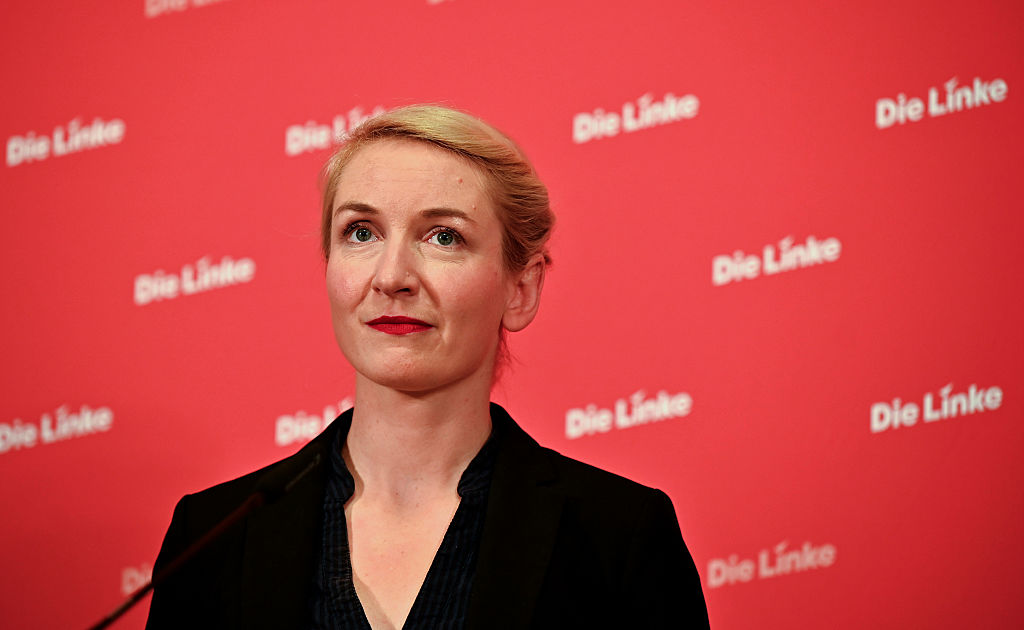
Jacobin spoke to Ines Schwerdtner, coleader of Germany’s socialist party Die Linke, about Chancellor Friedrich Merz’s rearmament drive and the Left’s foreign policy in an age of disastrous wars. (Katharina Kausche / picture alliance via Getty Images)
- Interview by
- David Broder
The night of last February’s German election, Christian Democratic Union leader Friedrich Merz said that Europe had to become more “independent” of the United States. The year since has shown that he meant this in rather narrow terms. His government has pledged massive military spending in order to boost Europeans’ role in NATO — even lifting Germany’s constitutional “debt brake” in order to allow this — while also kowtowing to Donald Trump’s leadership.
Yet Merz’s position is hardly strong. His grand coalition government — uniting his conservative party with the Social Democrats — is today rivaled by the nationalist Alternative für Deutschland (AfD), today in first place in many polls. It combines chameleonic economic positions with a strong anti-immigration line and may win power in some states for the first time in 2026. But there are also other sources of dissent in German society, not least popular skepticism toward rearmament and war.
For socialist party Die Linke, there’s an urgent fight to form an alternative, left-wing opposition. It made a good start in last February’s election, where — despite widespread precampaign expectations that it would fall out of the parliament (the Bundestag) — it nearly doubled its score. Not only did it increase its number of MPs, but in 2025 its membership soared from under 60,000 to over 120,000. It’s a step toward not just better election results but rebuilding its presence in working-class communities.
One of the architects of this success was Ines Schwerdtner, a former editor of the German version of Jacobin, the coleader of Die Linke, and a member of the Bundestag. In an interview, she spoke to our Europe editor David Broder about the Merz government’s rearmament push, German attitudes toward war in Ukraine and the Middle East, and whether Berlin’s coming city hall elections can see the same advances for democratic socialists as New York.
The night of the 2025 election, Merz said that Europe had to become more independent of the United States. The coup in Venezuela and threats to Greenland recently revived this discussion of “strategic autonomy.” Some on the Left discuss this in terms of European rearmament and security. How do you see this?
Even the most Atlanticist conservatives in the Merz camp today think they can no longer depend on NATO and the US. We on the Left always said that we need a security system that is not dependent on NATO. But this also meant a security system that involved Russia. What we’re discussing now, in our party’s programmatic process, is how you can have a security system that isn’t about becoming an imperial force, akin to what maybe Emmanuel Macron would suggest.
We need to work with other left-wing parties in Europe to fight against this building up of the European Union as another global military power, even if obviously a weak one compared to the United States and China. As my party colleague Jan van Aken said, Russia will always be on the map next to us. So, even though it sounds completely off to talk about a security system with Russia, this is what needs to be talked about, after the war in Ukraine. What comes next? This is the trickiest question we face. We just published an article together suggesting that the socialist left should seek a new form of internationalism, building alliances with countries from the Global South and other midsize powers.
European leaders are still running behind Trump on peace proposals for Ukraine. Merz suggested the possibility of German peacekeepers after the ceasefire, but this hardly seems a realistic prospect. The kind of deal being suggested by Trump sounds like a carve-up of territory. What peaceful solutions can the Left credibly offer?
We’ve always maintained that a peaceful solution relies on the whole international community — also with the United Nations and Global South countries like China, Brazil, and India. Most important of all is that there is no deal made over the heads of the Ukrainians. Any peace must be one that is socially sustainable — a just peace. That also means that Ukraine needs reliable security guarantees. Proposals for European and especially German soldiers to be sent and confront Vladimir Putin, however, do not seem to help with peace negotiations. This was also why previous chancellor Olaf Scholz was a little more hesitant than Merz is now. On the European security structure, we discussed focusing on the Organization for Security and Co-operation in Europe (OSCE), as something that is not NATO or a European military power or army but that could serve as a starting point.
Germany isn’t directly joining the war on Iran, but Chancellor Friedrich Merz made clear his support for it. Much German media tells a strongly pro-war narrative, and yet a poll suggested Germans are against this action. Meeting Merz last week, Trump also damned Europe, especially Spain, for not being even more compliant. What should the German government do?
The fact that Merz sits next to Trump and smiles while another European country is being threatened is scandalous and spineless and dangerous — something that cannot be said of Spain’s prime minister, Pedro Sánchez. Sánchez and his center-to-left-wing government were already right in their assessment of the US actions in Venezuela, and they are right again now in the case of Iran.
Here it is important to recognize that one can wish this brutal regime to end and still acknowledge that the war of aggression launched by Israel and the United States is absolutely contrary to international law and only for their own power interests.
Germany and Europe must under no circumstances allow themselves to be drawn into this conflict and should instead support the democratic opposition in Iran. As Sánchez did, Germany must oppose a German military base like Ramstein being used for this war. Just like in the first months of the Ukraine war, we must also focus on the rising energy and food prices caused by the war. We need to quickly present instruments that can curb prices and prevent an inflationary shock.
Germany and the EU are rearming, and this appears to be outstripping the green transition as a focus of EU economic policy. You voted in the Bundestag against the government’s lifting of the debt brake (Germany’s constitutional limit on borrowing) for military purposes. Some left-wingers, however, argued that your representatives in state governments could have done more to block the change and disrupt the process. Couldn’t Die Linke have stopped it — and why didn’t it?
The government parties knew after the federal election that the Alternative für Deutschland (AfD) added to Die Linke had the numbers to block a constitutional change. So, they relied on the outgoing parliament to push the change through. We went to the high court — twice — to try and stop that. Federally, we did everything we could to block the lifting of the debt drake. However, the debt brake was negotiated and voted on as a package, and the opening up of military spending came with investments of €500 billion in infrastructure. So, even though we on the federal level blocked it, two states where Die Linke is in government voted for it in the Federal Council, even though their votes would not make any difference. I still feel this was a mistake.
The Greens agreed to lifting the debt brake even in the Bundestag, and I was sharply critical of them, because this was like opening up Pandora’s box. It’s the worst of both worlds, since we still have the debt brake pressuring the overall budget, especially social security, plus this endless militarization. The German debt brake was always horrible, also as a role model for European debt rules, and now it’s even worse. I sit on the Bundestag’s Budget Committee, and you can see how it can push through billions for militarization within seconds, while also forcing cuts in Bürgergeld (welfare benefits). You see how dramatically overstated the discourse about public spending is when there’s no debate at all about how much should go to the military budget. The NATO goal of spending 5 percent of GDP on the military goes undisputed. So, I think this was a historical moment where we could have pushed for a major reform of the debt brake without prioritizing military spending, but since the Greens backed it, we couldn’t stop it.
You have backed Isabella Weber’s call for an “anti-fascist economic policy.” What does that involve? What might different policies on things like benefits or infrastructure actually do to affect the AfD vote?
Isabella coined that term right after Trump won the US election, saying that Democrats failed because they did not fight inflation and the rising cost of living for working families and ordinary people. She rightly also said that there’s a deeper insecurity that people feel: Is the state working? Is infrastructure working? Do you have control over your life? The Democrats did not really see this deeper feeling. I think you could also use this in the German context, even though obviously the rise of a far-right party like the AfD also involves many issues, notably migration.
Still, we know from historical studies like Clara Mattei’s work that austerity always paved the way to far-right takeovers. So, “anti-fascist economic policy” is a term to refer to the value of policies like fighting high rents and introducing price controls, to give people some sense of security back. I use the term — and really it’s more of an analytical term for left-wingers than something you’d say going door-to-door.
Sure — we had a perfect moment [during the buildup to the 2025 election] when Die Linke’s Heidi Reichinnek spoke out for anti-fascist values, and this helped us take the moral high-ground: we are anti-fascists. But even then, you still need to organize around the insecurities that most people face. In the long run, you need an economic policy that really gets to the root causes. That means stable and working infrastructure, childcare, trains, people being able to pay their rent and not fearing losing their jobs. The Left has perhaps forgotten about that, but focusing on these bread-and-butter issues really helped us in the campaign.
I’m interested in what that means for your party organization. Die Linke beat expectations in the 2025 election, massively grew its membership, and has polled higher ever since. Some accounts, like sociologist Klaus Dörre’s, say Die Linke has made itself the party of the new, progressive, urban working class and also a space for the left-liberal, intellectual middle classes in a way that wasn’t true before.
Still, this is surely different from a left-populist strategy and is perhaps also bound up with the terms of Die Linke’s recent dispute with Sahra Wagenknecht. You’re a former Jacobin editor and have often cited the example of the Belgian Workers’ Party, who frequently say they want to organize the breadth of the working class; what you said about the anti-fascist economic policy might also seem more aimed at winning voters where the AfD is doing well, perhaps in more rural areas. How do you see Die Linke’s way through these questions?
I think this is our most important strategic question now. In the election, we won a lot of young women and gained among a more middle-class, progressive milieu previously attached to the Greens and Social Democrats. We also gained among rather more traditional kinds of workers and precarious groups, but surely not as much as I’d have wanted. This was always the base of the [1990s–2000s] Party of Democratic Socialism and then of Die Linke — an urban, intellectual, middle-class group and then also working-class people disaffected [from the Social Democrats and Greens] after the Agenda 2010 [neoliberal welfare reforms, cutting benefits].
There are left-wing parties in other European countries too who have activists with a lot of time for politics but also want to become workers’ parties. This demands building structures in companies and on the shop floor, but this takes a lot more time than winning progressive voters. I wouldn’t call them “progressive parties,” but surely it’s easier to interchange votes [with Social Democrats and Greens] than shift the overall balance in society. But we need to expand the social base for people who feel the need for a socialist party.
There are two things that have changed in Die Linke. First, we’ve focused on bread-and-butter topics, which often also affect the “progressives” — and even if they aren’t low-income themselves, even middle-class voters like us helping people on issues like heating costs. On these same topics, we can also reach more “antiestablishment” nonvoters and people who might even vote AfD.
From the Belgian Workers’ Party, we also took this different style of left-populist narrative: tax the rich, even things that Bernie Sanders or Jean-Luc Mélenchon would say. So, we have a mix of influences from the Party of Democratic Socialism and the West German Labour and Social Justice – the Electoral Alternative (WASG) rooted in the labor unions organizationally, and what more traditional Marxist parties do, and some features of left-populist parties in Europe. I feel drawing on these different roots has shaped our successes. Still, the base remains fragile, and we can’t be like the ones in the “Three Little Pigs” with a house that can be blown away by the wind. We have to build a stone house that is solidly rooted in neighborhoods and workplaces. I think that’s what has to be done to become a workers’ party. But as [the Belgian Workers’ Party’s] Peter Mertens tells me, that’s a job for ten years; it can’t be done overnight.
But having already had this influx of especially young women voters and new activists into Die Linke’s ranks over the last year, has this forced a change in the party culture?
The infighting with Wagenknecht’s people — on migration but also on how to talk about the working class — was always destructive. Yet the younger members who weren’t there are free from this trauma: they didn’t experience years and years arguing about class politics versus identity politics. Now we say we’re doing class politics, and no one is questioning this: everyone thinks, well, of course we focus on rent because this is for the social majority. They don’t see it as an internal battle, as it was before.
So, I feel like these new members bring a different mood, and they take it as normal that we go door-to-door to talk to people. It’s clear: the working class is diverse. We speak to a migrant, female nurse as a worker, as we would do to a male dockworker. Ironically, in the clash between class and identity politics, it was only after Wagenknecht left that we could really focus on class.
We now have workers here in the parliament. It makes such a difference, if you have a steelworker or someone from the car industry or a nurse. They really shock the other [MPs] because these workers say, the steel from the Bundestag, that was made in Duisburg — we built this! This is a whole other way of talking about class, in terms of working-class pride. Sometimes they scream and shout in parliament — it’s said they don’t behave well. But what is “behaving well” when you’re sitting next to Nazis? So, I see a lot of change in the party and in how we do class politics.
There’s also been conflict in the party about Palestine. At a demonstration in Berlin in September, you as a leadership started to refer to genocide in Gaza and somewhat apologized for not saying that before. Still, there’s still a lot of disagreement both in Die Linke and in the Palestine movement about what your position really is. Has Die Linke’s stance actually changed since then?
I would say so, because the reality in Gaza broke in and no one could neglect it anymore. Many new members, including a lot of young people, have been politicized and radicalized through the war in Gaza. Some would say it is like the Vietnam moment or the Iraq War for us.
I feel like this war has definitely radicalized many people inside the Left, and that has changed the way we talk about Palestine. Our work in parliament changed completely, because we were the only ones talking about the reality in Gaza while other parties did not. We have had to move in baby steps, while the international left was far ahead, fighting the German media and other parties. And yet when large parts of the German public were silent about Israel’s war, we realized we had the majority, common sense, and humanism on our side.
Pressure from Palestinian communities also mattered, and it came for good reason: we had not done enough before. All these factors changed the party position: now a big majority shows more solidarity with Palestinians, while also condemning antisemitic attacks on the streets. Both need to be done at the same time. A lot of frustration is still being projected onto us, which I understand. Still, I feel we made a big step closer to the international left in this sense.
Looking at the German state elections slated for 2026, in Saxony-Anhalt the AfD is extremely strong. It came first in last February’s federal election, is polling up to 40 percent, and could reach government. I saw an interview with your Die Linke colleague Jan van Aken where he said he didn’t imagine going into government with the Christian Democrats to stop the AfD . . . and yet there’s also the possibility of tolerating a bourgeois government to keep out the far right.
This creates a classic conflict between your antiestablishment approach and then siding with anyone who might help block the AfD. Is there any way of breaking out of this kind of lesser-evilism or even finding some leverage in this situation?
This situation in eastern Germany is very much on our minds. In either Saxony-Anhalt or Mecklenburg-Vorpommern, the AfD could be the strongest party and even govern alone. That’s not just a strategic question but a historic problem, and I think if that happens we’ll be faced with a very different kind of situation.
To prevent that, we need to look closely at what’s happening locally. I think in Saxony-Anhalt, we’re now the only progressive force, and the Social Democrats and Greens could fall out of the state parliament. The conservative Christian Democrats are thinking more about how to work with the fascists than with Die Linke. I think this is pretty clear. We shouldn’t be naive or begging them to work with us.
Die Linke tolerates Christian Democrat–led governments [with Social Democratic support] in Saxony and in Thuringia, and that’s already complicated. The party accepted some cuts and also gained something. But this is the situation around eastern Germany. It’s not completely new. The new change this time is that the AfD may be able to govern alone. I feel that the Christian Democrats may break [their previous stance against allowing the AfD to govern]. And I’ve told comrades: Look at Austria, look at other European countries [where conservatives allied with the far right]. Give me a reason why conservatives here are going to act any differently.
I think what we can do is win some electoral districts, “red” lighthouses in the ocean of black and blue [conservative and AfD colors], and show people that you can win against the Right, appealing to activists in the party and on the broader left, like I did in my federal election campaign in Lichtenberg [eastern Berlin, unexpectedly defeating the AfD]. We can do the same kind of campaign now in Halle and Magdeburg and some other smaller cities. That means showing you can defend civil society and migrants and queer rights but also going door-to-door to show we are the social alternative to all that [far-right] bullshit. We are the anti-fascist party, but we also are the party of the people, bringing concrete help.
In Mecklenburg-Vorpommern, it’s a bit different because we’re in competition with the Social Democrats but also in government there. So, we are defending what we achieved before, like free childcare and expanding kindergarten. I know when Zohran Mamdani does it, it’s almost a revolution, and when Die Linke does it in eastern Germany it’s seen just to be normal! In Greifswald and Rostock, for example, we have some concrete wins that we’re mobilizing for, rather than just saying we are against the Right.
We aren’t just defending democracy as an abstract term, but defending our cities and our societies, our neighbors. This also means bringing some of our young activists from western Germany to come to these cities doing canvassing, talking to as many people as possible.
You mentioned Mamdani. You visited New York City ahead of the election, saying you wanted to learn from the campaign. What exactly could be learned? Is there anything about the Mamdani campaign, politically or from the get-out-the-vote operation, that gives international lessons?
We knew the playbook before: the canvassing, the bread-and-butter issues, and the mobilizing efforts that we also used in Germany in early 2025. Still, I thought: this is a different type of campaign, because it was so professionally planned. And I think Mamdani masterfully communicated his political messages. It’s also changed the way we discussed our upcoming campaign in Berlin, with this kind of confidence.
Ironically, when we were in New York City and Democratic Socialists of America (DSA) comrades asked us, “What’s it like governing in a major city like Berlin?”, I had to reply that it can also go wrong, and you shouldn’t make the same mistakes that the Left did in government in Berlin. So, I felt like this is more like a back-and-forth of learning from each other. It’s not that the American left does everything right. . . . It’s a kind of sentiment we heard sometimes when we started Jacobin’s German edition, like presenting Bernie as perfect and dismissing the German left as disastrous. Certainly, Mamdani did it way more professionally and aesthetically better, but I think we have some experiences in governing and building the party that may also help American comrades.
For Mamdani, there’s a certain balance between the democratic socialist rhetoric and policy wins, including through how he manages city hall’s relationship with Kathy Hochul. After the Berlin state election in September 2026, there’s some possibility of another government that has Die Linke in coalition with Greens and Social Democrats. Many of our readers will know about the campaign to expropriate the big landlords in Berlin and the referendum vote for that . . . which was never delivered. How does that figure in the Berlin election?
That’s also what I realized in New York, that we are in a completely different state when it comes to this kind of policy.
Freezing the rent is what we [had first] tried in Berlin when Die Linke was in government and was responsible for housing. The rent freeze was stopped by the Federal Constitutional Court, because you could only do that on a federal level. So, the next step was the move to expropriate and socialize [the big landlords’ holdings]. This is a major attack on huge companies and capital.
I don’t want to play down what Mamdani is up against, and it’s huge for New York politics. But in Berlin, we face a big struggle over socialization. We need to be using every lever that we can to push on the budget and on rents to make the city affordable again.
The paradox is that, compared to five or ten years ago, we as a party are stronger, but the budget situation is worse, and people’s expectations are higher after the referendum vote. So, after September’s [Berlin elections], we have a whole fight ahead of us.