Under Trump Pressure, Bolivia Arrests Its Own Attorney General
After opening an investigation into political strategist Fernando Cerimedo, “MAGA’s man in Latin America,” for attempted femicide and drug ties, Bolivia’s attorney general was arrested by his own government. Even the vice president now fears for his life.
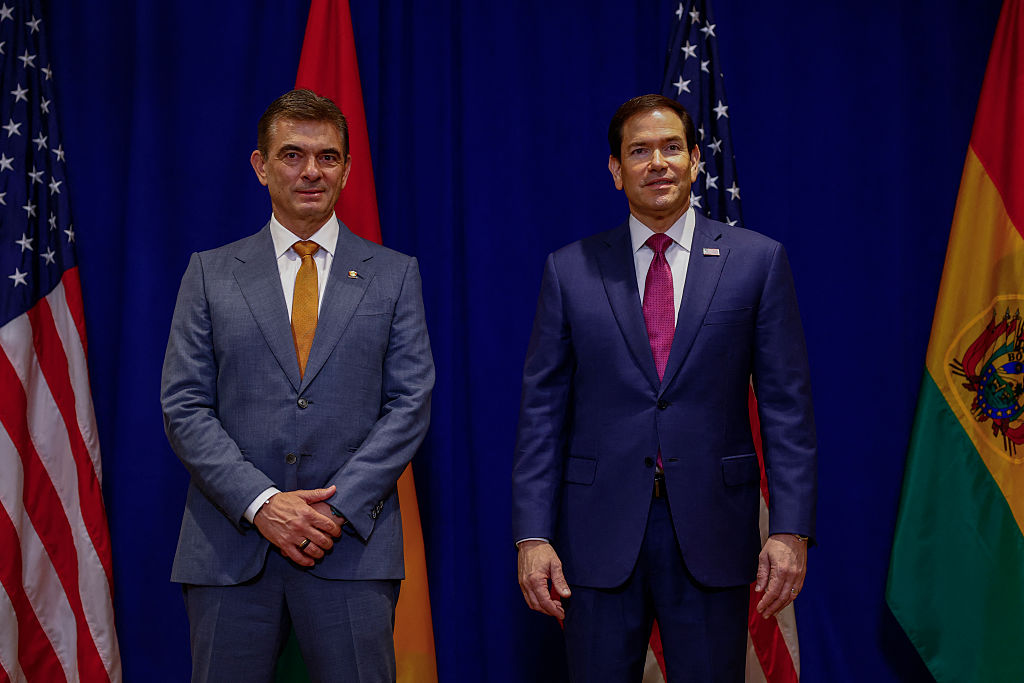
Bolivian President Rodrigo Paz meets with US Secretary of State Marco Rubio on the sidelines of the 81st United Nations General Assembly in New York City on September 21, 2026. (Jeenah Moon / Pool / AFP via Getty Images)
Early last week, the Trump administration’s State Department announced visa restrictions on a group of Latin American officials it accused of corruption and of “undermining democratically-selected governments.” Of the twenty-one people it targeted in Bolivia, Washington chose to name only one: Bolivia’s sitting attorney general, Roger Mariaca.
A little over twenty-four hours later, on September 30, Bolivian police detained Mariaca at Viru Viru International Airport in Santa Cruz while agents raided prosecutors’ offices in Sucre and Santa Cruz. He was taken without a warrant before the legislature had taken any steps to remove him from office, as required by the constitution and, as the government itself later acknowledged, with intelligence supplied by the US Drug Enforcement Administration (DEA), an agency with a particularly sordid history in Bolivia. It looked like an order sent straight from Washington.
“The arrest of Bolivia’s attorney general just after the US rescinded his visa,” journalist Benjamin Swift, based in La Paz, told Jacobin, “is a clear signal of the United States’ growing influence in Bolivia.”
At the time of his arrest, Mariaca was investigating the far-right Argentine political operative Fernando Cerimedo, “MAGA’s man in Latin America,” who was arrested just over a month prior at the same airport while attempting to flee to Buenos Aires. Cerimedo was taken in for allegedly ordering a hit against his pregnant partner, the lawyer Nadia Beller, who survived the attack by two gunmen outside a Santa Cruz hotel. Mariaca’s office soon also began digging into Cerimedo’s alleged ties to drug-trafficking networks.
Cerimedo, who has close connections to Donald Trump’s innermost circle, has reportedly had a hand in virtually every recent far-right electoral victory in the region, including that of Javier Milei in Argentina, José Antonio Kast in Chile, Nasry Asfura in Honduras, and Abelardo de la Espriella in Colombia. He was also deeply involved in the disinformation campaign that claimed the 2022 Brazilian election was stolen from Jair Bolsonaro, crafting a narrative that — as Sunday’s first-round election results show — continues to sway voters. In Bolivia, he was not only a strategist in right-wing President Rodrigo Paz’s campaign but became one of his top aides once in government, holding his own office in Bolivia’s presidential palace.
After Cerimedo’s allies arrested Attorney General Mariaca, US Secretary of State Marco Rubio signaled the White House’s involvement and support, declaring that the Trump administration “stands firmly” with President Paz as his government takes “bold and decisive actions to combat narco-trafficking, systemic corruption, and transnational organized crime.”
Attacking the Judiciary
Mariaca was arrested along with thirteen others from the Public Prosecutor’s Office and the justice system, including Santa Cruz departmental prosecutor Alberto Zeballos and prosecutor Martín Irusta, in a direct attack on Bolivia’s judiciary. Former socialist President Evo Morales called the operation unconstitutional and accused the DEA, banned from the country until recently for its meddling in politics and involvement in cocaine trafficking in Bolivia, of running it.
President Paz’s minister of government, Marco Antonio Oviedo, who oversees the police, pointed to Mariaca as the leader of “a criminal organization embedded in the justice system and in the administration of a very important institution in our country, the Public Ministry.”
“Either you stand with the law,” Oviedo said, “or you stand with crime, with narcoterrorism” — a term borrowed directly from the Trump administration.
The day before his arrest, Mariaca publicly attributed the initial US sanctions against him to his office’s investigations into Cerimedo and the gasolina basura (junk gasoline) case over contaminated fuel imports. There have been massive fuel shortages in the country since the president slashed fuel subsidies, hitting the poor the hardest. “We know the work we have been doing has not been to the liking of certain political sectors, both outside and inside our country,” Mariaca said.
“The timing of Mariaca’s arrest is alarming,” Thomas Becker told Jacobin. Becker is an international human rights lawyer who led the landmark US civil case that found former Bolivian President Gonzalo Sánchez de Lozada (1993–97, 2002–3), a close Washington ally, liable for extrajudicial killings.
“The US is meddling in Bolivia’s internal affairs in plain sight,” he said. “Washington is no longer even pretending to hide its hand. This is the ‘Donroe Doctrine’ in action.”
Legal Maneuverings
Two days after the arrest of Mariaca, both chambers of the Plurinational Legislative Assembly passed Law 1773. It amends Article 25 of the Organic Law of the Public Ministry to let lawmakers, by a two-thirds vote, permanently suspend an attorney general who has been formally charged or placed under precautionary measures for serious crimes and name an interim replacement. Paz signed it on Friday. In a session that ran more than twenty hours, into early Saturday, 113 of the 128 legislators present voted to remove Mariaca for good, and the Assembly installed José Armando Urioste Viera as interim attorney general for ninety days.
It was, in effect, a post hoc legalization of an unconstitutional removal. Vice President Edmand Lara, a populist figure who has broken with President Paz, argued that “the law is not retroactive” and that suspending officials on the strength of charges alone violates the constitutional presumption of innocence. He has so far refused to swear in Urioste.
A US official attended the session as part of the Shield of the Americas, which some have dubbed the new Plan Condor. Senator Ana Crispín accused him of handing lawmakers QR codes that she alleged were tied to payments for their votes.
Kathryn Ledebur, director of the Andean Information Network in Cochabamba, speculated “that the Paz government will hand Mariaca over to the DEA [very quickly], just like they did with Marset, no extradition process or anything,” referring to Uruguayan kingpin Sebastián Marset, captured in a DEA-backed operation in Bolivia in March and sent to the United States.
“Apparently, getting your visa revoked doesn’t mean you won’t get to know the US — quite the opposite.” She may be right. The day after the sanctions list was released, Defense Minister Ernesto Justiniano said the case could lead to “a judicial step in the United States, probably an extradition request.”
Vice President Lara Says He’s the Next Target
In the following days, sitting Vice President Edmand Lara, a former police captain who was pushed out of the Bolivian National Police after publicly denouncing corruption inside it, sounded the alarm that he could be next. Speaking from Madrid, Lara said he received warnings “from within the executive” that police were preparing to plant evidence in order to arrest him, and he named a police colonel, Marcelo Ferrufino, as the man behind it.
“I fear for my physical integrity and for my life,” Lara said. “This would be a frame-up for political ends, to silence me.” The government has not responded publicly.
Lara was elected on Paz’s ticket, likely winning him the election, but he broke with the president in December 2025, declaring himself in “constructive opposition” as the president abandoned his moderate positions to align himself with the far-right Santa Cruz business interests that he had defeated electorally. Lara has since become one of the most vocal critics of Paz and his security cabinet. He backed the union-led protests in May, pressed for transparency over Cerimedo’s role in the government, released audio recordings implicating the adviser, and has demanded that Washington’s hand be pulled back from Bolivia’s security and politics.
After Mariaca’s arrest, the vice president warned that “no foreign police agent, whether from the DEA or any other institution, can exercise arrest powers in our territory outside Bolivian law,” refusing to treat a US sanctions list as grounds for prosecuting Bolivian officials.
Rule by Emergency
Since June 20, the Paz administration has governed under a “state of exception,” curtailing civil and political rights, including the right to protest. Road blockades are banned, mass gatherings are restricted, and the military is deployed alongside the police. The emergency powers were declared after fifty days of protests and blockades by Bolivian unions, campesino and indigenous organizations, and the opposition.
The protests were triggered by Law 1720, which allowed small agricultural holdings, legally protected from seizure, to be converted into medium-size properties that could be mortgaged to banks. Indigenous and campesino groups saw it as a first step toward handing their lands, redistributed after the 1952 Revolution, to “more productive” sectors; opposition politicians said it was written on behalf of the large and politically dominant agribusiness sector concentrated in Santa Cruz, the country’s conservative economic capital.
After protesters marched more than a thousand kilometers from Pando to La Paz, President Paz repealed the law on May 14. But by then, the movement had widened into a revolt against the end of fuel subsidies, the imported “junk gasoline” that was wrecking engines, and the worst economic crisis in decades.
As the government moved toward emergency rule, Claudia Herbas, a deputy for the Alianza Popular opposition who introduced the bill to repeal the decree, warned that coercive measures would only escalate the violence, urging a return to the negotiating table. Instead, the blockades were broken by force. Bolivia’s Ombudsman’s Office recorded twenty-two deaths over the course of the conflict, along with eighty-eight injured and 583 arrested. The Inter-American Commission on Human Rights found that police used excessive force, in some cases in coordination with far-right vigilante groups.
The protests were broken within days, but the state of exception continues. On September 17, the Assembly extended it through mid-December, with Paz arguing it would let the government act against “narcoterrorism.” The Mariaca affair fits neatly into that project. It hands an embattled president, whose approval rating had collapsed to 21 percent by September, a fresh justification for emergency rule long after the blockades have ended. And it lets him centralize power and delegitimize a judiciary that has occasionally checked him, even after he had already abolished the Ministry of Justice and turned the machinery of the state against his political enemies.
This is the first time a state of exception has been invoked under Bolivia’s 2009 constitution; the last comparable measure was the 2008 state of siege in Pando, declared after the Porvenir massacre of campesinos.
These emergency powers echo darker chapters of Bolivian history, both of them provoked by Washington. In 1971, Hugo Banzer seized power in a US-supported coup and ruled by decree until 1978, banning unions, jailing and disappearing opponents, and joining Plan Condor; when he returned as an elected president, he declared a state of siege during the 2000 Cochabamba Water War. And in 2019, after the coup d’état that forced Morales from office, the interim government of Jeanine Áñez issued a decree shielding the armed forces from prosecution; within days, security forces killed at least twenty people in the Sacaba and Senkata massacres. The Trump White House hailed the coup against Morales as “a significant moment for democracy in the Western Hemisphere.”
MAGA’s Man in La Paz
Mariaca was elected by the Assembly in October 2024, during the government of former socialist President Luis Arce, to a six-year term. Arce himself has been jailed in preventive detention since December by the pro-US Paz administration; just last week, a judge refused to release him despite illness. The other socialist former president, Evo Morales, has been holed up in his compound in the Chapare coca-growing region, where he is shielded by supporters from an arrest warrant. Paz has threatened that Morales’s “days are numbered.”
Morales has interpreted Mariaca’s arrest as evidence of who is really running the country. “It confirms that in Bolivia, the United States governs,” he said. “It is open and direct interference.” The point of the operation, he added, was to decide “whom they will persecute and detain in order to save Cerimedo — and saving Cerimedo is saving Rodrigo Paz and his family.”
The investigation Mariaca was leading goes to the heart of the Paz government. “MAGA’s man in Latin America” kept an office on the twenty-third floor of the presidential palace, sat in on cabinet meetings, and controlled the president’s communications; one Bolivian analyst called him “the closest thing to a prime minister the country had.”
Cerimedo also worked for Milei and Kast, and de la Espriella’s campaign has ties to his former business partner. Milei, Kast, and de la Espriella are all now presidents of their respective countries. At a ceremony at Mar-a-Lago in February, where Cerimedo was honored as the year’s top Hispanic political consultant, he thanked his business partner Brad Parscale, Donald Trump’s former campaign manager, who has since registered as a foreign agent for Israel. Photos have also surfaced of him with Donald Trump Jr. Since his arrest, the powerful in Bolivia have kept their distance; Paz insists that “Mr Cerimedo never had the authorization to represent [him].”
But Cerimedo first cut his teeth in Brazil. Between the two rounds of the 2022 presidential election, Eduardo Bolsonaro, son of then President Jair Bolsonaro, traveled to Buenos Aires to meet Cerimedo. Days after Lula’s victory, Cerimedo hosted a live stream on his outlet, La Derecha Diario, claiming that voting machines built before 2020 had skewed the count toward Lula. Close to 400,000 people watched the stresm before Brazil’s electoral court ordered it taken down, and Bolsonaro’s Liberal Party leaned on the same claims in its bid to annul the votes cast on those machines. In 2024, Brazil’s Federal Police named Cerimedo as one of the “nuclei” of the coup plot that culminated in the riots in Brasília of January 8, 2023. He was the only foreigner to be charged in the plot.
In late July, less than a month before his arrest in Bolivia, Cerimedo joined Eduardo Bolsonaro for an hour-long live stream, reviving the debunked vote-tampering claims just two days after Flávio Bolsonaro, whose presidential bid performed above expectations in Sunday’s first round, repeated the falsehood about the voting machines to foreign diplomats.
The Cover-Up
Cerimedo’s partner, Nadia Beller, survived the attempt on her life in which she was shot three times, though her pregnancy did not. Beller immediately accused Cerimedo of ordering the hit. He was arrested hours later at Viru Viru airport and has since been placed in preventive detention, first for attempted femicide and then also for illicit enrichment.
In an interview with Jacobin, Beller indicated that “police raided the prosecutor’s office without a court order” and warned that “they are going to make the evidence against Cerimedo disappear.” The arrest, she told me, is “clearly linked to Washington, illegal, and [is being] used to go after the opposition.”
Prosecutors were examining Cerimedo’s alleged links to drug-trafficking networks, including audio recordings released by Vice President Lara in which a voice attributed to Cerimedo discusses payments of $15,000 per small plane and coordination with Franz Cabrera, then head of the national antinarcotics police. Cerimedo denies the allegations.
The case was being pursued by the Public Ministry that Mariaca led until he was jailed without due process. The day after the arrest, the La Paz departmental prosecutor handling the Cerimedo file, Luis Carlos Tórrez, resigned.
In a public letter after the Assembly installed Urioste, Beller listed twenty-six corruption cases that have surfaced in less than a year of Paz’s government and asked whether the new attorney general would investigate any of them.
Beller also pointed to Washington’s record. Former Honduran President Juan Orlando Hernández was sentenced in the United States to forty-five years for conspiring to import cocaine and turning Honduras into a narco-state, and Trump pardoned him. “It makes us think that justice never reaches Trump’s friends; they are forgiven everything,” she wrote. “And since Rodrigo Paz and Cerimedo are now anointed with his grace, they will go unpunished.”
She recalled, too, that Minister Oviedo had warned Bolivians that “either you are with us or you face the consequences” and that “those on the other side will be fought,” and compared his statements to those of Luis Arce Gómez, interior minister of the 1980 García Meza dictatorship, who warned that opponents “have to walk around with their will under their arm.”
Luis Alberto Echazú, a former mining minister under Morales, went further: “The rulers who, like Rodrigo Paz, have handed over state political decisions to these kinds of foreign agents disguised as advisers must be put on trial for treason against the homeland,” he said.
One former adviser to Paz, who resigned his government post over policy disagreements, alleged that there is an effort inside the government to cover up Cerimedo’s role. “It is clear that nobody involved is being honest about what transpired,” said the adviser, who requested anonymity to avoid retaliation.
A New Plan Condor
Bolivia has become one of the focal points of Washington’s new war on drugs, now under the name of “narcoterrorism,” a label that the administration has used to mobilize the resources and legal authorities of the post-9/11 war on terror. Bolivia, coincidentally, sits on an estimated twenty-three million metric tons of lithium, among the largest reserves on earth. The Arce administration’s extraction deals with Chinese and Russian firms have been frozen since Paz took office and turned toward the United States. A friendly government in La Paz is a foothold in the heart of the continent and a rebuke to Beijing’s growing influence in the region.
As it was under the Nixon and Reagan administrations, the drug war has also proven a convenient excuse to go after political opponents. When the blockades in Bolivia peaked in June, Deputy Secretary of State Christopher Landau called the protests “a coup financed by this perverse alliance between politics and organized crime”; Secretary of Defense Pete Hegseth warned that “Bolivia must not allow itself to fall prey to the old status quo of narco-terrorist dominance”; and Marco Rubio vowed that Washington “will not allow criminals and drug traffickers to overthrow democratically elected leaders.” Paz himself branded the protesters “narco-terrorists,” and a number of officials in the Trump administration’s orbit have also painted Evo Morales as a terrorist.
“During this state of exception, Paz has gone after unions, opposition politicians, journalists, activists, indigenous groups, and anyone who stands in his way politically,” one activist who has helped lead protests in El Alto told me. “This is clearly part of a bigger plan to go after the Left.”
The United States has targeted other elected officials and members of the judiciary in the region, including Colombian Senator Martha Isabel Peralta, an indigenous leftist from the Historic Pact, and the Peruvian judge Juan Carlos Núñez, who ruled against regulators at the Chinese-built port of Chancay.
Former Colombian President Gustavo Petro has described the Shield of the Americas as a smokescreen for bringing Washington’s adversaries to trial while protecting its allies, a twenty-first-century Plan Condor and a “political apartheid against anyone who thinks differently from the owners of the White House.”
Under Plan Condor, the United States helped install, arm, and protect a string of brutal right-wing military dictatorships across South America, most notoriously Augusto Pinochet’s in Chile, as they coordinated the kidnapping, torture, and murder of leftists across borders. Another US protégé was Peru’s Alberto Fujimori, whose spy chief, Vladimiro Montesinos, was on the CIA’s payroll,. and who was convicted in 2009 for death-squad massacres that Peru’s Supreme Court deemed crimes against humanity. His daughter, Keiko Fujimori, took office in July as president of Peru. As it happens, her adviser, Carlos Díaz-Rosillo, was photographed with Cerimedo in Peru over a year ago, before the official launch of her campaign.
Open for US Business
President Paz has also been working hard to court US investment, which he says was driven away by “socialism” and “constant political instability,” including the protests, which he blamed for Coca-Cola’s decision to scrap a planned $380 million investment, much of it slated for El Alto. In September, the Assembly approved a $1.9 billion loan program from the International Monetary Fund (IMF) to back Paz’s economic restructuring; the IMF board signed off on October 2, releasing a first $214 million the same week Mariaca was jailed. The political pivot was even reflected in La Paz’s famous state-owned cable cars: this summer, thirteen cabins were wrapped in images of American flags and the Statue of Liberty in ad space sold to the US embassy for its “Freedom 250” celebration of American independence.
Bolivia joined the Shield of the Americas at its founding in March. In May, the DEA returned to Bolivia for the first time since Morales expelled it in 2008, along with the US ambassador, for political interference. The two countries have resumed military cooperation after a twenty-year rupture. DEA intelligence underpinned the operation against Mariaca, and Marset was handed to the United States after a DEA-backed capture.
After the arrests, Secretary of State Marco Rubio tied the operation directly to the anti-drug-trafficking commitments Bolivia made at the Shield of the Americas leaders’ summit the week before, and fifteen member governments of the alliance issued a joint statement backing the Bolivian government’s actions. The war on drugs is once again being used as a pretext to prosecute political adversaries across the region. These brazen moves will keep ramping up as right-wing power backed by the Trump administration consolidates itself.