Who Will Rule Bolivia?
Bolivia’s blockades are a colossal display of worker and indigenous power against an unpopular right-wing government. But the mobilizations are far from unified, and a dangerous political vacuum beckons.
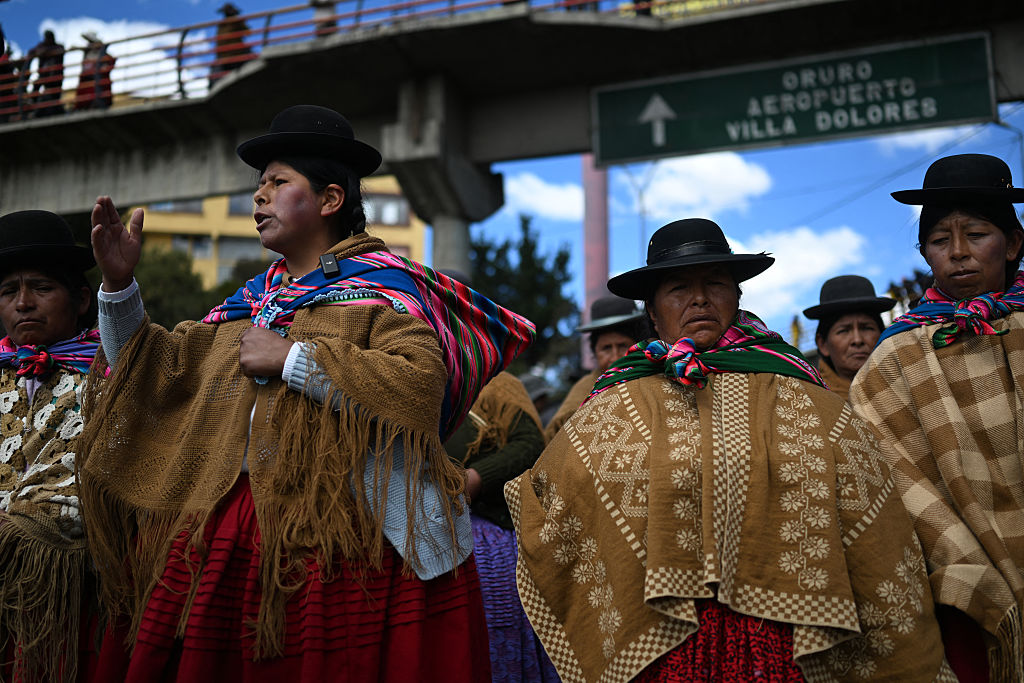
Over 40 days of blockades have brought Bolivia to a breaking point. As President Rodrigo Paz’s grip on power weakens, it’s unclear what political force could seize it. (Marvin Recinos / AFP via Getty Images)
Bolivia is at breaking point. For over forty days, the cities of La Paz and El Alto, along with the regions of Oruro, Potosí, and Cochabamba, have been strangled by blockades impeding the passage of food, goods, and people by road. Demonstrators seek the resignation of President Rodrigo Paz.
The blockades are a colossal display of worker and indigenous power against an unpopular right-wing government. But the mobilizations are far from unified, and these frictions have the potential to create a disturbing power vacuum and to escalate a dangerously unstable political and economic climate.
Meanwhile, the government is resorting to increasingly repressive tactics as it struggles to contain a conflict that is moving rapidly beyond its control. Ninety people have been arrested, and many injured in the disputes. Leaders of trade unions have been reportedly kidnapped off the street, and a number of them imprisoned. In a public statement, the trade union confederation, the Central Obrera Boliviana (COB), denounced the government for initiating a “manhunt” against its leadership.
Arbitrary arrests of union leaders across the country have taken place, particularly those linked with evismo (the ex-President Evo Morales). For example, Yesenia Vargas, former leader of the Carrasco Federation in the Cochabamba tropics, was this week imprisoned. Vargas was part of the delegation that traveled to El Alto to demand the resignation of President Paz.
Just over a week ago, in the early hours on Sunday, the right-wing dominated Bolivian legislature approved a bill that would allow President Rodrigo Paz to declare a state of emergency. There are fears that the state of exception will soon be invoked and the military deployed to violently unblock the streets. Crucially, Paz also has the steadfast support of the US government, with Secretary of State Marco Rubio promising emergency assistance for the beleaguered president.
The town of San Julián in Santa Cruz, home to peasant groups known as Interculturales, was last week the site of a violent “unblocking” in which the far-right paramilitary group, the Santa Cruz Youth Union, working with the police, stormed the town and reportedly used live ammunition against blockaders.
Nonetheless, social movements have declared they will neither back down nor negotiate with the government.
Behind the Blockades
The sectors coordinating most of the blockades in the highlands against Paz are those who voted for him in last year’s elections. The Aymara people were formerly an essential pillar of the Movement for Socialism (MAS)’s base, who Paz courted with pragmatic promises of “capitalism for all,” appealing to a growing class of wealthier Aymara commercial sectors — a logic known as qamirismo, which derives from the Aymara word qamiri, used to describe someone with money.
Once in office, Paz abandoned promises to continue MAS social programs, and his primary base of support shifted to the revanchist business interests in Santa Cruz, a sector that did not even vote for him but rather the far-right Jorge “Tuto” Quiroga.
Roberto Pacosillo Hilari is a veteran Aymara political leader and a key figure in the blockades. He told Jacobin that Paz is the latest in a long tradition of politicians in Bolivia who extract wealth from the people while giving them nothing in return. “There is no trust with this man. He is a liar. In Aymara we would say sallqa, which means a person who lies, a charlatan. This is the reason we want to him to resign.”
Paz’s capitulation to right-wing business and elite interests is viewed by protesters as a return to a past in which indigenous peoples were systematically excluded from power and their votes exploited to serve the interests of power-brokering elites.
As conflict with the state boiled over, Bolivians have once again taken to the barricades to exert leverage. “The blockade,” Bolivian anthropologist Pedro Pachaguaya told Jacobin, “is an ancestral political technology that transforms territorial control into negotiating power.”
These blockades are the outcome of collective social processes. “The blockader is not the backward peasant besieging the modern city — she or he is a complex citizen who activates their community affiliation when the assembly decides.” Pachaguaya adds.
Another key element of the protest concerns the structural crisis in the economy and the long-standing issue of gasolina basura, or “junk fuel.” Poor-quality diesel has been wrecking the engines of public transport minibuses, and the promised compensation to drivers for the costs has not been forthcoming. Accordingly, the transport sector has been on strike intermittently for months. Drivers are queuing for five days in their vehicles to obtain gas in El Alto and La Paz.
Paz has been unable to secure a reliable supply of fuel, a problem that began in 2023 under the MAS government of Luis Arce. In the absence of foreign reserves due to a collapse in hydrocarbon exports, Bolivia cannot import fuel in sufficient quantities. Despite securing loans and bailouts from international institutions, the economy is in free fall, and the poorest are paying dearly.
The Conservative Volte-Face
Earlier this year, in April, festooned in a traditional red poncho, Paz gave a rousing speech in Achacachi, the historic heartland of Aymara peasant movements that had overwhelmingly voted for him in the elections last year. Initially attracted by his promise of “capitalism for all” and the man-of-the-people appeal of his vice president, Edman Lara, achacacheños and other peasant and indigenous communities across Bolivia are now profoundly unhappy with Paz’s immediate capitulation to right-wing, business, and old elite interests.
Discontent began with Paz’s attempt to issue Decree 5503 in January this year, before massive protests abruptly forced him to change tack. Then, in May, he attempted to pass Law 1720, which would have deepened the commodification of small landholdings, benefiting agribusiness at the expense of small peasant farmers.
Peasant and indigenous movements from the Amazonian regions of Pando and Beni marched for one month on foot to La Paz to demand the repeal of the law. They were ultimately successful, as the legislature voted to abandon the decree. But it was too late; movements from the highlands, as well as coca-growing sectors from the Chapare, mobilized and formed blockades demanding nothing less than the resignation of Paz.
Seeking to discredit the mobilization, much pro-government media has portrayed the blockaders as stooges of ex-President Evo Morales and has peddled a narrative that Evo is masterminding the blockades with a view to seizing power. But in truth, evistas are just one element of a large and broad multisector mobilization, and there is little indication that Evo commands much support beyond his core base. COB leader Mario Argollo, for example, has been keen to distance the COB mobilization from Morales. “There is no external funding whatsoever in our mobilizations,” he maintained in an interview. “We ask Evo Morales not to piggyback on our struggle.”
Argollo affirmed that the mobilizations are being driven by the grassroots. “The people no longer believe in the government; there is a lot of distrust,” he said. “You can’t have a dialogue like this. But that will be decided by the rank and file. Up to this moment, they only demand resignation, but we meet constantly and the situation will be evaluated.”
But it is also true that the bloqueos are not universally supported within communities, and major divisions permeate the movements. Those blockading do not all share the same ideological or class interests. For example, some sectors of the peasant union confederation, the CSUTCB, have reportedly condemned the blockades.
Scuffles erupted in the streets of El Alto between blockaders and their opponents. The divisions reflect a phenomenon of parallelism, whereby movements are divided into multiple overlapping factions, blighting the unity of the indigenous and workers’ movements since the later years of the MAS.
There is, of course, no denying the painful impact of the prolonged blockades. Hospitals have warned they cannot perform critical surgeries because they do not have enough oxygen. Reports suggest that some people have died due to their inability to access emergency health care. Gas and meat are virtually unobtainable in La Paz. A small head of broccoli is being sold in supermarkets in the capital for $6, and in the absence of chicken or beef, cold boxes of chicken are being flown in from neighboring cities.
The airports remain open, but in El Alto many have been forced to walk for miles with suitcases in tow to circumvent blockades. The right-wing governments of Peru and Chile have sent supplies in support of the government to ease the pressure of the blockades.
Economist Javier Gómez points out that the blockades correspond to “a new cartography of power” that reflects the far-reaching territorial and economic shifts of the past two decades, including the expansion of informal economies, the rise of extractivism, and the growing penetration of illicit capital in Bolivian society.
A large cabildo (public meeting) was held this week in La Paz by disgruntled middle-class and urban sectors who demand a greater use of force by the state to unblock the roads. But Paz will be wary of using military force to quash the blockades, mindful of escalating the conflict and opening the door to human rights violations. With few friends, his grip on power is weak.
As the blockades show no signs of abating, difficult questions loom large. The movements demand that Paz and Lara resign, but there is no obvious figure to replace Paz nor a clear electoral entity around which to mobilize, although evistas are angling for an opportunity to get Morales back on the ballot. In the elections last year, the MAS was annihilated as a political force, and there is virtually no progressive or left-wing presence in the legislature. A dangerous political vacuum beckons.
Today’s mobilization is testament to the Bolivian workers and indigenous masses’ refusal to be treated as political pawns, to be instrumentalized during elections and then disregarded. But the fragility of Bolivia’s political ecosystem is worrying as it moves into the post-MAS era, in which social movements demand that the state represent their interests but have proved unable to reassert a tangible grip on state power. There are few winners in this mobilization, and Bolivia faces a grim and uncertain future.