The Scandal That Could Break the Latin American Far Right
Fernando Cerimedo built the disinformation machine behind the far right’s wins from Argentina to Bolivia to Honduras — with technology and money from Trump’s own operatives. Now he’s in a Bolivian jail, charged with trying to have his ex-partner killed.
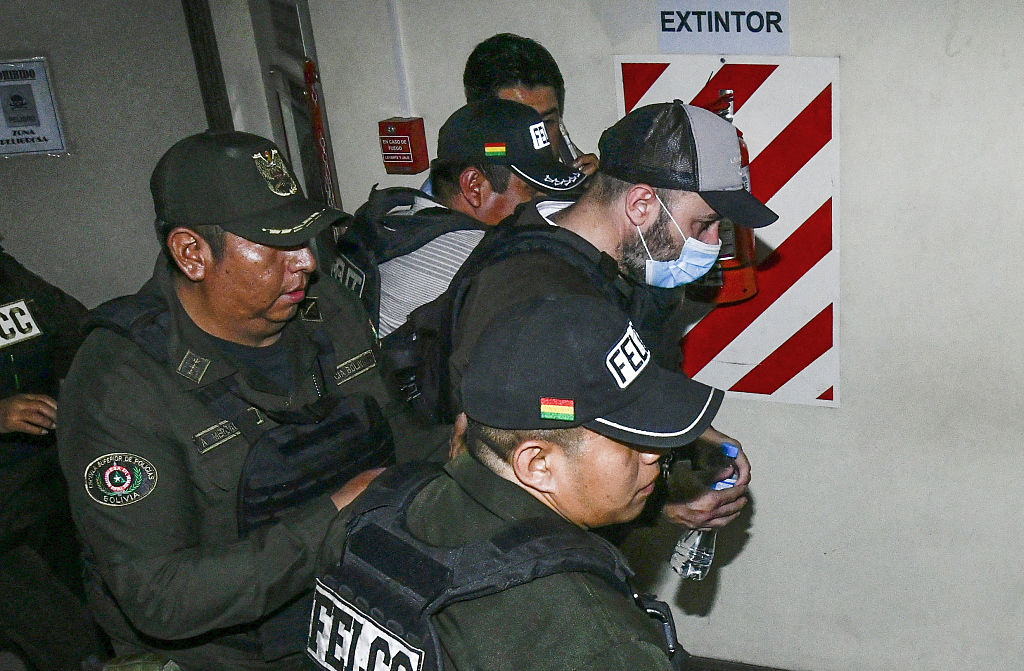
Police officers transfer close adviser of President Rodrigo Paz, Argentine Fernando Cerimedo, from the Justice Palace to the Palmasola prison in Santa Cruz, Bolivia, on August 21, 2026. Bolivian police arrested Cerimedo over a gun attack on his former partner. (Rodrigo Urzagasti / AFP via Getty Images)
On Tuesday, August 18, an Argentine citizen named Fernando Cerimedo was arrested at the Viru Viru International Airport in Santa Cruz de la Sierra, Bolivia. Cerimedo, age forty-five, was charged with the attempted homicide of his ex-partner, Bolivian lawyer Nadia Beller, and ordered held for 180 days of pretrial detention. The details are grisly: security camera footage showed hit men, disguised as delivery workers, firing on an unsuspecting Beller at point-blank range before fleeing the scene. Compounding matters, Beller, who miraculously survived the assault, was apparently pregnant with Cerimedo’s own child.
Thus far, the affair could be classified as a case — gruesome, yes, but hardly unusual — of a botched femicide in the wake of a failed relationship. Something to briefly grace the crime section of the local papers. And indeed, that is how a number of interested parties would be keen to frame it. But Cerimedo happens to be the disinformation mastermind behind the far-right campaigns that have taken Latin America by storm.
Nor are his connections limited to the Southern Cone: they extend up into the inner circles of Trumpism itself.
Cerimedo Is at the Center of the Latin American Far Right
Once you start looking at the Latin American far right, Fernando Cerimedo’s name starts popping up everywhere. He was in Brazil, helping the Bolsonaros spread the narrative of fraud in the 2022 elections that saw the return of Luiz Inácio Lula da Silva. He was in Argentina, where — according to Beller — he worked for the very Javier Milei he considered “crazy” all while compiling information on the bribery scandal involving Milei’s sister, Karina, the secretary general of the presidency. He was in Chile, where he bragged about tanking the referendum for the new constitution that would have replaced the Augusto Pinochet–era version still in force while reportedly also assisting in the presidential campaign of José Antonio Kast. He was in Peru, hanging with a close adviser to Keiko Fujimori in the run-up to the June presidential elections she won by a hair’s breadth. He was in Honduras, where he purportedly appears on audio admitting to electoral crimes in the November 2025 elections that saw the surprise victory of Donald Trump ally Nasry Asfura. And he was in the Colombian presidential elections, where, according to the official count, another pro-Trumper, Abelardo de la Espriella, defeated Iván Cepeda by less than 1 percentage point in June.
Why was he in such high demand? Because Cerimedo was the guy who could put it all together. Political marketing. Audience targeting. Farms of bots numbering into the hundreds of thousands. Deceptive polling. Opposition research. Artificial intelligence manipulations. In short, he supplied the negative message — lie or slander — then segmented, sensationalized, and amplified it to reach the largest and most receptive audience possible. Together with his partner, the serial falsifier Javier Negre (repeatedly sentenced in Spain for fabricating information and even entire interviews), they founded La Derecha Diario, the online media platform designed to launder this material in the form of “news” across all of Latin America.
Beginning in Argentina, the outlet quickly established regional editions in Mexico, Uruguay, Ecuador, Israel, and an English version in the United States, where Negre would become a regular fixture at White House press conferences. In the case of Mexico, as Negre himself explained at a Conservative Political Action Conference event, the outfit was invited to set up shop by far-right magnate Ricardo Salinas Pliego in order to “wage the cultural battle.” Mexico, Beller contends — a starting point for interfering in the country’s 2027 midterm elections — was next on his list. All of the above fueled by a network of digital wallets found on his phone totaling some $132.8 million.
A Minister Without Portfolio
But nothing beats Bolivia, where Cerimedo was far more than a digital hit man: he functioned as a sort of all-powerful minister without portfolio in the right-wing government of Rodrigo Paz, elected in October 2025 following a devastating fracture in the ruling Movement Toward Socialism (MAS) party. Although they were careful to keep him off the official payroll, the “principal adviser” wielded what amounted practically to co-governance powers in communications, the cabinet, and the police. So great was this power that, in the days leading up to the attempt on Beller’s life, Cerimedo was in contact via chat with Lieutenant Colonel Erik Correa González, director of intelligence for Bolivia’s Special Anti-Narcotics Force, to coordinate the assault. Correa is also under investigation for allegedly receiving bribes of $50,000 per plane to turn a blind eye to cocaine flights. For his part, and in addition to attempted homicide, Cerimedo is also being investigated for illicit enrichment via a drug connection, specifically the trafficking of controlled substances and the covering up of drug trafficking.
It is the irony of ironies. Cerimedo’s disinformation machine specialized in attaching the prefix narco to progressive leaders, movements, and governments up and down the region in order to discredit them. Now he stands accused not only of colluding with narcos himself, but of using one of them to try to off his own former partner and unborn child. Every accusation is a confession.
The US Connection
If the Cerimedo story ended here, that might at least partially justify the dearth of coverage in the English-language press. But it does not. According to an investigation published in the Mexican daily La Jornada and based on documents filed under the Foreign Agents Registration Act (FARA), Cerimedo’s port of entry into the United States was Miami. The South Florida city was more than a business address; it operated “as a platform for coordination among Latin American campaigns, ideologically driven media outlets, political consultants, organizations within the Cuban American ecosystem, and sectors of the Republican Party with the ability to influence U.S. policy toward the hemisphere.” And the key welcome-wagon figure in this extremist petri dish is Damian Merlo, a lobbyist, public relations consultant, managing partner at the Latin America Advisory Group (LAAG), and former screening officer for the US Department of State in Havana. It was Merlo, in fact, who organized the viral appearance of Javier Milei on the Tucker Carlson program in 2023, two months before his election as president of Argentina.
For Cerimedo, Merlo could offer access to the offices of congresspeople deeply involved in hard-right politics in Latin America, such as Representatives Mario Díaz-Balart and Maria Elvira Salazar — who chairs the House Foreign Affairs Subcommittee on the Western Hemisphere — and Secretary of State Marco Rubio. Indeed, in an official State Department photo of the Shield of the Americas summit on March 7, 2026, Cerimedo is seated next to Rodrigo Paz and across from the US secretary of state at a chummy table of six.
When, in that same 2023, Cerimedo established his company Numen Academy in Miami, Numen and LAAG joined forces to work on the Milei campaign. Numen also brought Cerimedo together with a fundamental person in this entire saga: Brad Parscale, digital media director for Trump 2016 and campaign manager for Trump 2020. It was a match made in heaven, as the two offered a very similar basket of “services”: it was Parscale who paid some $6 million to Cambridge Analytica in 2016 to harness Facebook data harvested from eighty-seven million users without their consent. In the Honduran elections, Parscale advised Numen remotely about leveraging data to target voters. In Bolivia, he went one better, traveling to the country to help Numen’s team harness his companies’ data tools. In 2025, Cerimedo was designated representative and exclusive Latin American licensee of Campaign Nucleus, owned by Parscale, and Eyesover, an affiliated company. “Brad provided all the technology I work with,” Cerimedo has admitted. In October 2025, Parscale registered under FARA with the Israeli government, through the intermediary of Havas Media Germany GmbH.
The House of Cards
Tariffs, boat bombings, open interventionism, the kidnapping of a sitting head of state: even a cursory review of the second Trump administration’s onslaught on Latin America and the Caribbean is enough to drive anyone to desperation. But as the Cerimedo affair demonstrates, the far-right barrage is more fragile than it may at first appear. From Kast to Milei to Paz, the leaders elected under the wave have, in quick succession, become unpopular, run into scandal, faced popular protest, or all of the above. Victories in Honduras, Peru, and Colombia were razor-thin, ripe for being upended by the type of manipulation contracted in the North and metastasized in the South. Absent a popular mandate, some have resorted to states of exception; others, to grasping more tightly to the Shield of the Americas and the “collaborations” it proffers with US forces.
But the fact that so much of this can be traced to one man behind the curtain is telling. Cerimedo, of course, will be discarded and replaced; the line of former clients and compadres vying to distance themselves from him has already formed. But the house of cards that is the Latin American far right is swaying on its flimsy foundations: the rot of its digital magician has come to symbolize the rot at the heart of its project.