Trump’s Oil Deal Is a Return to Venezuela’s Colonial Past

Donald Trump’s backroom deal with Venezuela’s leaders formally gives the US control over the country’s oil. It marks the definitive end of modern Venezuela’s social contract, in which oil production was meant to serve national economic goals.
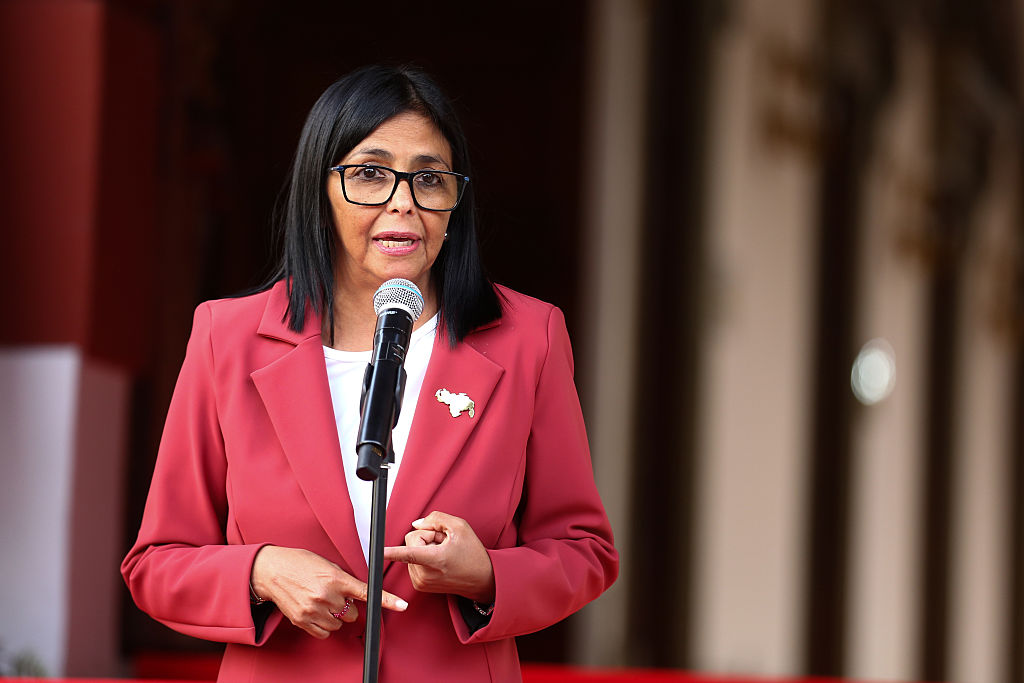
Venezuelan President Delcy Rodríguez and the US Secretary of the Interior Doug Burgum (not pictured) discuss energy exchange at the Miraflores Palace in Caracas  on March 4, 2026.

Venezuela’s resource nationalist consensus was built over decades through broad, cross-ideological political movements. US plundering of its oil will likely only strengthen that consensus. (Julio Urribarri / Anadolu via Getty Images)


On Friday evening, US President Donald Trump announced — via Truth Social post — the “biggest oil deal in world history,” which would see the United States take partial control of a shocking sixty-five billion barrels of Venezuelan oil, more than doubling the United States’ current reserves.

Secretary of State Marco Rubio, who negotiated the deal with interim Venezuelan President Delcy Rodríguez, hailed the agreement as “a huge win for both the American and Venezuelan people,” dangling the scintillating prospect of “nearly $100 billion in private investment” for Venezuela and the creation of “thousands of high-paying jobs.”

Details of the deal were already leaking Thursday afternoon, with sources suggesting that it would take the form of a one hundred-year lease across seventeen oil fields — including undeveloped heavy crude sites in the Orinoco Belt as well as developed light crude sites in Lake Maracaibo. The deal was also announced amid rumors that Venezuela may be leaving the Organization of the Petroleum Exporting Countries.

Reactions to the deal were swift. Institutionalists of both neoconservative and liberal stripes were united in disbelief and anger that Rubio had made a long-term deal with Delcy. Leftists of all tendencies in the United States largely opposed the deal for its clearly imperial designs and for further muddying the legacy of Hugo Chávez.

The Wall Street Journal compared it to The Godfather: Part II, and energy and business experts were skeptical of its potential impact on markets — rightly pointing out that details were murky. It also didn’t help public perception when reports surfaced that Venezuelan oil oligarch Alejandro Betancourt would be in charge of operations under the deal.

But perhaps most shockingly, the deal includes a provision, unprecedented in US history, that allows the Pentagon’s Office of Strategic Capital to take a 35 percent ownership stake in the newly formed private extraction entity, along with the rights to buy 20 percent of the output at cost.

Miami hard-liners, the nexus of American foreign policy on Venezuela, didn’t know what to think. For years they had championed “maximum pressure” policies, anticipating that the collapse of the Venezuelan government would pave the way for the American exile lobby to manage the country’s privatization. Instead, Rubio, the most powerful Miami hard-liner on earth, bypassed them entirely. In one notable incident, Congresswoman Maria Elvira Salazar deleted her initial negative response to the deal on X and then replaced it with a glowing review.

On Saturday evening, Delcy Rodríguez walked through the agreement in a brief televised address, touting its “endless benefits” to the Venezuelan people while reiterating the core premise of her presidency that, despite all appearances to the contrary, the Venezuelan government remained sovereign. Crucially, Rodríguez mentioned a twenty-five-year lease, contradicting earlier reports of a one-hundred-year concession. Her royalties calculation also assumed a baseline price of $65 per barrel of oil, which some suggested was severely undervalued. Far from clarifying anything, the address heightened the sense of confusion surrounding the deal.

“We do not have written documents,” notes political economist Antulio Rosales. “We have Truth Social posts and a five-minute speech from Delcy Rodríguez. This is a masterclass in authoritarian governance; it lacks transparency, it lacks political legitimacy, it has not been debated in the Venezuelan parliament or American Congress.”

Within Venezuela, the deal has resulted in a political outcome that would’ve been unthinkable months ago: conservatives are angry with the Trump administration. “This deal offends right-wingers who assumed they would have an intermediary role in resource management,” explains historian Miguel Tinker Salas. “Now they have no role.”

This is creating a small measure of consensus in a country that is widely perceived as politically dysfunctional and polarized. “There’s greater indignation in Venezuela from both the Right and the Left, who feel that the country has been sold out,” Salas added. “Ironically, it has united them.”

Venezuelan Oil Nationalism’s Deep Roots

In the early twentieth century, Venezuelan dictator Juan Vicente Gómez granted sweeping, low-rent concessions to foreign oil trusts to guarantee international backing for his autocratic regime. Tinker Salas draws a direct parallel between Trump’s deal and this era: “The contract announced by Trump takes us back to the era when oil was first discovered. An era when dictators such as Juan Vicente Gómez made decisions on behalf of the country.”

A popular misconception about Venezuela’s resource politics — perpetuated by Washington and the international press — is that resource nationalism in Venezuela was the ideological invention of Hugo Chávez. In reality, this consensus was built over decades through broad, cross-ideological political movements.

“Oil nationalism evolved from the early twentieth century and reached its peak in the 1960s and when the industry was nationalized in the 1970s,” explains Rosales. “It was centered on the idea that they needed to control the resource within the ground (rents and royalties), as well as the industry above ground (through monopolizing extraction with a national company).”

From the passage of the Ley de Hidrocarburos in 1943 to the historic 1976 nationalization under social democrat Carlos Andrés Pérez, the principles of modern Venezuelan energy politics have remained consistent. The 1999 Constitution, the foundational document of the Bolivarian Fifth Republic, explicitly codified these. “The Venezuelan Constitution is clear: the oil belongs to the Venezuelan people,” Tinker Salas emphasizes. “This deal strikes against every normative legal and political process that Venezuela has experienced over the past seventy years.”

This helps explain why the reaction to this deal has been so uniformly negative across the political spectrum. For years, the ruling Partido Socialista Unido de Venezuela (PSUV) warned that if right-wing opposition figures like María Corina Machado took power, they would execute a fire sale of Venezuela’s oil wealth to the Americans. “Many Venezuelans were concerned that MCM would return and agree to the very deal that Delcy has just signed,” observes Salas.

“There is a simmering discontent in Venezuela, like a volcano,” Salas warns. “Oil no longer generates the expectation of social and political change.”

In the wake of the announcement, a small but notable political discourse has emerged on Latin American social media, suggesting that this deal marks the end of the Fifth Republic. The social contract that defined modern Venezuela, the promise that oil rents and production would serve as an engine for national development and social redistribution, has been fundamentally broken.

Crooked Dealings

We know that the deal itself will be governed by “productive participation contracts,” a recent opaque concession framework wherein private, US-backed entities assume total operational control. As Ricardo Vaz, editor at Venezuelanalysis, explains, this arrangement strips Petróleos de Venezuela, the national oil company, of its core function. It “turns over prime and promising oil fields, further consolidating Venezuela’s status as a mere oil resource owner as opposed to an oil producer.”

PSUV is doing everything in its power to contradict this characterization. “Delcy is trying to say that her deal is compatible with the basic tenets of oil nationalism, and the minimum 16 percent rent is an important detail,” Rosales notes. “It is the bare minimum that any oil nationalist would consider to be sufficient. This number is symbolic of a long struggle against autocrats, such as the despot Juan Vicente Gómez, who provided concessions under this figure.”

And while it’s true that this deal would not have been possible under the constitutional framework that existed up until January 2026, the ground had already been cleared through an internal restructuring of the state apparatus. “The current oil dynamic is a prolonged crisis that finds its roots in mismanagement, corruption, and the crisis of the Venezuelan economy — which drove Venezuelan oil workers out of the country — as well as prolonged American sanctions,” Rosales details. Those sanctions are critical, because they starved Venezuela of foreign investment and led to the passage of the 2020 Anti-Blockade Law, in which productive participation contracts were first conceptualized.

To facilitate foreign investment, the Venezuelan government stripped the legislative branch of its oversight function and shifted approval and regulatory control to the executive. While the Trump administration demanded further changes on behalf of US corporations, Rosales notes that the internal groundwork had already been laid: “It would be a mistake to say this was only desired by the United States. The Venezuelan political elite also wanted to change the locus of approval, oversight, and control from the parliament to the executive. They gave the green light for a more authoritarian approach to oil management.”

“I would not necessarily call it ‘oil trade’ because it suggests a relation between equals,” Vaz observes. “What we have right now, amid very opaque conditions, is a Venezuelan energy sector that is completely subordinated to US interests . . .  Venezuelan oil revenues are currently under White House control. Funds are deposited in a US Treasury account before US officials decide the timings and amounts to disburse back to Caracas.”

Another profound tragedy of the deal lies in its implications for the environment and for the future development of both the United States and Venezuela, chaining both countries to the oil economy at the precise moment that both should be investing in renewable alternatives.

“Venezuela was at the forefront of the hydrocarbons industry’s rise. Now it is at the forefront of its afterlife, but this time without the consent of Venezuelan society,” Rosales reflects. “The United States and Venezuela are tied at the hip to each other. And they are tied at the hip to the fossil fuel industry in a world that desperately needs green energy alternatives. . . .  Diversification of energy is the only thing that makes sense for the continued development of the global economy, and both countries are turning their back on it.”

A Privatization to Disappoint All Parties

Within Venezuela, the legacy of the Bolivarian Revolution is now contested not just by popular social movements but by government forces. “What we have seen thus far has been a remarkable [party] discipline even as the project sharply turns away from its core principles,” explains Vaz. “In the case of the National Assembly, there has been zero dissent in terms of approving new laws that directly dismantle the advances made under Chávez.”

Over the past few months, it’s become increasingly clear that the PSUV’s abandonment of long-held internationalist principles are part of a desperate bid to ensure regime survival. “There is no sugarcoating this. Right now Venezuela is fully subordinated to US interests both in its domestic and foreign policies,” Vaz says. “Simply put, Rodríguez and the leadership reached the conclusion that their best bet to stay in power is to fully cater to Trump’s agenda.”

The government’s top-down consensus has not fully suppressed discontent. High-profile figures, including former Vice President Elías Jaua, have openly condemned the deal, making calls to recover national sovereignty alongside the Popular Anti-Imperialist Front and non-Chavista leftist organizations.

For now, the Venezuelan government has managed to contain a wider uprising. “When it comes to the popular movements within Chavismo, most of them, unfortunately, have been silent or offered some vague, uncritical backing for Rodríguez,” Vaz notes.

However, as living conditions deteriorate under stagnant wages, eviscerated social services, botched disaster responses, and chronic power blackouts, this patronage model will face increasing financial strain. “My overall expectation is that major deals like this one will eventually be folded into the debt restructuring process,” Vaz warns. “As we all know, debt is the prime mechanism to maintain Global South countries mired in dependency and underdevelopment.”

“From the left perspective, there are surely many necessary discussions on where the Bolivarian Revolution could have taken a different path, to make the gains more irreversible,” Vaz reflects. “I think it was a concrete path toward socialism that, under imperialist pressure and aggression, was gradually and then completely abandoned.”

But perhaps the greatest shock was felt by the traditional Venezuelan right. For years, the US-aligned opposition viewed privatization as their exclusive political domain. “What is a major shock for the opposition in Venezuelan society is that, in their mind, this was a thing that only they could do,” Rosales explains. “They surrendered agency to a foreign country thinking their political power would be returned.” Instead, they are now realizing that the American empire’s demand for resources will always override its rhetorical commitments to liberal democracy.

“From the reaction of the Venezuelan opposition there is clear disbelief, illusions shattered over what they felt was the US empire’s role in Venezuela,” Vaz explains. “In their worldview, it was only natural for Venezuela to be incorporated into US interests, but they did not expect it to such an extent, and they certainly did not expect that it would be done with other people in power.”

Neocolonial Redux

The deal has stripped away the polite fictions of US foreign policy. For decades, the neoliberal consensus insisted that the Cold War in the Americas was over, and that US engagement in the western hemisphere was driven by a commitment to human rights, rules-based markets, and the promotion of democracy. But by seizing sixty-five billion barrels of oil as part of a backroom deal with an authoritarian president hated by both the Left and the Right, Trump and Rubio have disabused Venezuelans, both within the country and in the diaspora, of any remaining illusions about US empire.

Clearly the Trump administration views this deal as a diplomatic and economic triumph. “Venezuela has unarguably been an early success for the ‘Donroe Doctrine’,” Vaz notes. “Trump managed to trample international law, now has a powerful lever for energy security, a market to export US products, . . .  and a pliant ally on international matters. And this in turn has meant driving away geopolitical rivals — China, Iran, and Russia — which had in Venezuela their most significant partner in the western hemisphere.”

Yet the path forward for the United States is fraught with peril. The night Nicolás Maduro was captured by US forces, Trump and Rubio, with Pete Hegseth, were too consumed with triumphalism to realize they had set a new status quo. Every new failure of the Venezuelan government would no longer be an abstract consequence of mismanagement; they would now be partially owned by the United States.

When social services are dismantled to feed the margins of foreign operators, when the state fails to deliver aid in the aftermath of devastating earthquakes, when the national grid collapses and plunges millions into darkness, and when the domestic economy is hollowed out by food imports and suppressed wages, the Venezuelan public will no longer look solely at the PSUV. They will also look at the US Treasury accounts holding their oil revenues in escrow, and to the foreign companies extracting their wealth under threat of military intervention.

“Whether this is sustainable in the medium to long term is a tougher question,” Vaz argues. “Certainly, going back to neocolonial relations with the United States is not going to result in improved living conditions for the majority, and there’s only so much the US and local elites can contain with puppet presidents, repression, and electoral fraud. This overt and rampant neocolonial offensive is bound to create new waves of Latin American nationalism.”

The United States is operating under the assumption that a beleaguered Venezuelan populace will quietly endure a century of humiliation as the price of survival. But such conditions cannot be permanently imposed on a people who tasted, however briefly, the fruits of socialism. The grinding daily indignities of blackouts, rampant inflation, and food shortages, as they are further exacerbated, will slowly erode the client state. These are the precise material conditions revolutions are made of.