Delcy Rodríguez Heads a Compromised Bolivarian State
After Nicolás Maduro was kidnapped by US forces, Delcy Rodríguez was sworn in as Venezuela’s president. She has a long record in the Chavista camp, but she faces an uphill battle in dealing with her country’s compromised sovereignty.
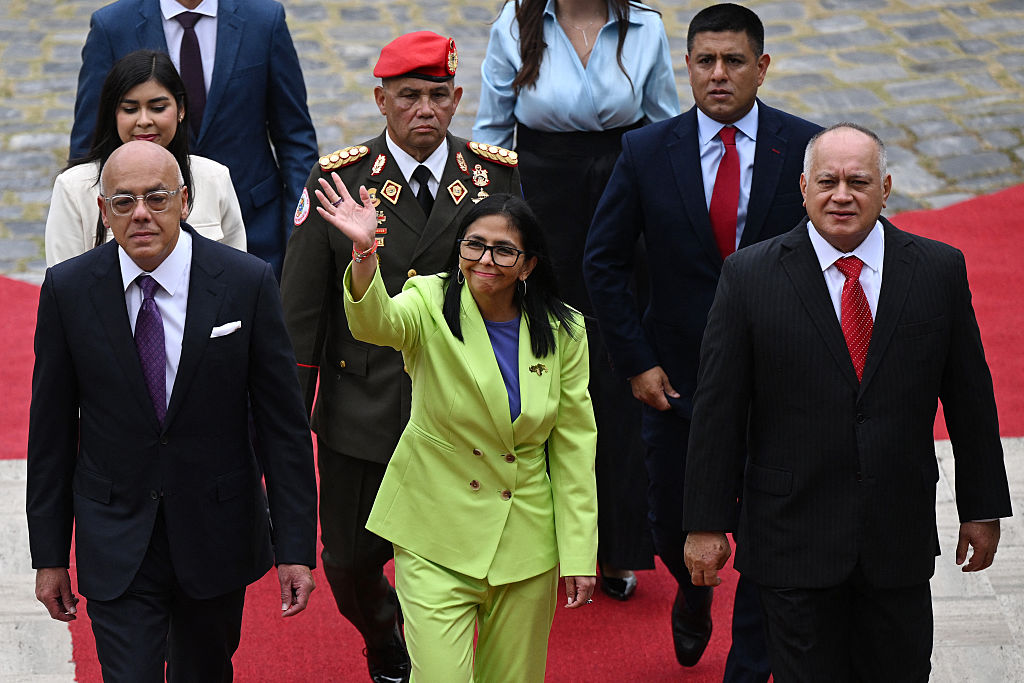
Delcy and Jorge (L) Rodríguez are poised to begin a new leadership in Venezuela. (Federico Parra / AFP via Getty Images)
The Triptych Room takes its name from three somber visions of power that bear down on the Federal Legislative Palace of Venezuela. They are glimpses into the intimate life of El Liberator, Simón Bolívar: a promise made to his mentor at Monte Sacro, a moment of introspection surrounded by weary troops, and his lonely death of tuberculosis in the Caribbean.
This January 5, framed by these sober scenes, Delcy Rodríguez was sworn in as Nicolás Maduro’s successor in a carefully orchestrated presidential inauguration. The whole world watched after Maduro had been captured by US forces and flown to New York to face charges of narco-terrorism. But this was also a family affair between the small group of people who have clung fiercely to power for almost thirty years.
From Childhood
To Rodríguez’s left stood Maduro’s only son — known as Nicolasito, a member of the National Assembly — who bore the Venezuelan Constitution on a red velvet cushion. Resting one hand on the book, Delcy rose the other in oath and looked up at her older brother, Jorge Rodríguez, who stood before her as president of the National Assembly. On the podium, Delcy and Jorge were poised to begin a new leadership, presided by Nicolasito as the figurative reembodiment of Maduro.
Delcy made her presidential vow to Jorge in the name of their late father, Jorge Antonio Rodríguez, and for all the little boys and girls of Venezuela. Delcy and Jorge were themselves small children on the day they learned that their father would not be coming home. In July 1976, Rodríguez died while held in detention by Venezuelan intelligence on suspicion of abducting US businessman William Niehous. A postmortem examination identified seven broken ribs and internal bleeding. The cause of death, aged just thirty-four, was cardiac arrest.
Rodríguez’s short adult life had been packed with political action. Barely out of school, he joined the youth branch of an emergent liberal party and then a more radical group of dissidents, taking part in Caracas’s mass student protests in 1968. These were tumultuous times in Venezuela.
The country’s US-allied centrist leadership was urged to stamp out the guerrilla movement that had been ignited by the Cuban Revolution and spread with the splintering of the Left. Feared to be a hotbed for militant organization, Rodríguez’s alma mater, the Central University of Venezuela (UCV), was repeatedly shut down during this period. By the start of the 1970s, Rodríguez had become a prominent advocate of revolutionary armed struggle and pursued this aim in founding a Leninist organization called the Socialist League.
As Rodríguez gained notoriety at home, he found international fame with the Niehous abduction. Niehous was vice president of glass manufacturers Owens-Illinois when, on February 27, 1976, he was snatched from outside his home in a fashionable suburb of Caracas. The kidnapping, which was to be the longest in Venezuelan history, had profound geopolitical ramifications.
The group that held him hostage demanded that Owens-Illinois pay a US$3.5 million ransom, that it distribute food among the poor, that it compensate its two hundred employees with US$100 each, and that it publish a manifesto in the New York Times, the London Times and Le Monde that denounced the corrupt alliance between business and politics.
The executives’ decision to comply with some of these demands soured relations with the president’s office in Venezuela, which, by that point, had taken a hard line on domestic insurgency and was unwilling to negotiate with nonstate actors, despite pressure from the US Cabinet Committee to Combat Terrorism. More three years after being snatched, Niehous was accidentally discovered by rural police. He was chained to a post in a hut on the banks of the Orinoco river.
Rodríguez’s three offspring had not yet completed their primary education when their father was killed by the police. But these events bore heavily on the future trajectory of the two eldest siblings. Along with many of those involved in the Niehous abduction, Jorge and Delcy came to chavismo from the Venezuelan Marxist tradition that had its roots in partisan organization, which was effectively outlawed by the 1961 Constitution — triggering a turn to foquismo and an approximation with Cuba. During the late 1980s and early 1990s, they passed through the corridors of the UCV, holding important roles in student politics as their father had done before them, and vowing vengeance for his assassination.
Jorge studied psychiatry and wrote melancholy stories in his spare time. Delcy read law and, backed by state funding, would pursue postgraduate study at Paris Nanterre and Birkbeck, University of London. It was in 2002, four years after Hugo Chávez’s first election, that the siblings eventually arrived in government. There, they joined ranks with the rebellious factions of the military that had supported Chávez’s coup attempt as a paratrooper in 1992 and who, led by his transition into party politics, would land influential roles in his socialist government.
Thus a coalition was born between the remnants of the guerrilla struggle, politicized blocs of the armed forces, union leaders, populist politicians, leftist lawyers, public intellectuals, and strategic business interests. This evolved into the Bolivarian Revolution, funded by the gains of a profitable oil sector, which marked a break with the bipartisan power-sharing pact of the previous four decades.
Five years senior to his sister, Jorge was first to rise far, and fast. He began his career in the National Electoral Council, designed to organize elections as an independent body, and was appointed its president in 2005. By 2007, he had become vice president to Chávez, succeeding José Vicente Rangel, his father’s close friend who had been a guerrilla fighter in his youth. Twelve months later, Jorge was elected mayor of Caracas and held the position for the next eight years, sponsoring a star-studded cultural agenda and a glitzy architectural portfolio that showcased the urban, millennial brand of the Bolivarian Revolution.
Delcy, meanwhile, took a different route up to the highest office, starting as minister for presidential affairs in 2006. Amid rumors of a fallout with the head of state, she was fired after just six months and replaced by Chávez’s older brother. For the next five years, she worked as an aide to Jorge in his role as the presidential deputy. It was not until Chávez’s death that Delcy was offered another opportunity, now under the steer of Maduro. After 2013, Delcy cruised between the top ministerial jobs in communications, foreign affairs, economy and finance, and natural resources. In 2018, she arrived at the seat of the vice president, ten years after it had been vacated by her brother.
Delcy and Jorge have always been pragmatic. Side by side they have risen in power and have watched as their country has been gripped by a crisis of unspeakable proportions. Over the past five years, the quickstep between them has accelerated and intensified as Maduro’s inner circle has shrunk and hardened. The threat of international sanctions has forced some to abandon their posts. Others have been extradited on criminal charges. Still others have been offered as sacrificial lambs or have fallen as a result of internal divisions. Most spectacularly, on Saturday, January 3, in the dead of night, Maduro himself was seized and extracted by the US military.
For many onlookers, it came as a shock when Donald Trump announced that he intended to work with the existing administration. It had long been assumed that the de facto leader of the opposition and Nobel Peace Prize winner, María Corina Machado, would assume the top job. Instead, she was batted away for the Rodríguez siblings. This move sends a signal that Trump may differ with his secretary of state, Marco Rubio, on the importance afforded to the political positioning of their associates, even as they agree on the need to reassert US hegemony in the Americas.
Trumpian Line
Scrutinized in the harsh light of day, this decision represents a coherent strategy for Trump. The US president makes no secret of the fact that he runs his country as he does his business. This logic now applies to the expansion of his political operations. Until recently, Delcy acted as minister of petroleum and hydrocarbons. She is well connected in the sector and has clout among OPEC magnates. As minister of economy and finance, she partially privatized the national oil industry in an effort to boost flailing production rates and tackle hyperinflation. Forced by economic necessity to veer from her anti-capitalist stance, she set in motion the job that Trump intends to finish.
A long stint as minister of foreign affairs when Venezuela rearranged its geopolitical allegiances means that she is flexible and confident in dealing with hostilities. During the Biden administration, when the move toward dictatorial governance in Venezuela was mediative and not offensive, Jorge was tasked with representing Maduro in extensive US negotiations. A shrewd and skilled communicator, he is reputed to enjoy friendly relations with Richard Grenell, one of Trump’s most trusted aides. The tides of history have delivered him to the shores of the people who once pursued his father.
So long as Jorge and Delcy work seamlessly together and follow Trump’s agenda, there will be no need to call time-consuming elections. The pair have already shown they are willing to be pliant on pressing issues, which include restructruing the national oil economy, releasing political prisoners, deporting Venezuelan migrants, halting the flow of drugs, and dialing down the government’s anti-imperial rhetoric.
This does not mean that the weeks and months ahead will be easy for the two. They find themselves in a double headlock. Their lives and their careers depend on their capacity to strike a balance between the risk of further violence from the United States and the threat of agitation from powerful domestic interests. One of the challenges on the horizon will be placating military strongmen Diosdado Cabello and Vladimir Padrino.
Looming figures in the inner circle, they have entrenched rivalries with the Rodríguez siblings who, unlike them, are targeted by the latest wave of US indictments. Briefly vice president before Rangel, Cabello was sidelined for the presidential role after Chávez’s untimely demise and has long harbored resentment for those who have beat him to the top. As minister of interior, with Padrino as minister of defense, he commands the loyalty of the army, for the most part, and of the unruly armed groups who control large swathes of the country.
Cabello’s subdued appearances in his weekly television show, Bashing With the Bludgeon, indicate that he is prepared to stand in line for the time being. But if he came to believe that his position were in danger, he could summon the weight of the military and use this as leverage in securing US support to overthrow the sitting president. All the while, the specter of Maduro will hover over the inner circle’s every move in the form of Nicolasito. Representing his father’s interests in absentia, the young deputy will have to choose his allegiances quickly and wisely if he is to survive this transition.
For now, though, the people who are nominally still in power in Venezuela will be inclined to work together as they have done for the past generation. Their recent actions have shown that ideology is inferior to survival. This much was known to Tito Salas, the artist comissioned to paint the Tríptico Bolivariano for El Liberator’s cenetary by military dictator Juan Vicente Gómez in 1911. Salas opted not for a gilded aesthetic that glorified political power or the sacrifices made to obtain it. His palate was dark and morbid.
The final portrait in the triptych exhibits Bolívar’s fragile corpse, stretched beneath a creased white shroud. His ambitions have transformed into a thin plume of smoke that emanates from his lifeless body. This is all that remains, Salas tells us, of the collective suffering that fuels political aspirations in Venezuela. One day, whatever path they take, it will be all that is left of Delcy and Jorge.