Southern Gothic Films Take On the Horrors of the Past
The Criterion Channel’s Southern Gothic collection gathers a century of films about a region that set out to make its slaveholding past look civilized. Instead, it produced a body of work steeped in rot, delusion, and violent religiosity.
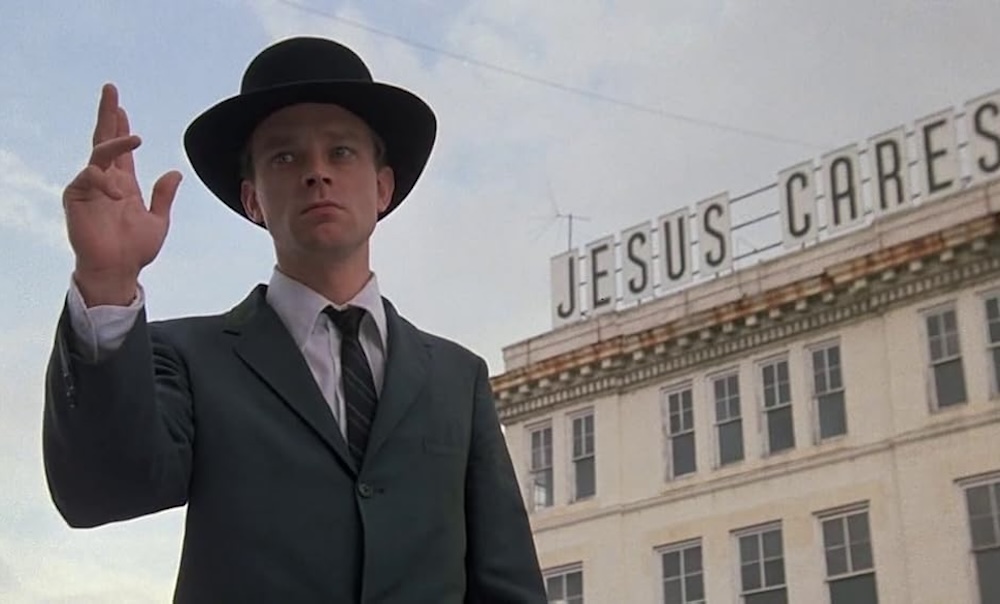
Baby Doll, The Night of the Hunter, Wise Blood: the Southern Gothic canon runs on sexual dread, delusions of grandeur, and preachers you absolutely should not trust. (Ithaca Productions / Athena Film GmBH)
One of the films featured in the Criterion Channel’s “Southern Gothic” series is Baby Doll (1956). It’s based on Tennessee Williams’s one-act plays 27 Wagons Full of Cotton and The Unsatisfactory Supper, which Williams adapted for the screen in collaboration with the most famous interpreter of his work, director Elia Kazan. It begins with the lurid, sexed-up horns of Kenyon Hopkins’s score vamping as if in accompaniment to a strip show as we approach a grimly dilapidated Mississippi plantation house with grimy pillars like the post–Civil War plantation in Gone with the Wind. And there we have in a single film moment a perfect summation of the Southern Gothic. It’s a subgenre that takes a sensationalistic, yet critical and modern, revisionist approach to the culture of the contemporary American South, countering the romantic narrative of the “Lost Cause” that was invented to salve the wounds of losing the Civil War and, along with it, an economic model reliant on slave labor that made a minority planter class obscenely rich.
The South’s collective post–Civil War determination to conjure up something noble and grand out of an evil history of exploitative violence helped create a culture so peculiarly dreadful that it inspired a whole new literary form in the hands of twentieth-century writers who grappled with its shocking effects, led by William Faulkner, Flannery O’Connor, Erskine Caldwell, Tennessee Williams, and Carson McCullers. They were the literary cabal dubbed “Southern Gothic writers,” and they took on the horrors encapsulated in the famous Faulkner line, “The past is never dead. It’s not even past.”
Ruined Abbeys and Ancestral Sins
Whether the past is dead or not, and whether even a dead past will still remain ever-present in ghastly revenant form, is the prime concern of all Gothic narratives. When the Gothic genre first arose in the late eighteenth century, it was in the form of dark melodramatic thrillers powered by both dread and subversive excitement about the idea of the return of the “Dark Ages,” the deeply Catholic medieval era, which was regarded then as a pre–Age of Reason era of barbarity. The form was launched by Horace Walpole (The Castle of Otranto) and Ann Radcliffe (The Mysteries of Udolpho). It was carried forward over the next century and a half by Matthew Gregory Lewis (The Monk), Mary Shelley (Frankenstein), Joseph Sheridan Le Fanu (Carmilla), Bram Stoker (Dracula), Robert Louis Stevenson (The Strange Case of Dr Jekyll and Mr Hyde), Nathaniel Hawthorne (The House of the Seven Gables), Charlotte Brontë (Jane Eyre), Emily Brontë (Wuthering Heights), Charles Dickens (Great Expectations, Bleak House), Wilkie Collins (The Moonstone, The Woman in White), Oscar Wilde (The Picture of Dorian Gray), Edgar Allan Poe (“The Fall of the House of Usher”), Henry James (The Turn of the Screw), and Arthur Conan Doyle (The Hound of the Baskervilles).
Early Gothic works, which became enormously popular, explore the obsession with Gothic architecture associated with harsh old religious beliefs, superstitious rites, crypts and graveyards, and barbaric torture, by establishing morbid settings such as ruined abbeys, forbidding castles, and moldering ancestral homes, all rumored to be haunted. Luckless protagonists, often young, inexperienced, and helpless women, experience harrowing entrapment within these settings where they are preyed upon by human evildoers — often powerful, wealthy, aristocratic men. Supernatural forces are another source of terror, sometimes in the form of ghosts, vampires, or demons, sometimes more ambiguously in the form of overpowering psychological torments — dreams, hallucinations, drug-induced visions, and memory-plagued characters reciting tales of past generational sins so great they overwhelm the consciousnesses of the living.
Gothic narratives tend to bring with them a harsh critique of entrenched power, taking on the abuses of the aristocracy and the hoarders of generational wealth and privilege. Class, race, and gender become inevitable topics in a form that deals with the plight of those victimized by long-established systems of punishment and exploitation.
Later Gothic works — including novels, poems, stage plays, and films — further developed the genre’s central preoccupation with the threatening resurgence of the past in somewhat more prosaic terms. For example, here’s one twentieth-century plot: the deceased wife of a darkly mysterious aristocratic male whose grand family lineage goes back to the medieval era seems to haunt the halls of his ancestral estate house and prey on the nerves of the anxious young second wife. The aristocratic male may or may not have murdered his first wife, see, which doesn’t bode well for wife number two. That’s the plot of Daphne du Maurier’s runaway 1938 bestseller Rebecca, which was adapted as the equally successful 1940 film by Alfred Hitchcock, and it will do nicely to convey the way the preoccupation with the past can be mapped onto contemporary life in later Gothic plots.
A More Recent Past
The Southern Gothic variation fixates on a far more recent but still remarkably terrible past involving vast cash-crop antebellum plantations run by a minority of pampered white families and worked by vast numbers of enslaved black people who were terrorized by fantastically cruel practices, including widespread rape. The children of white Southern aristocratic males and enslaved black women often looked remarkably like their white half-siblings living in luxury on the same plantations.
Cultural authority figures staunchly defended the South’s “peculiar institution.” The clergy used the Bible, citing chapter and verse in innumerable sermons delivered from the pulpit to justify slave ownership and white supremacy.
Meanwhile “poor white” Southerners scratched out a meager living but identified with the rich white planter class in order to see themselves as farther above the lowest rung of a society harshly divided by race and class. After the Civil War impoverished the entire region, a deluded sense of victimization and unjustly degraded nobility seized white imaginations.
All this tends to manifest in Southern Gothic narratives as a heated stew of psychosexual twistedness: perverse sadomasochistic behaviors festering in squalor; sick, exploitative, and obsessive religiosity; ghosts and eerie atmospherics emerging out of blood-soaked soil; and weird delusions of grandeur.
The Child Bride of Tiger Tail
Baby Doll, for example, became notorious for its introductory shot of Baby Doll Meighan (Carroll Baker), a nineteen-year-old “child bride” sleeping curled up in a baby’s crib, sucking her thumb, which became the movie’s poster image and most sensational come-on. She’s being ogled through a peephole poked through the disintegrating wall of their desiccated antebellum plantation house by her husband, middle-aged, harried, racist, alcoholic, and desperately horny Archie Lee Meighan (Karl Malden). He’d promised her dying father, a once-wealthy traditionalist whose fortunes had faded, that he’d wait until Baby Doll’s twentieth birthday to consummate the marriage, and he’s being steadily driven crazy by frustrated lust as well as his own waning fortunes and power.
It seems Archie Lee also promised Baby Doll’s father that she’d live in the grandest house around, which is why he bought Tiger Tail, the pillared plantation house now going to wrack and ruin, though it was the pride of the county about a hundred years earlier. His cotton gin business has been steadily going downhill to the point that the sordid wreck of Tiger Tail is all he could afford, and even the furniture he bought to fill it gets repossessed. This leads Baby Doll to threaten that the deal is off as far as consummating the marriage on her imminent twentieth birthday, since in her view Archie Lee has already reneged on the deal.

Baby Doll, an impoverished girl who was essentially sold off by her downwardly mobile father, has a fourth-grade education but affects grand lady-of-the-manor airs. She’s chaperoned by her fragile, elderly Aunt Rose Comfort (Mildred Dunnock), who clearly suffers from dementia and is almost as incapable of doing any cooking or housework as the pampered Baby Doll. The older female housekeeper-attendant who will offer the inexperienced young heroine no real protection in her hour of peril is a stock Gothic character. But Aunt Rose Comfort is still a necessary chaperone, in part because Baby Doll is afraid to be alone in the plantation house, which she’s convinced is haunted.
The whole rural community is in on Archie Lee’s marital predicament, and many shots are devoted to a Greek chorus of laughing black men. They’re clearly members of an impoverished underclass in the Jim Crow South, but in Baby Doll, they’re also unafraid of demonstrating their mocking amusement at the floundering failures of the white overlords. Humiliated, Archie Lee tries a desperate gambit, setting fire to the cotton gin of a powerful outsider in the community, Sicilian American Silva Vacarro (Eli Wallach), whose superior machinery and savvy have put almost all other cotton gin owners in the area out of business.
Silva, hated by the xenophobic locals but kowtowed to because of his newly acquired wealth and status, strongly suspects Archie Lee of the act of arson, but offers him twenty-seven wagons full of cotton to run through his rickety cotton gin so Silva can be on the spot at Tiger Tail and get proof of what Archie Lee has done. Silva has his own ways rooted in ancient Sicilian culture that he often brags about, such as an inclination toward vigilante justice that rivals the well-known lynching practices of Southerners. But he’s perceived as a figure of the New South — bringing industry and business savvy, traits once associated with the Yankees, to the supposedly more arcadian Old South.
Silva coerces a signed affidavit out of Baby Doll attesting to the fact that Archie Lee burned down Silva’s cotton gin. In the process, Silva also vengefully seduces Baby Doll — a seduction aided by the ghosts in the plantation house that Silva imitates, creeping around making noises in adjacent rooms until Baby Doll is grateful for his company.
Archie Lee is only dangerous once he’s driven to the wall by Silva. He’s got his own ties to the entrenched “old boys’” network in the area, and they know how to deal with troublemaking outsiders. That’s when Baby Doll is finally frightened of Archie Lee, enough to urge Silva to flee, because these “old boys” are the dispossessed and ruined cotton gin owners put out of business who are also clearly members of the Ku Klux Klan. Their nighttime approach probably means vigilante “justice” and violent death.
Vengeance at the Girls’ School
Baby Doll is unusual among Southern Gothic films, in that it incorporates a dark version of screwball comedy in many scenes involving the absurd goings-on in and around the plantation house. Most Southern Gothics are relentlessly grim and melodramatic. Take, for example, the extraordinarily weird and wonderfully dread-filled Don Siegel movie The Beguiled (1971), which is rare among Southern Gothics in being a period film set during the Civil War. The present in this film is the already war-destroyed South, even as the war continues in its last year. A wounded Union soldier (Clint Eastwood) trapped behind enemy lines persuades the headmistress (Geraldine Page) of a girls’ school — located in what was formerly a working plantation house — to take him in and let him recover there in hiding.
In order to prevent anyone from turning him over to the Confederate troops camped nearby, he uses all his considerable seductive power on the lonely, poor, and frightened women and girls of the school, including the sole enslaved woman still working there (Mae Mercer). His first transgressive “conquest” is the lingering kiss on the lips that he plants on a twelve-year-old schoolgirl. But soon his arrogance in seducing several young women and girls there, while rejecting the advances of the middle-aged headmistress, backfires on him and instigates a frenzied maenad attack of lust-fueled jealousy and hatred. Under the direction of the headmistress, his wounded leg is amputated in an act of vengeance, and though he’s badly impaired, the stage is set for a contest of vicious reprisals.

There’s still a terrible past to be revealed by the Union soldier — it’s the headmistress’s long-term, incestuous relationship with her late brother, who was the rich plantation owner before the war.
The deep-rooted psychosexual sickness powers most Southern Gothics, even those films in the series that lack other important Southern Gothic traits. Cape Fear, for example, both the 1962 and 1991 versions, generates terror through the monstrous villain Max Cady, a sadistic, drawling Southern ex-con who seeks revenge on a lawyer he blames for his lengthy imprisonment, and who has studied enough law to master the system and use it to enable his violence. His brutal rape and torture of a local woman — who is too frightened of him and the punishing processes of the legal system to bring charges against him — is only a rehearsal for the ultimate vengeance he has planned. That is, similarly savage attacks on the lawyer’s wife and teenage daughter.
The False Preacher
Charles Laughton’s 1955 masterpiece The Night of the Hunter is a unique film that’s also on the edge of the Southern Gothic, but it has the subgenre’s familiar figure of the corrupt or false or disturbingly fanatical preacher. In this case, it’s Harry Powell (Robert Mitchum), who has no official place within an established church but follows a bloody religion, “the religion the Almighty and me worked out betwixt us.” The Powell character was based on a real-life West Virginia serial killer named Harry Powers, hanged in 1932, who answered lonely hearts ads placed by widowed women, marrying them and then killing them for their money. Harry Powell also lives off the money stolen from murdered widows, and his entire religion of violence is powered by a twisted misogyny. Observing that there is plenty of killing in the Lord’s own book, Powell decides God only clearly hates the soft, seductive allure of women. He attends a strip show to foster his own rage, and the phallic switchblade he carries in his pocket shoots the knife through the cloth in a grotesque substitute for sexual erection and release.

This is the nightmarish figure who’s coming after the small-town widow Willa Harper (Shelley Winters) and her two children (Billy Chapin and Sally Jane Bruce). He believes they still have the money stolen by her bank robber husband who — before he was hanged for his crimes — briefly shared a cell with Harry Powell. Powell’s terrorizing of the little family is so harrowing an experience you’ll never forget this film once you’ve seen it.
The Church Without Christ
But perhaps the most unsettling and strangely little known of the great films in the series is John Huston’s Wise Blood (1979), based on the 1952 novel of the same name by Flannery O’Connor. It’s about Hazel Motes (Brad Dourif), a young Southerner and veteran of an unnamed war who returns home bent on an enigmatic religious mission. Himself the grandson of a fanatical preacher who raised him (played by John Huston), shown in flashback, he sets about preaching his own invented religion, the “Church of Truth Without Christ.” Repudiating all notions of evil or an afterlife or Jesus Christ’s redemption of a sinful humanity, Hazel begins to draw a curious crowd in the street only to have an eager con man (Ned Beatty) try to join forces with him as his promoter, seeing it as a great moneymaking scheme. When Hazel furiously rejects him, the con man simply finds a homeless man and dresses him up in the same preacherly suit and hat as Hazel’s and sends him out into the street to approximate the same speech.
Hazel is impeded in his serious aims at every turn. A lonely, addled street boy named Enoch Emory (Dan Shor) hero-worships him and tries to earn his friendship, telling him he’s found a better Jesus in the form of the shrunken, mummified corpse of a South American man that’s on display in the local museum. Hazel’s own attempts to befriend an itinerant preacher (Harry Dean Stanton) who is known to have blinded himself in a fit of religious self-martyrdom, run aground when the preacher’s supposed daughter Sabbath Lily Hawks (Amy Wright), an abused young woman who’s come to revel in feeling like she’s in a debased state of sin, falls in love with him. Then Hazel makes a test of the preacher’s blindness and finds out he’s faking it.
This event is crushing, because it goes back to Hazel’s own childhood religious agony. His obsession with removing Jesus Christ from religion goes back to his early youth when, apprised of Christ having died for our sins, he muttered “I never asked him to,” and tried to work off the moral debt and sense of guilt by walking around with stones in his shoes. It’s only a matter of time before Hazel is driven to make good on the fake-blind preacher’s outrageous con. Hazel blinds himself with quicklime. He also wraps barbed wire around his naked chest under his shirt and, yes, puts all those stones back in his shoes.
But even these gruesome attempts at self-salvation only create more prosaic and entangling obstacles to any serious religiosity. His slightly batty middle-aged landlady, who objects in scandalized tones to his extreme religiosity as “not normal,” nevertheless falls in love with him and becomes determined to take care of him for the rest of his life. He ends up trapped and helpless in a dingy bedroom, barely alive but not allowed to die a martyr’s death because the landlady won’t let him.
And I should add, peppered through much of this relentlessly bleak film is the darkest of dark comedy.
More dark comedy would’ve helped Wildcat (2023), a biopic about Flannery O’Connor’s short but prolific life as a Southern Gothic writer in her native Georgia. Nevertheless, it’s a good companion piece with Wise Blood. O’Connor herself wound up trapped in a small room in her mother’s house after lupus — which had also killed her father at a young age — began ravaging her system, though the room also became the writing space where she did her greatest work.
Ethan Hawke directed and cowrote the ambitious script with Shelby Gaines, and his daughter Maya Hawke plays O’Connor starting off as a young writer having liberating experiences both personally and professionally in New York City before the disease puts an end to her freedom. Maya Hawke also plays several of the female characters in O’Connor’s short stories, including Lucynell Crater of “The Life You Save May Be Your Own,” Mary Grace of “Revelation,” Star Drake of “The Comforts of Home,” and Joy “Hulga” Hopewell of “Good Country People.”
Her mother Regina (Laura Linney) tries to be supportive. But she doesn’t understand or approve of the harsh, unsparing qualities of her daughter’s literary portraits of Southern life. And Regina has many maddening traits of “respectable” middle-class Southern white women, including virulent racism and inflated notions of her own virtue, that will be faithfully represented in Flannery O’Connor’s fiction.
O’Connor was a serious-as-a-heart-attack Catholic preoccupied by what it would require to attain a virtually impossible state of grace. Her struggles are represented in the film in various ways including her tortured talk with an Irish Catholic priest (Liam Neeson) and her conversations with the bright young atheistic literary set in New York City. A sophisticated young woman, who’s supposed to be ex-Catholic writer Mary McCarthy in a recreation of an actual 1950 party scene, offers the bromide that the rite of the Eucharist in the Catholic Mass should be seen as a “beautiful symbol” of human salvation through Christ rather than a truth to be taken literally. Confronted with this squeamishness about consuming the transubstantiated body and blood of Christ, O’Connor retorts in implacable Hazel Motes style, “Well, if it’s a symbol, to hell with it.”
The Southern Gothic series offers an embarrassment of riches when it comes to examining elite abuses of power over several generations. Such long-standing abuses create in many of these narratives an overpowering atmosphere of evil that characters often mistake for something supernatural, or that pushes them toward their own outlandish cruelties, or a morbid and brutal religiosity. Taken together, these films constitute a sensationalistic reckoning with the grim legacy of Southern culture in the United States.