The Corporate Thriller Lied to Us
Criterion Channel is hosting a retrospective on Hollywood’s “corporate thrillers” from the 1980s through the early 2000s. If anything, their message about the capitalist rot in America’s institutions looks far too tame for how the last couple of decades turned out.
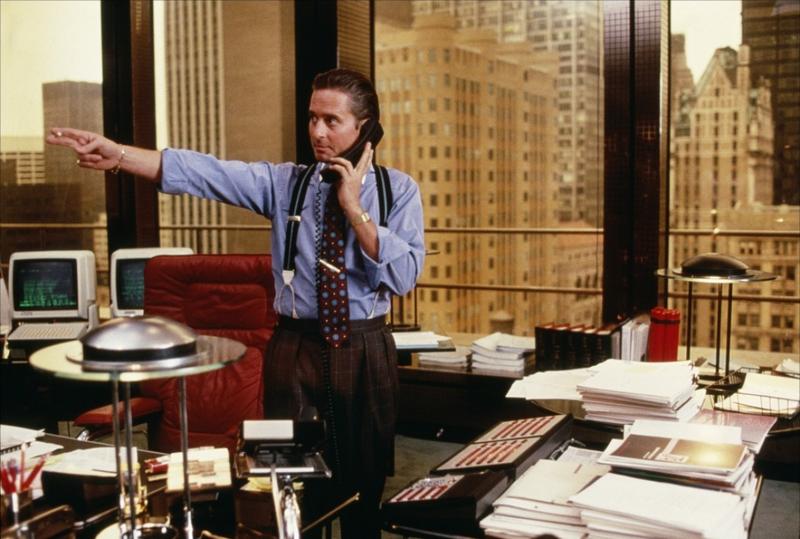
Michael Douglas in Wall Street. (20th Century Fox)
I never got into the corporate thrillers of the 1980s, ’90s, and aughts, the subject of a new retrospective at the Criterion Channel. These films tended to involve plots and characters that ostentatiously deplore that world of greed and wrongdoing, but that deploring generally requires a long, lingering, lascivious process of glamorizing evil excesses.
They’re rather like Cecil B. DeMille’s biblical epics that proved wildly popular for decades, such as The King of Kings (1927), The Sign of the Cross (1932), Samson and Delilah (1949), and The Ten Commandments (1923 and again in 1956). Their spurious piety in condemning sin provided a perfect excuse for depicting it on a tantalizingly vast scale. Sign of the Cross even features a sequence in which a nearly naked Christian woman is tied up and presented to a gorilla in the Roman colosseum. Just another pious biblical epic from Hollywood.
But I have to admit, my prejudice against the genre led me to miss some pretty good films. Now that Criterion Channel is running a ten-film Corporate Thrillers series, I’ve finally seen Primal Fear (1996) and Michael Clayton (2007), for example, both remarkably solid dramas that insist on the dark, serious malevolence of our capitalist world in a way that some of the goofier works do not — looking at you, The Devil’s Advocate (1997).
That tendency toward cartoonish nonsense is a major strain in the genre, which is how we wound up with Disclosure (1994), that ludicrous Hollywood response to Anita Hill’s landmark 1991 accusations of sexual harassment against Supreme Court nominee Clarence Thomas. He was confirmed anyway, but Hill’s dignified charges led to an early version of the #MeToo movement as women all over the United States aired their own experiences of having to work jobs in sexually threatening or demeaning circumstance.
So naturally, the American film industry came out with a topical thriller about a female CEO, played by Demi Moore, who sexually harasses her male subordinate (Michael Douglas), a gender reversal that happens in real life in only a minority of reported cases.
Influential forerunners of the corporate thriller were the paranoid conspiracy thrillers, aka political thrillers, of the 1970s, such as The Parallax View (1974), The Conversation (1974), Three Days of the Condor (1975), and All the President’s Men (1976) that tended to reveal corrupt government wrongdoing on a vast scale. The genre provided opportunities to directors such as Sydney Pollack (Three Days of the Condor) and Alan J. Pakula (The Parallax View, All the President’s Men) to make the best films of their careers. They brought film noir moods to social realist directing styles.

But the Reagan era of the 1980s, when deregulation gave big business the chance to seize power and operate without state interference — with, in fact, government collusion — shifted the center of menace to corporations and the law firms that defend them, kicking off a new movie genre with Oliver Stone’s Wall Street (1987) and Pollack’s The Firm (1993). Shifting from political to corporate/legal thrillers, Pollack also did Absence of Malice (1981), and — if you include his work acting and producing — Michael Clayton, while Pakula directed Harrison Ford in Presumed Innocent (1990) and Denzel Washington and Julia Roberts in The Pelican Brief (1993).
And soon the pattern was set for one popular plotline that recurs over and over, about an ambitious young man, generally white and working-class, who desperately wants a lush life in the big time — Tom Cruise plays him in The Firm, Charlie Sheen in Wall Street, Keanu Reeves in The Devil’s Advocate. This character gets mentored by a smooth Machiavellian boss in how to achieve his careerist ends at any cost. In Wall Street, the role of ultimate corrupter Gordon Gekko was played by Michael Douglas, and his “greed is good” speech became emblematic of an era of ruinous, turbocharged capitalism.
In such films, there’s always a twisted father-son relationship between mentor and mentee — in Taylor Hackford’s The Devil’s Advocate, it turns out the Keanu Reeves’s character is the literal son of Satan, played by Al Pacino — which makes the initial seduction-of-the-innocent scene particularly sickening. In this scene, the eager young naif is fed a smooth but startling line of talk, the mentor-father’s personal philosophy, about the rewards of transgression of laws and all sense of human decency, while he’s shown what those rewards will be.

Generally, they involve a lavish house or apartment, an expensive suit, a flashy car, and almost inevitably, a gorgeous young woman throbbing with hypersexuality. The young man has often got a wife or girlfriend already in tow who will soon be shunted aside as he works impossible hours trying to impress his mentor-father and increasingly pants after the sexier woman being dangled before him by the mentor-father.
Daryl Hannah plays that character in Stone’s Wall Street, and she’s the former girlfriend of Gordon Gekko, creating an incestuous entanglement that gooses up the Freudian horrors when the naif discovers how wrong he’s been to follow in the path of the mentor-father-corrupter. Pacino’s gleeful, puckish Satan in The Devil’s Advocate has a glamorous daughter-slash-girlfriend, played by Connie Nielsen, to hand off to his more-than-willing son. Incredibly enough, the supposedly more down-home wife/girlfriend to be shunted aside is played by Charlize Theron early in her career.
The Hollywood Corporate Thriller Identifies the Rot in America
Young men in these films who dream of corporate success may initially protest the idea of breaking laws or committing immoral acts. But they are quickly pulled in, surrounded as they are by everyday examples of petty ambition and unethical behavior. At a deeper level, they’re already inclined toward corruption. By now, that tendency feels embedded in the American psyche.
However, lip service must be paid to virtue in mainstream Hollywood films, and lesson-learning is an inevitable part of the genre. The protagonist always has to go through a process of investigation and discovery as he finds out how deep and dangerously widespread the corruption is just in time to turn around and fight for his life, possibly for his wife/girlfriend/family member, and definitely for whatever’s left of his blackened and shrunken soul.
The specifics can be changed, of course, to pivot in more topical directions. Instead of a stock brokerage firm o law firm as the main setting and situation, you can have a high-tech computer company run by an apparently nerdy Bill Gates–like figure as the mentor-father-corrupter (Tim Robbins) as in 2001’s Antitrust.
He brings in the naif, a young genius coder (Ryan Phillippe), who soon neglects his old girlfriend (Claire Forlani) for a hot young woman coder (Rachael Leigh Cook). During the big reveal of how bad the threat to civilization really is, she turns out to be the Bill Gates figure’s secret girlfriend and sidekick in high-tech menace. Though there’s an extra twist when it’s revealed the old girlfriend is yet another Bill Gates’s sidekick who might also be about to murder our too-inquisitive antihero.
There’s a major plot variant in other corporate thrillers as the genre ups the ante in representing generalized corruption. Sometimes, the character representing young innocence in the United States is either diminished or omitted entirely. This plot involves the older but still heart-throbby antihero who’s already ultrasuccessful and thoroughly corrupt at the beginning of the movie.
At some point early on, he delivers a heartless spiel that’s usually the function of the mentor-father-corrupter. For example, Richard Gere plays this slickster in Primal Fear, a Chicago lawyer famous for defending obviously guilty clients for huge fees and appearing on the covers of glossy magazines. He starts the film bragging about his off-the-charts success rate and ruthless personal philosophy to a relatively innocent reporter, reduced to a very small character who’s merely a sounding board for Gere’s lawyer.

So how to go from there, an already thoroughly corrupted state, to a plunge into even more limitless levels of malevolence? Gere’s character becomes unusually invested in a young male defendant — Edward Norton in his breakout performance — that he’s convinced is actually innocent for once. He’s been accused of the gory murder of a priest — and here’s where the young naif returns in a new and alarming form.
Norton earned accolades here for his vivid portrayal of the young man as he gradually reveals the many faces of his trickster character. Is he the innocent naif, sexually abused by the priest for years but nevertheless not guilty of his murder? Or is he only partly innocent because he’s schizophrenic, with a split personality, and it’s his sly and brutal alter ego who did the murder — perhaps even several murders? Or is he yet another client who’s guilty as hell, only this one has been able to play Gere’s supposedly wised-up lawyer like a mandolin?
Michael Clayton has a similar broad structure, starting with George Clooney as the graying and already-corrupt “fixer” — or as he puts it, “garbage man” — at a top law firm who cleans up the worst criminal messes made by rich but vile clients. And he needs his high-paying job because he’s a gambling addict in ever-deeper debt to shady characters. This adds to his intense self-loathing, and he’s looking for redemption as he’s handed a particularly nasty job, which involves taking care of the mess made by a top litigator in the law firm, played by Tom Wilkinson, who’s acting out publicly in an apparently psychotic state.
He’d been handling the defense of an agricultural conglomerate accused in a class-action suit of poisoning the environment with a toxic weed killer, and he’s now raving about offering proof that the conglomerate is guilty. But in the process of trying to contain his colleague, Clayton gets drawn into the bottomless evils of agrobusiness.
Michael Clayton offers a good example of the handsome A-budget production quality and top talent often involved in the corporate thriller, which is generally a prestige genre. It often takes on some of the seriousness of the regular drama, meant for adults, which was once a typical offering at movie theaters but increasingly became a box-office liability and migrated to television.
Michael Clayton not only made a lot of money, it also got nominated for many Academy Awards including Best Picture, Best Director, and Best Original Screenplay for writer-director Tony Gilroy (who wrote the Bourne action films and also made his remarkable directing debut here), Best Original Score, Best Actor (Clooney), and Best Supporting Actor (Wilkinson).
The only actual Oscar winner, for Best Supporting Actress, was Tilda Swinton for her performance as a variation on the “naif” figure, an anxious, ambitious lawyer given her big chance when she’s appointed general counsel to the agricultural conglomerate and then discovers how appallingly far she’s willing to go for career success.

Some of these films are worth watching just for the extraordinary amount of fabulous acting talent. Primal Fear, for example, not only stars Gere and Laura Linney and features Norton in his star-making role, it also has Frances McDormand, John Mahoney, and Alfre Woodard, and in small parts, Andre Braugher, Maura Tierney, and Terry O’Quinn.
Similarly, The Firm stars Tom Cruise, Gene Hackman, and Jeanne Tripplehorn, but it also has Holly Hunter, Ed Harris, Hal Holbrook, Gary Busey, and David Strathairn in supporting roles, and in small parts, Wilford Brimley, Paul Sorvino, and Karina Lombard. The fact that, not that long ago, big studios made these thoroughly adult films and put them on the big screen with real money behind them seems unthinkable in the 2020s.
The high production values and deep talent pools serve to augment the serious themes of these films that profess to expose how deep the rot goes in our capitalist system. But at the same time, formula films, no matter how earnest or solemnly presented, are generally reassuring and tend in a problem-solved way.
The rot is exposed, the worst of the perpetrators are stopped, killed, ruined, and/or imprisoned, and the protagonist is sadder but wiser. Virtue may not be triumphant — in these films, it’s always at least a bit hollow at the beginning, and pretty thoroughly eviscerated by the end. But the damage done and regret of the antihero stands for some sort of reckoning with a society that grows more monstrous by the minute.
The Corporate Thriller Tracked the Rise of America’s New Oligarchy
This is a genre that often alludes to the real-life corporate evildoers we will come to know better. For example, in The Devil’s Advocate, Craig T. Nelson plays a loud, crass billionaire who’s charged with murdering his wife when she threatened to leave him. He lives in a mansion made into a ridiculous spectacle of bad taste by the tacky gold-leaf adornments emblazoned on every wall. The guy is such a universally despised bozo that the antihero defends him in court by declaring outright how loathsome he is. While his wife was being murdered, it seems, he was shacked up with his hot office assistant.
Yes, it’s very clear that Donald Trump, prepresidency, was the inspiration for the character.
A few corporate thrillers sound more serious warning notes in these too-mild cautionary tales by ending the films on shots craning up and out to God’s-eye-view heights. It suggests that the whole world is both endangered and implicated in this prevailing social degeneration. Stone’s Wall Street ends with just such a closing shot of Sheen’s repentant character walking up the broad marble steps of the New York County Courthouse to give himself up for insider trading, a drop in the bucket — in the ocean — of corporate sleaze.
And Primal Fear creates the same sky-high shot of Gere’s traumatized lawyer, walking away from his last jailhouse meeting with Norton’s trickster-killer after he congratulates the lawyer for acting, essentially, as his partner in crime. He stops in his tracks as if not knowing where to go or how to proceed after confronting his own shallow, over-confident cynicism, which came nowhere near comprehending the human capacity for malevolence.
Nevertheless, one of the more poignant aspects of watching these films now is seeing how quaint they seem, even while they’re demonstrating how aware we were decades ago of being on a ruinous path. Just how ruinous and how fast we’d barrel down that path, however, is the knowledge we now bring to them.
These corporate thrillers tend to seem leisurely and padded, only rarely evincing the raw edge of terror that’s called for. The 1970s political thriller did a better job of conveying how surreally bad things were back then — and how much worse they were going to get. After watching the Criterion Channel’s offerings, which are fascinating in their way, it’s probably time to revisit the more prescient political thrillers of the 1970s. Those were the films that truly got to our rotten core.