Zach Cregger Made a Resident Evil Movie With Bite
Zach Cregger has never seen a Resident Evil movie, and that’s definitely for the better. His reboot is a fast, funny, scary blast of pure genre filmmaking and a darkly comic portrait of a society past collapse.
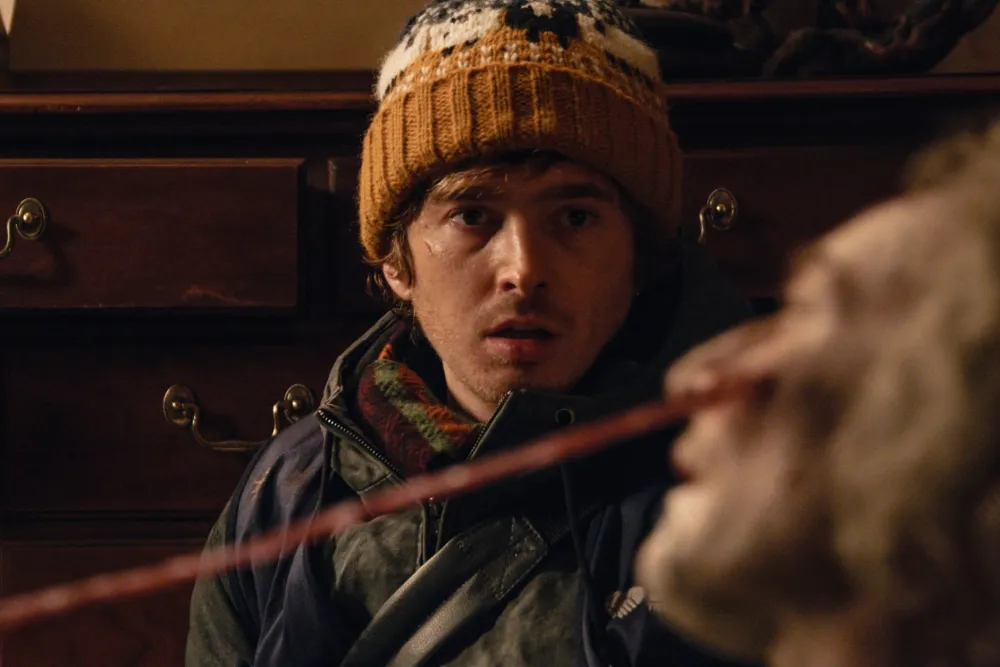
Fresh off of Weapons and Barbarian, Zach Cregger is back with a shockingly good reboot of the Resident Evil franchise. He’s three for three now. (Sony Pictures)
Zach Cregger’s horror-comedy Resident Evil is a real blast of a movie, fast, funny, scary, and inspired. Only an exuberant film lover could come up with such a gleefully inventive ninety-five-minute thrill ride as this one.
I gather that Cregger is a fan of the Resident Evil video game franchise. That seems like the only possible explanation for why the acclaimed director of highly praised non-IP horror hits Weapons (2025) and Barbarian (2022), who presumably has a blank check to make any horror-related movie he wants, would choose to make the eighth Resident Evil entry in the twenty-four-year-old franchise.
The reason certainly isn’t his love for the previous films. In an interview, he was unable to define what his version of Resident Evil is in relation to the rest of the movies — “A sequel? Prequel? Universe-expanding retro-reboot?” Cregger answered with a shrug. “I couldn’t really say. I’ve never seen one.”
To Hell With the Franchise. Just Make a Good Movie.
Fans of the films won’t like it, but I say this is the right attitude. Though some people claim that Cregger’s Resident Evil really conveys the sense of playing the game. Maybe it does. I don’t care. I don’t think it matters one single, solitary damn. I only care about how it plays as a stand-alone film, and as a stand-alone film, it’s delightful as hell.
It stars Austin Abrams, who was so memorable as James, the addled young drug dealer living in a pup tent in the woods in Weapons. He plays Bryan, a harried twentysomething medical courier up against a crazily escalating series of gruesome attacks by “fucking monsters” as he tries to deliver an unidentified but urgent package to the remote rural Raccoon City hospital up in the wintry hills.
Bryan is a callow young man in most ways, and perhaps not the sharpest knife in the drawer. But he brings an excessively dogged dedication to this courier job that makes him a comic example of Jean-Paul Sartre’s “bad faith” actor who’s allowed his identity to collapse into his professional role. Though there’s one complicating factor explaining his absolute desire to take on this last, voluntary delivery of the night: Bryan doesn’t want to go home. If he goes home, he has to have a serious face-to-face talk with his girlfriend, Michelle. She’s just discovered she’s pregnant, and she’s increasingly upset about Bryan’s glib answers on the phone that serve as a way to dodge any in-depth consideration of their relationship. It seems Bryan will face a thousand lab-created killer mutants on the loose rather than have that talk.
Besides, delivering this package pays double Bryan’s usual rate. Given the grim economic times we live in, that’s motivation enough for most.
There’s a glorious initial horror sequence — let’s call it the mountain road sequence — with so many lines of tension developing toward bloody disaster, the delirious viewer gets tied in knots just watching it. Bryan goes skidding up a heavily forested mountain road at night, his beat-up little car not equipped with the tire chains he’s been told are a necessity. In front of his meager headlights, the road fades into terrifying blackness. Michelle is on the phone with him, but at critical points in their angsty conversation, the reception keeps dying out.
Just then — heart attack — a woman steps out from the snowy void right in front of him, and he brakes wildly but hits her anyway, tossing her up over the roof of his car. He swerves to a stop and gets out, horrified at what kind of gore he’s about to see. But all he can find are tracks in the snow heading off into the trees.
Inadequately dressed in a puffy jacket and crappy sneakers, and relying on the thin light generated by his cell phone, he follows the tracks into the wilderness of trees, absurdly calling “Hello? Hellooooo?”
He finds the woman, pale and staring, lying on her back, apparently alive but catatonic, with her contorted arms held out stiffly in front of her. As Bryan creeps up to her, we see him from her point of view, his head framed in the weird rectangle made by her arms.
“Good gods,” I thought. “Cregger’s recreated the shot from Rashomon.”
That’s Akira Kurosawa’s famous art film, released in 1950, which also serves as a dire referendum on Japanese culture post–World War II. In it, the complex central narrative commences when a woodcutter discovers a dead samurai in the forest. It’s a shocking event that will lead to an investigation and a series of deeply degraded, self-serving, and blatantly unreliable courtroom accounts about how the samurai died that indict a culture fallen into a moral abyss, and perhaps a humanity that’s truly irredeemable. And that’s the surreal shot from the dead samurai’s point-of-view, his reaching arms frozen in a state of rigor mortis framing the woodcutter’s face, that Cregger is evoking.
A Darkly Comic Portrait of a Society at Collapse
It’s both harrowing and funny for the 0.0000001 percent of the audience that gets the reference — film studies teachers everywhere will love it — because in an amusing genre-flick way, the reference is significant. This Resident Evil is creating a black comic portrait of a culture that’s probably past saving. The way people continue to follow their petty job descriptions and ignore the absolute catastrophe that’s staring them in the face — that’s soon biting and zombifying and mutating and consuming them — is summed up in Bryan’s stubbornly repeated lines, “That didn’t happen,” and “That wasn’t real.”
But at the same time, it’s not ordinary people’s fault. As systems collapse all around them, a job these days is a hard-won lifeline.
There are a lot of homages to other films — John Carpenter’s The Thing and Ridley Scott’s Alien are obvious ones — but many aren’t even references to other horror movies. For example, there’s the Die Hard–like scene when Bryan faces up to the fact that his situation is so desperate, he’ll probably never make it back to have that serious talk with Michelle. So via cell phone. he leaves an emotional apology and affirms his devotion to her in a heartfelt too-late-now message before he goes into the final climb up to the twenty-eighth floor of the Raccoon General Hospital building to deliver his package. And, like in Die Hard, he ends up doing it all without shoes.
But back to the mountain road sequence. It goes on and on as a tour de force of pitiful human striving and error on Bryan’s part and increasing dread and nervous laughter for the audience. Bryan gets the catatonic woman into the car and tries to drive her to safety, ignoring her increasingly feral behaviors. Then he gets pulled over by an irritable local sheriff (Johnno Wilson) — relieved to offload the woman onto the police officer — and then all hell break loose on the road. Cregger keeps returning to deep-focus shots of the entire frozen landscape encompassed in the sequence, while adding new elements of terror into a frenzied chase involving a vicious dog that’s not just an ordinary dog, the wrecked and abandoned vehicles, the catatonic woman suddenly fully mobile and racing through the snow with animal speed, and Bryan’s sprints to a barn for shelter from weather and other, more urgent dangers. Then he tries to find sanctuary in a farmhouse, going from homely room to room and venturing up the dark, doomy stairs — yes, that’s Night of the Living Dead, folks.
Far in the background, the flashing red-and-blue light bar on the police car is a haunting constant, a visual sign of urgency as well as a landmark indicating the spot where the surreal crisis state started for Bryan. It’s also an indicator of splendid filmmaking from start to finish, so good that the rest of the movie can’t quite live up to it.
The catastrophic harm done by the biotech firm the Umbrella Corporation, which unleashed the experimental substance that infects and monstrously mutates whatever living beings come into contact with it, is ludicrously downplayed as a minor “human error” by its officious representatives, played by great comic actors Paul Walter Hauser and Zach Cherry. It turns out Bryan is carrying, instead of a kidney or other lifesaving organ to be transplanted, the “stabilizer” that can cure the infection and undo the mutations — it’s not just a McGuffin, it’s the solution to all the chaos!
Even knowing how crucial his mission is can’t propel him to the top level of the hospital, however, when he finds out he’s expected to walk up all twenty-eight floors. It’s dangerous to take the elevator in a collapsing building blinking and buzzing with electrical shorts, a building which also happens to be teeming with kill-crazy mutants. But Bryan is dead-tired by the fourth floor. After all, how bad can the elevator be?
You should go see the movie and find out. And without spoiling anything, it’s quite an ending! Cregger’s Resident Evil is an unexpectedly refreshing exercise in pure genre film entertainment, and it’s quite rightly doing gangbusters business. Cregger has done it again: he’s three for three now.