Great Cinematic Odysseys to Prepare You for The Odyssey
From Preston Sturges and the Coen brothers to Martin Scorsese and John Ford, the Criterion Channel’s “Odysseys” series traces the enduring appeal of Homer’s epic in American cinema.
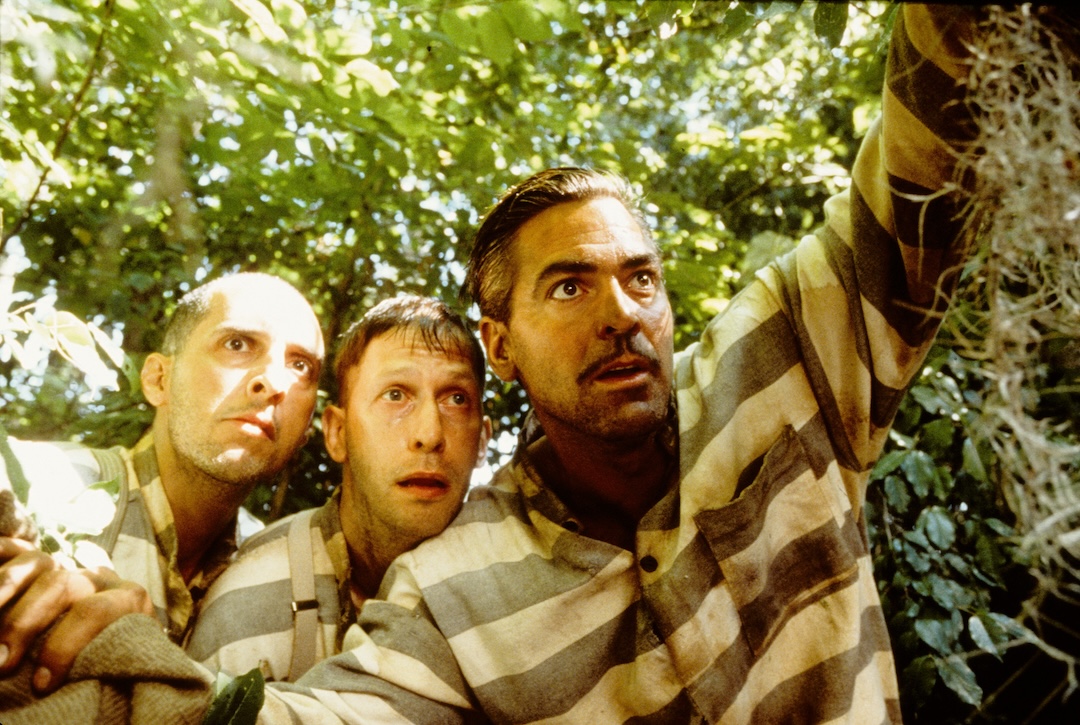
John Turturro, Tim Blake Nelson, and George Clooney in the Coen Brothers’ Odyssey-inspired O Brother, Where Art Thou? (Touchstone Pictures)
There’s a new Criterion Channel series called “Odysseys” that is clearly meant as a tie-in with Christopher Nolan’s upcoming much-anticipated epic The Odyssey opening soon.
But before I get into the Criterion film picks, I must note that I have now had this conversation a few times in the past month when discussing, in vague ways, summer movie releases:
Me: The next one I have to review is The Odyssey.
Them: What’s that one about?
Me: It’s, you know, THE Odyssey.
Them: [blank stare]
Me: Homer’s Odyssey? Odysseus? Trying to get home after the Trojan War? Sirens? Cyclops? All that?
Them: [faking recognition] Oh! Oh, yeah. Right, right. That Odyssey.
So it’s a braver thing than it might seem to create a film series relating both to Homer’s epic and “that big new Christopher Nolan movie starring Matt Damon,” without even specifying the connection, on the assumption that you’ll get the connection without being told. Over at Criterion Channel, they’re like the Irish monks of medieval times who preserved the knowledge of a whole civilization in illuminated manuscripts. They go right on with their work, regardless of what kind of ignorant claptrap has taken over in the outside world.
Of the films chosen by Criterion coprogrammer Sean Fennessey of The Ringer podcasts, only O Brother, Where Art Thou? (2000), the delightful roots-music-driven comedy written and directed by Joel and Ethan Coen, is directly referencing The Odyssey throughout. Set in hardscrabble Depression-era Mississippi, it’s about a glib conman and tale-spinner named Ulysses Everett McGill (George Clooney) who breaks free of a Mississippi chain gang with the two fellow prisoners manacled to him, Pete and Delmar (John Turturro and Tim Blake Nelson). Everett’s in a hurry to get home because he’s heard his estranged wife, Penny (Holly Hunter), is being courted assiduously and might soon remarry.
But Everett tells his pals nothing of his real motives, beguiling them instead with a tantalizing tall tale of a cache of bank robbery money that must be recovered within a few days, before Franklin Delano Roosevelt’s government floods the Tennessee Valley and “hydro-electrics up the whole dern state.”
On their journey, the trio of escapees encounter many obstacles, all predicted by a blind seer just as in Homer’s Odyssey, here depicted as an old man working a pump trolley along a railroad track:
You seek a great fortune, you three who are now in chains. You will find a fortune, though it will not be the one you seek. But first . . . first you must travel a long and difficult road, a road fraught with peril. . . . I cannot tell you how long this road shall be, but fear not the obstacles in your path, for fate has vouchsafed your reward.
Their obstacles include appropriately Homeric encounters with three seductive women washing clothes in a stream who waylay them with the lure of sex and moonshine whiskey (the sirens); a huge, one-eyed, silver-tongued Bible salesman who robs them, played by John Goodman (the Cyclops); a distracting lakeside community baptism ceremony where both Pete and Delmar suddenly get religion in a full-immersion rite (the lotus eaters interlude); and a terrible nighttime, torchlit, murderous sequence at a Ku Klux Klan rally (a variation on Odysseus’s trip to the underworld).
O Brother, Where Art Thou? even begins with an intertitle featuring the opening line from Homer’s epic:
O Muse! Sing in me, and through me tell the story
Of that man skilled in all the ways of contending
A wanderer, harried for years on end. . . .
Ulysses Everett McGill is that harried wanderer and “man of constant sorrow” who ultimately finds a great unexpected treasure in the local music constantly played and sung by black and white Southerners all over the place. They’re so familiar with it, they have no idea of its tremendous worth. This theme is signaled by the first song in the film, “Po’ Lazarus,” sung by actual chain-gang prisoners of the Mississippi State Penitentiary, who created the percussive sounds with the axes they were using to cut logs. It was recorded in 1959 by famed ethnomusicologist Alan Lomax, who feared the loss of a precious legacy and went around recording many musical performances of ordinary people in the United States and Great Britain from the 1940s through the 1960s.
Ironically, given the movie’s many citations of its source material, Joel and Ethan Coen always maintained that they never read The Odyssey. This is probably not true, as the Coen brothers are notoriously prankish tall-tale tellers themselves. Tim Blake Nelson, who was a classics major at Brown University and had definitely read The Odyssey, is on record as saying he didn’t believe them.
Though in the old days, it was a common phenomenon for people to know a fair amount about texts they never read. Certain canonical works had so permeated the culture, people knew them at secondhand, never having read the primary source material — even if they were assigned it in high school. It used to be pretty easy to pass for greater erudition than one had by soaking up plenty of info through general reading and pop culture references.
Homer by Way of American Slapstick
The Coens certainly did know at firsthand a different source for their film: Preston Sturges’s great 1941 comedy Sullivan’s Travels, which is another “odyssey” movie included in Criterion’s series. It’s about a popular Hollywood movie director, John L. “Sully” Sullivan (Joel McCrea), who specializes in slapstick comedies but longs to deal with serious social issues by adapting a realist Depression-era novel entitled — get ready for it — O Brother, Where Art Thou?, which suggests that the Coens were attempting to at long last make Sully’s big important picture themselves. Trying to dissuade the young director, Sully’s two studio bosses mock his lack of real-life experience of poverty and suffering:
What do you know about trouble? . . . You want to make an epic about misery. You wanna show hungry people sleeping in doorways. . . . You wanna grind ten thousand feet of hard luck, and all I’m asking you is, what do you know about hard luck?
But the gambit backfires when Sully admits to his shame that he went right from an expensive boarding school to college to a career as a successful Hollywood director. Rather than giving up the project, he decides to educate himself. He puts on ragged clothes and goes out into the world with nothing but ten cents in his pocket and a determination to share the suffering of the common people.
Many comical adventures ensue as Sullivan gets tailed on the road by a promotional team in a luxurious “land yacht.” He gets rid of them, but he finds that one of his biggest problems is sinking into anything like a life of true privation. He can’t even stay out of town — no matter how he travels, on foot or hitchhiking or riding the rails, he keeps getting delivered right back to Hollywood and the lap of luxury. It’s anything but an odyssey, as if Odysseus’s biggest difficulty was staying away from his home and family in Ithaca long enough to have adventures.
But eventually, in a remarkably bleak turn of events, Sully inadvertently manages to find real trouble when he’s arrested on an assault charge and consigned to a long sentence on a prison farm chain gang in the Deep South — certainly a kind of underworld straight from Homer. He’s so far beyond rescue that, at last, he knows what it means to be really in trouble. Deep suffering begins when there’s no way out.
In these dire circumstances, Sully’s great discovery is that comedy is a balm to the soul of those who live in a permanent state of trouble. He learns this when the chain gang gets a rare treat, hosted by a black church that screens for their downtrodden guests an old Disney cartoon full of the slapstick antics of Mickey Mouse’s dog Pluto. Sullivan’s Travels is a tribute to all the makers of comedy who ever existed, literalized in the film’s opening dedication. It’s also Sturges’s defense of his own work in films at a time when Frank Capra was admired for making more serious populist comedy-dramas taking on social ills.
Cinematic Homecomings
Several of the other films in the series, which include Martin Scorsese’s After Hours (1985), Wes Anderson’s The Darjeeling Limited (2007), David Lynch’s The Straight Story (1999), and Nicolas Roeg’s Walkabout (1971) are far more equivocal about the blessings of homecoming, though they preserve the harrowing nature of the arduous trek full of detours and obstacles. Even the comedies sink into grimness when it appears all is lost and there’s no way home, though “home” might turn out to be the blank featureless office and a dead-end job. Martin Scorsese’s satirical black comedy After Hours manages to keep both humor and horror going throughout as corporate data-entry drone Paul Hackett (Griffin Dunne) decides to enliven his existence with an evening in SoHo and lives to regret it. Unlike the other films of the series, this odyssey is confined to a constrictive urban area in Manhattan. And Hackett isn’t seeking out any big adventure or pursuing any vital mission.
The most mundane acts drag him ever deeper into a nighttime labyrinth of weirdness and escalating menace. He attempts to hook up with a flirtatious but troubled young woman (Rosanna Arquette); to borrow enough money to get home after losing his only $20 bill in a wild cab ride; to get out of the pouring rain when the only refuge on offer is the apartment of a strange and desperately needy woman with a beehive hairdo (Teri Garr); and to hide from an angry mob convinced he’s the perpetrator of a series of local burglaries.
After Hours was a small indie production made at a rough time in Scorsese’s career but won him the Palme d’Or at Cannes and became a cult favorite. I loved After Hours when it came out and hadn’t seen it since, but I appreciated once again its relentlessly scabrous view of humanity and its pummeling depiction of modernist angst. When the familiar is entrapping and the strange is just too damn strange, that leaves you with a dread of every place, everybody, everything.
It’s one of the great benefits of this series, rewatching such a wide span of striking films that are “by turns tragic, comic, mythic, and deeply personal tales of wanderers and seekers tap into the fundamental human yearning to find our way back to where we belong.” It’s always worth revisiting, for example, John Ford’s landmark The Searchers (1956), the only Western in the Criterion retrospective. The Searchers centers around a violent, racist Civil War veteran (John Wayne) and his vengeful, yearslong search for his niece (Natalie Wood), who was abducted by the Comanches in a raid on her home. Wayne’s homecoming in The Searchers is a famously heart-wrenching one. Having given up his barbaric plan to murder her abductor and her as well, on the assumption that she’s probably been “tainted” by sexual experiences with a Comanche, he returns his niece safely to the surviving extended family members. But he’s excluded from their lingering embrace and their drawing inside together in reunion. In the famous last shot of the film, he stands clutching himself with one arm, framed by the prairie homestead doorway, before walking off toward the horizon, bearing away with him his antiheroic darkness and unsettledness that can have no further constructive place in their lives.
Maybe one’s great fortune has been there at home all along while you wandered in search of it. Maybe home is just a safer place than the rest of the crazy bedeviled world. Maybe you can’t go home again, like the man said. Maybe you’ll wish you hadn’t.