Hollywood Invented the Girlboss

The Criterion Channel’s excellent new “Office Romances” retrospective shows how Hollywood’s classic workplace comedies exposed a deep panic about women who dared to be competent.
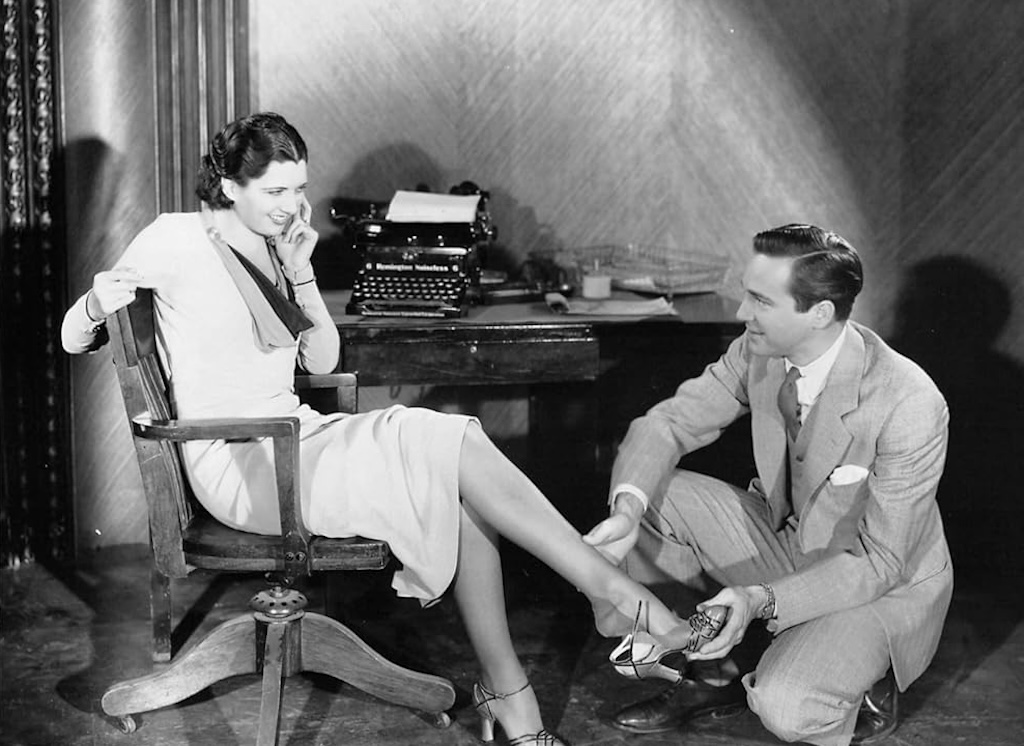
A still of Kay Francis and David Manners in the film Man Wanted.

Kay Francis and David Manners star in William Dieterle’s Man Wanted. (Warner Bros.)


The Criterion Collection has a new series running called “Office Romances,” about the popular movies from the 1930s through the 1950s dealing with “the ever growing number of working women” that catalyzed a new spin on the romantic comedy “where meet-cutes come amid desks and typewriters, and the course of true love is entangled with office politics and professional rivalry.”

The emphasis in the series is “still timely topics” like “work-life balance (His Girl Friday), gender equality (Woman of the Year), and even fears of jobs being eliminated by computers (Desk Set) . . .”

But take it from me, if you actually watch a lot of these films, what’s most striking about some of them is the rabid sexism such topics unleash in the moviemakers. The very presence of women in the workplace inspires a frantic misogyny and reactionary traditionalism that seems to mandate that such women are actually desperate to nab a husband and find true fulfillment in domesticity. One of the honorable exceptions is Howard Hawks’s His Girl Friday (1940), which knowingly recreates just such a narrative only in order to subvert it by demonstrating that the woman in question is only deluding herself into thinking she wants a husband, children, and suburban living.

In case you’ve forgotten, the plot goes like this: top reporter Hildy Johnson (Rosalind Russell) begins the movie announcing to ex-husband, newspaper editor, and former boss Walter Burns (Cary Grant) that she’s through with the newspaper game because she wants to live “like a real woman” married to the slow-witted insurance agent Bruce Baldwin (Ralph Bellamy), living with Bruce’s huffy mother, and bearing Bruce’s children up in Albany. Walter spends the entire film finding fiendishly inventive ways to stymie the marriage and keep Hildy writing the news stories she does so peerlessly. By the end, Hildy realizes that her great partnership in life is her professional collaboration with Walter — even when battling fiercely, they bring out the best in each other.

Still from the film His Girl Friday.
Rosalind Russell and Cary Grant star in Howard Hawks’s His Girl Friday. (Columbia Pictures)

American philosopher Stanley Cavell, in analyzing the film in his 1981 book Pursuits of Happiness: The Hollywood Comedy of Remarriage, said that Hildy thinks she needs to be in a traditional marriage in order to find the home she longs for that’s a haven from “the black world” of film noirish urban corruption and scheming that Hawks has established. Keep in mind, a pivotal moment in the film is when a downtrodden sex worker named Mollie Malloy (Helen Mack) tries to save Earl Williams (John Qualen) — a man accused of murder on trumped-up charges who’s been kind to her in the past and has now escaped from prison — by attempting suicide. She jumps out of the window of the newsroom, landing on the cement below, just as the ruthless newspapermen are crowding around her demanding she tell where Earl’s hiding. Pretty damn dark for a comedy.

Cavell argues that Hildy finds her haven, without initially realizing it, when she’s working at a frenzied pace with Walter under the harsh light cast by the lamp hanging over the news desk. That’s when Hildy and Walter are “at home.”

When Hildy is just beginning to recognize this, she declares feverishly with gleaming eyes that she’s not meant for domesticity after all because “I’m a newspaperman!”

By taking herself out of the limited roles assigned to women at the time, she’s “unsexed herself” and moved into a category as yet undefined by a lot of fearful people who were still dominant in the culture.

The Sexual Revolution of the 1930s

Also strikingly forward-thinking is the pre–Hays Code film Man Wanted (1932), which stars Kay Francis as Lois Ames, the owner and editor-in-chief of a magazine she inherited from her father. She’s mostly happily embroiled in her work, with one problem — she finds that women secretaries are inclined to balk at her constant requests that they work overtime. A lucky fluke makes it possible for her to try out a man as a secretary. It’s Thomas Sherman (David Manners), and he seems willing to work night and day for her. She doesn’t realize that it’s because he’s in love with her, though his jealous fiancée Ruth Holman (Una Merkel) strongly suspects it.

Lois has a husband she loves named Fred Ames (Kenneth Thomson), though he’s her complete opposite. An amiable, indolent drinker and playboy content to live on her money, his only real purpose in life is playing polo. Though Fred is also a serial philanderer — and Lois knows it. But she takes it in her stride. It’s to her benefit in a way, and Kay Francis manages to suggest without dialogue that she appreciates that fact — he’s kept happy, and she’s got more time to manage the magazine.

One wonders if Lois’s remarkably sophisticated attitude was modeled directly on Kay Francis’s own approach to her very real life. Poaching on the personal lives of big stars for movie plots was a practice that was shockingly common in old Hollywood screenwriting, and in the 1930s, there was no bigger star than Kay Francis. She was already on her third marriage when she did Man Wanted, and they were all of short duration. The incredibly long hours that movie stars worked in the old studio contract days probably contributed to the divorces, but Francis seemed to enjoy her work. She had such easy magnetism and charm, she effortlessly dominated her films and happily played dress-up as the silver screen’s most glamorous clotheshorse. She gave up on wedlock after her third failed try, and from then on, according to her biography Kay Francis: A Passionate Life and Career, she was delighted to play the field.

A big problem for Lois arises when Fred has an affair with a young woman named Anna Le Maire (Claire Dodd) who’s a polo enthusiast. While Lois is so bored with polo she sits through one of Fred’s matches with glazed eyes, looking everywhere but at the field, Anna can compliment him on his best plays. Thereafter, he’s hooked, and the congenial open marriage of Lois and Fred is doomed. But fortunately, Thomas manages to disentangle himself from Ruth just in time to catch Lois on the rebound.

The movie advances a like-goes-with-like theory of relationships, indicating that it’s far better for two ambitious careerists like Lois and Thomas to cohabit while polo-loving partiers Fred and Anna pair off.

The Secretary-to-Boss’s-Mistress Pipeline

Many of these films take a more cautionary tone about the sexual politics of the office once women start working in large numbers. More Than a Secretary (1936) is about an enterprising young woman named Carol Baldwin (Jean Arthur) who runs a secretarial school with her friend Helen Davis (Ruth Donnelly). They somehow had the wherewithal to start their own business in order to establish their independence. But Carol finds it tough going. It seems that most of the young women who sign up as students regard secretarial work as merely a means to an end — which is matrimony.

This was a widespread cultural assumption, that women working in offices were there looking to catch a husband or, even more threateningly, to have an affair with the already-married boss that might end up with an apartment and an expense account, either as the boss’s mistress or his new wife after the divorce. And, it has to be admitted, women were paid so much less than men that, unless they came from very supportive families, their only chance of owning a home or living in relative comfort might very well have to come through matrimony. Those women portrayed in what we tend to consider more “progressive” terms, cherishing their independence, tended to be affluent.

The secretary as predator and menace, trying to jump the claim of the boss’s wife, was a common scenario in films, whether it was represented as the reality or, more rarely, a myth to be exploded. Writer-director Billy Wilder’s The Apartment (1959) is hands down the most brilliant film about that cultural phenomenon, because he turns the situation around the right way. In general, it’s not the working women who are the systematic predators, though a lot of them wind up dating the executives in the building that houses a top insurance company. It’s the married executives of the boss class who regard their office building as a happy hunting ground for “girls” they can use as sexual playthings and toss away when they get bored or feel inconvenienced by them.

A still from the film The Apartment
Shirley MacLaine and Jack Lemmon star in Billy Wilder’s The Apartment. (The Mirisch Company)

Wilder makes a protagonist of Fran Kubelik (Shirley MacLaine), the elevator operator who’s always been very unlucky in terms of romance and continues her losing streak by falling in love with the most corrupt, cruel, and soulless of the married executives, the big boss Jeff D. Sheldrake (Fred MacMurray). Her affair with him goes so badly she winds up attempting suicide by swallowing a bottle of pills on Christmas Eve in the apartment of junior executive C. C. “Buddy Boy” Baxter (Jack Lemmon).

The apartment of the title is the convenient love nest of several executives who are too cheap to pay for hotel rooms for their assignations with company employees. This keeps Bud out of his own place most nights of the week. But in exchange, he’s getting promotions and rising fast in the building’s insurance company hierarchy. In fact, he’s in danger of modeling himself entirely on Mr Sheldrake when he finds Fran at death’s door in his bedroom. That’s how two basically decent but lonely and vulnerable people find each other in an urban world every bit as dark as the one in His Girl Friday.

But in movies like Working Girls (1931), and More Than a Secretary (1936), female gold diggers and husband hunters clutching steno pads abound. The most brazen of the man traps in More Than a Secretary, a peroxide blonde named Maizie West (Dorothea Kent), doesn’t even look up from redoing her makeup when her secretary school teachers are criticizing her terribly typed efforts and expelling her.

“We’re not running a matrimonial service,” Carol says rebukingly.

“Ha!” says Maizie. “That’s what you think.”

Instead, rather than sending one of her students to the next job, dowdy and bespectacled Carol offers up her own services as a secretary to a handsome but hard-to-please employer named Fred Gilbert (George Brent). He’s a health nut who runs a fitness magazine. He’s all business, which makes Carol’s job harder, and not because of the overtime. She’s working such long hours at his floundering magazine, she winds up boosting its circulation and saving it from being shut down, all in order to ingratiate herself and eventually turn Fred into husband material.

But it backfires — she winds up being promoted to assistant editor while Maizie gets brought on as his secretary. And suddenly Mr All-Business is neglecting his work, leaving it all on Carol’s shoulders, because he’s out every night with Maizie. And Carol can do the job, all right. She runs the magazine better than he does. This leads to one thrilling moment when Carol finally gets fed up and tells off her boss, leaning heavily into one charge that tops them all: “You’re incompetent.”

It’s really startling. In all these years of watching movies, I don’t think I’ve ever seen a film in which the female lead tells the male lead he’s incompetent. She might accuse him of being immoral, unethical, unkempt, disloyal, arrogant, a liar, a quitter, a coward, a cheat, a worm, a disgusting excuse for a human being — the list goes on and on. But never incompetent. There’s a basic gender bias in making the male lead generally invulnerable to such a charge. He’s always competent on the job even if he’s fifty kinds of an incorrigible failure in every other area of life. And the female lead isn’t vulnerable to the charge of incompetence because — as Maizie demonstrates when every man in the film is indifferent to her inability to do her job as long as she looks good and puts out — nobody cares if she’s competent or not.

Only Howard Hawks consistently cared. Every character’s professionalism tended to be Hawks’s central obsession, and the woman protagonist had to prove herself competent in order to interest the leading man and stay in the exalted company of men.

A Woman Who Doesn’t Know Her Place

A woman’s competence on the job is more often a threat, especially if she’s seen as too good at it, too professionally impressive, too successful. Woman of the Year (1942) can stand as Exhibit A. In it, Katharine Hepburn plays the dazzling Tess Harding, a famous journalist inspired by real life political affairs commentator Dorothy Thompson, who was the first reporter expelled from Nazi Germany because she was perceived as a threat to the Reich. She gained immense fame on the radio in the lead-up to World War II.

Tess has got everything, speaks many languages fluently, knows every head of state personally, and is regarded as an important figure in the war effort (as Thompson was). It’s a joy early in the film to see Hepburn stride confidently around looking terrifically happy getting out the top stories of the day.

Her only Achilles’ heel? She doesn’t know a thing about sports, which means she’s losing a minor feud she’s having in the press with a fellow reporter at her paper, sportswriter Sam Craig (Spencer Tracy). Then they meet in person, and Tess Harding is, on top of everything else, so good-looking and so witty, Sam is instantly smitten. As their courtship moves swiftly toward marriage, he remains the same genial, sentimental, down-to-earth guy, but her perceived faults multiply to infinity. Her job is so demanding, she’s got no time for a relationship, and she’s forever slighting Sam, standing him up, and demonstrating that this quick-witted woman is strangely, totally obtuse about any personal consideration of others.

This will make their marriage an unhappy one from the get-go, and Tess’s attempts to improve their relationship border on the insane. At the low point, she commandeers a Greek orphan boy, a war refugee, as a child she and Sam are supposedly going to raise together. Only, again, she’s never around, so it’s Sam and the boy spending lonely evenings at home while she works far into the night.

This grim state of affairs peaks on the night Tess is to receive a “Woman of the Year” award. Sam ditches the ceremony in order to return the Greek boy to the orphanage. He later informs Tess that he could give the world a bitter news item, that “the Woman of the Year isn’t a woman at all.”

A still from the film Woman of the Year
Katharine Hepburn stars as Tess Harding in George Stevens’s Woman of the Year. (Metro-Goldwyn-Mayer)

It gets worse from there. The well-known nadir is the final scene in which Tess tries to effect a reconciliation with Sam by demonstrating that she’s a real woman who can do homely domestic chores too — only it turns out she can’t. So hypercompetent she’s negotiating treaties, practically, but she can’t make waffles or coffee, and the scene of her cooking breakfast becomes a slapstick comedy disaster. Hepburn told director George Stephens that this new ending, written by Ring Lardner Jr and Michael Kanin, was the stupidest shit she’d ever read in her life, but she played it gamely anyway.

It figures that she did. This plotline was already familiar to her. It mandated that the too brilliant and well-educated, too accomplished and beautiful Hepburn, and the alter egos she played, had one glaring fault, which was “unwomanly” arrogance and a corresponding lack of sympathy for male weakness. Therefore, she had to be taken down a peg by the male lead, or even all the main male characters, as in her comeback hit The Philadelphia Story (1940). The earlier stage version of it, also a smash hit, had been written for Hepburn by her friend Philip Barry. Other Hepburn friends Ruth Gordon and Garson Kanin wrote Adam’s Rib (1949) for her and Spencer Tracy, and it’s another comedy masterpiece that recycles a variation on this plotline.

The Woman of the Year version of this plot is the most depressing. Hepburn’s playing a woman who’s so invaluable she’s regarded as vital to the Allied fight in World War II, and yet she’s mocked as a failure because she can’t efficiently dish up eggs and bacon for her husband.

Still, actors like Jean Arthur, Rosalind Russell, and Katharine Hepburn were key to these women-who-work films because they conveyed qualities of intelligence, independence, and competence. But they all got caught in the crosshairs of misogynistic attitudes toward just such women and inevitably played some characters who got blamed for their strengths. If they were too good at their jobs, they could either be condemned for displaying a perverse “manliness” in competing with men, or else condemned for trying to overcompensate for being withered old maids who couldn’t catch a man. On the other hand, women who did manage to secure a husband in holy matrimony were often presented as ball-busting wardens of a domestic jail.

Hepburn’s career was probably the most shocking in the rapid way she was shunted from formidable beauty to homely old maid roles. Early in her career, on top of all of her impressive star charisma and sharp acting abilities, she was so marvelous looking, she was a real trendsetter in replacing the round-faced, baby-doll look that was popular in women of the 1920s when she was coming up onstage. She once got a review when she was still a minor actor in a play that identified her as “a thin-cheeked girl,” and she herself noted that she had angular looks and a personality to match that sort of “jabbed into people.”

But so beautiful and just made for the artful lighting and camerawork that could make the most of those bright expressive eyes, those dramatic cheekbones, that lithe athleticism. Look no further than The Philadelphia Story for Hepburn at the peak of her physical glory.

Yet through the rest of the 1940s, she was getting pushed into more and more loyal-wife (Keeper of the Flame, State of the Union) and “Plain Jane” (Undercurrent, Without Love) parts. The latter defined her career in the 1950s (The African Queen, Pat and Mike, The Rainmaker, Summertime). Yet age was no necessarily defining factor in how Hepburn’s attractions were rated on-screen — it was an odd effect of Hepburn’s looks that all you had to do to signal “spinster” in films was put her hair up in a bun, but if you let her hair down around her shoulders, she became distractingly gorgeous again.

It’s a fascinating mixed bag, this series, once you get past the worst tendencies of the more regressive plotlines. The movies cover a surprising range of attitudes toward working women, and, of course, there are a couple of masterpieces here in His Girl Friday and The Apartment. Also well worth your time are Woman of the Year (the first half or so, anyway), Desk Set, The Whole Town’s Talking, and Man Wanted. And if you’re still not saturated by office romances by that time, Working Girls, More Than a Secretary, and The Office Wife await.