Mark Carney Is Taking Aim at Canada’s Labor Movement
Mark Carney wants to make Canada a destination for global investment. To this end, his new omnibus bill casts the right to strike as an obstacle to the “national interest” — and organized labor as a barrier to national strength rather than its foundation.
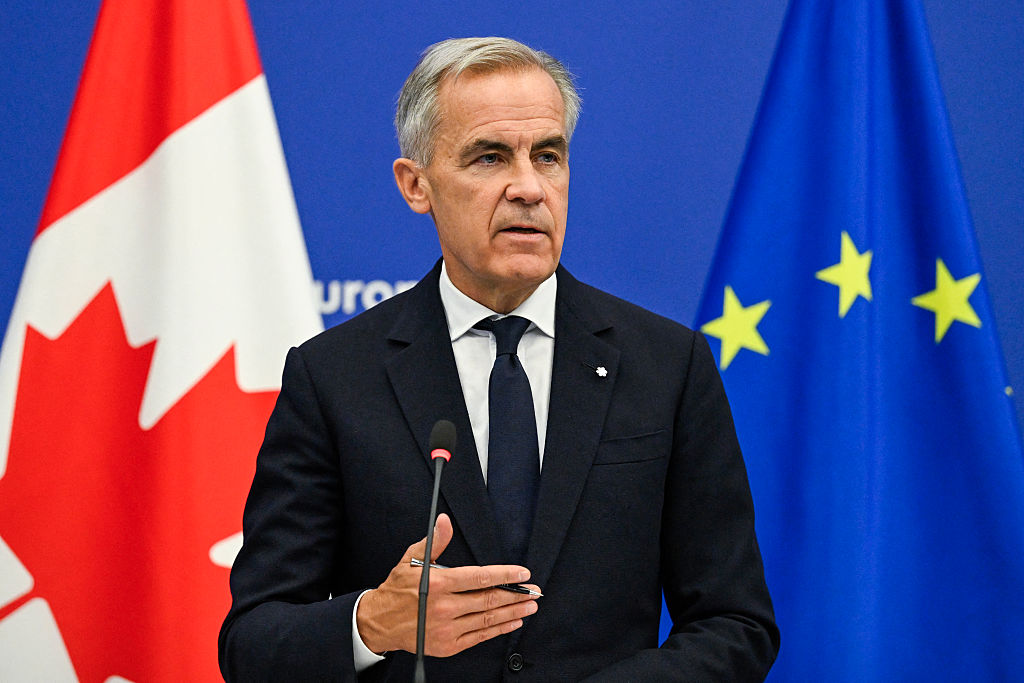
Mark Carney’s new omnibus bill belongs to a larger project aimed at reorganizing Canada around corporate priorities. It would give the state greater power over workers whose collective action can disrupt the transportation networks vital to that strategy. (Jean-Christophe Verhaegen / AFP via Getty Images)
On September 21, Canadian Prime Minister Mark Carney’s government introducedlegislation that could amount to one of the most significant rollbacks of workers’ rights in Canada since the creation of the postwar industrial relations system. Tucked inside the sprawling 232-page Bill C-39 are amendments to the Canada Labour Code that would give the federal labor minister explicit authority to terminate lawful strikes and impose binding dispute resolution when the minister decides a work stoppage threatens the “national interest.”
The legislation would also create a new “special mediator,” adding an additional state-directed phase to collective bargaining. Before workers can strike, the mediator would produce a report on bargaining disputes, which the minister would make public if the parties fail to reach an agreement. The new process would create a new perquisite for eventual government intervention under the controversial Section 107 of the Labour Code.
The government describes these provisions as “guardrails” constraining ministerial power. But they are anything but. The legislation instead doubles down on what has become a pattern of strikebreaking from the Liberals. These proposed changes to labor law fit within Carney’s broader corporate remodeling of Canada.