Ontario Is Gutting a Pillar of the Labor-Capital Settlement
Ontario’s latest workers’ compensation bill restores some long-overdue benefits with one hand while quietly dismantling core protections with the other. In doing so, it’s undermining the century-old bargain at the heart of the workers’ compensation system.
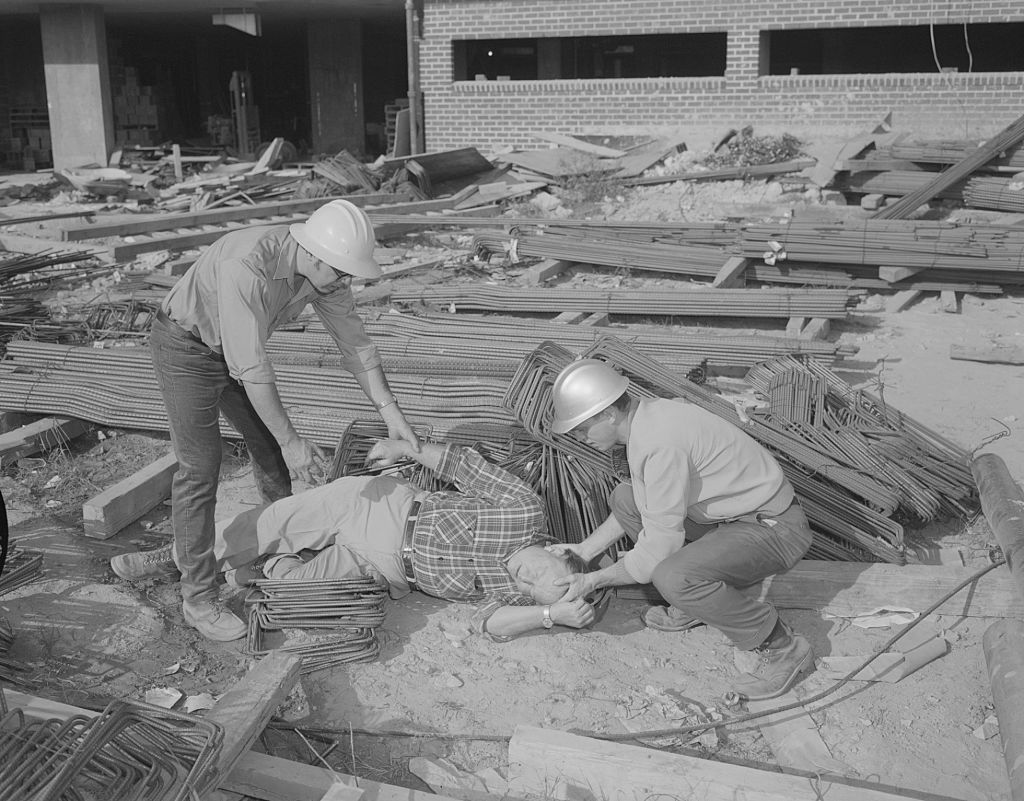
Workers are working longer hours and retiring later in life. Ontario’s Bill 105 would add insult to injury by rewriting the compensation bargain meant to protect workers against workplace injuries. (Harold M. Lambert / Getty Images)
A central piece of the twentieth-century labor-capital compromise is disappearing in Ontario, as the government moves forward with omnibus legislation that will transform the province’s workers’ compensation system.
If Ontario’s Bill 105 becomes law later this year, it will herald the most significant overhaul of workers’ compensation in nearly three decades. On paper, the bill contains measures the government is presenting as improvements, including a modest increase in wage-loss benefits from 85 percent of pre-injury net earnings to 90 percent. It would also introduce a provision allowing some workers to receive compensation beyond the age of sixty-five if they can provide evidence of their intention to continue working, while extending mandatory coverage for some care workers.
But buried within the bill are changes that strike at a core principle: Workers who are permanently injured should be entitled to a measure of benefit security. It also introduces the possibility of significant offsets to wage-loss compensation from other publicly funded programs.
Viewed in isolation, these may appear to be technical policy tweaks. But viewed through a historical lens, they represent a significant shift away from the foundations of the workers’ compensation system across Canada, forged in Ontario over one hundred years ago.
Whither the Historic Compromise?
Before Ontario’s workers’ compensation system emerged, injured workers had to sue their employers if they hoped to recover lost wages. But courts frequently sided with employers using doctrines such as contributory negligence and assumption of risk. Workplace injuries often left workers unemployed and with little recourse.
In 1913, Ontario attempted to address these realities. Based on the recommendations of Chief Justice Sir William Meredith, the province adopted what became known as the “historic compromise.” Workers would give up their right to sue in exchange for an employer-funded no-fault compensation system. Injured workers would receive secure compensation for as long as their disability lasted, without needing to prove employer fault, through an independent body charged with adjudicating claims. This was the foundation of modern workers’ compensation law, and it rested on the promise that workers would not bear the economic costs of workplace injury.
The significance of Bill 105’s changes is that they roll back hard-fought entitlements for millions of workers. This raises the question of what remains of the historic compromise when security is eroding.
The most far-reaching and concerning proposal contained in Bill 105 is the elimination of long-standing “lock-in” protections that currently provide many permanently injured workers with a degree of certainty about their future benefits after years of assessments. Following seventy-two months, a workers’ wage-loss compensation is “locked in,” meaning it is not subject to ongoing reviews that could reduce the amount, subject to certain exceptions. This offers workers a much-deserved point of relief and relative certainty. They know their compensation is secure, and they know how much they will get each month. They can make life plans without the looming specter of their benefits being reduced or even terminated.
Under the proposed changes to the law, the Workplace Safety and Insurance Board (WSIB) would gain broad authority to revisit, reduce, or terminate lost wages compensation long after a worker’s injury has stabilized. This would lead to unlimited review, where a worker with a permanent disability lives with constant uncertainty that their compensation could be reduced if, for instance, the WSIB or an employer believes that their functional abilities have changed and that they could theoretically do some kind of work.
Perpetual Probation
When Ontario first considered replacing permanent disability pensions with a wage-loss system in the early 1980s, injured workers worried they would be trading lifelong security for lifelong uncertainty. Instead of receiving stable compensation, they feared the prospect of having to constantly prove they remained disabled, while the compensation board continually reassessed their medical condition, work capacity, and earning potential.
Those fears were echoed by one of Canada’s leading workers’ compensation scholars, Professor Terence Ison. He warned that an unrestricted wage-loss system would place injured workers in a state of “perpetual probation.” Without some kind of guardrail, the WSIB would have ongoing authority to investigate workers’ lives, monitor their medical condition, challenge their earning capacity, and repeatedly assess whether they still qualified for benefits.
The seventy-two-month lock-in was the solution that emerged from significant debate. Ontario adopted a wage-loss system but rejected perpetual monitoring. Instead, the WSIB would have six years (seventy-two months) to assess a worker’s long-term earning capacity. After that, there would generally be finality. Bill 105 reopens this debate.
The elimination of the seventy-two-month lock-in will not affect all injured workers equally. Some of the workers most vulnerable to the change are those employed by large public sector employers, like hospitals, school boards, and municipalities.
Unlike most employers in Ontario, these institutions directly reimburse the WSIB for the full cost of benefits paid out on individual claims, plus an administrative fee. Every dollar paid in wage-loss benefits is a dollar that ultimately comes out of the employer’s budget. This creates a perverse financial incentive to challenge, reduce, or terminate benefits wherever possible.
This potential for perpetual probation runs counter to what Sir William envisioned in his final report to the government in 1913. He wrote that “the true aim of a compensation law is to provide for the injured workman and his dependents and to prevent their becoming a charge upon their relatives or friends, or upon the community at large.” Injured workers should not be at risk of poverty because of an injury. But removing the lock-in could mean just that for thousands of injured workers whose benefits will remain under review, surveillance, and reduction.
Loss of Earnings Benefits Are Being Increased . . . to What They Used to Be
The provincial government has presented one aspect of Bill 105 as a clear victory for injured workers. Loss of Earnings (LOE) benefits would increase from 85 to 90 percent of a worker’s net wage loss.
On its face, the change is welcome. For the first time in nearly three decades, Ontario would restore a benefit level that many workers have long argued should never have been reduced in the first place. This would also bring Ontario in line with other provinces and territories, like Alberta, British Columbia, Saskatchewan, Prince Edward Island, the Northwest Territories, and Nunavut. But what remains unacknowledged in this amendment is the history behind it.
When Ontario’s workers’ compensation system was overhauled during the premiership of Mike Harris, injured workers had to bear significant benefit reductions, including the reduction of wage-loss benefits from 90 percent of net earnings to 85 percent. The change was part of a broader effort to reduce the WSIB’s liabilities and lower costs for employers during a period marked by welfare cuts and privatization.
For permanently injured workers, the consequences were significant. Workers who lost their earning capacity because of workplace injuries suddenly faced larger income losses. Over decades, that seemingly modest 5 percent reduction translated into thousands of dollars in lost income for workers already living with permanent disabilities, chronic pain, and very limited employment prospects.
Viewed in light of this history, Bill 105's increase to 90 percent is less of a new benefit than a partial restoration of what was previously taken away. But it may not apply retroactively for those thousands of workers who were impacted by the initial reduction of benefits back in 1998.
And the increase must also be understood alongside other proposed changes. The same legislation that restores the 90 percent rate also proposes some of the most significant reductions in long-term benefit security with the removal of the lock-in provisions.
A contradiction exists throughout Bill 105. The government is restoring part of what was taken away decades ago while introducing new mechanisms that could make compensation less secure for the very workers it says it aims to help.
Proposed Income-Offsets to Reduce Loss of Earnings Benefits
Another provision in Bill 105 has the potential to shift the cost of workplace injuries out of the workers’ compensation system and onto other social programs. Bill 105 would require the WSIB to reduce a worker’s LOE benefits if, when combined with certain government benefits or employer-funded payments, the worker’s total income exceeds 100 percent of their pre-injury earnings.
The details will be left to future regulations, so it is not yet clear which benefits or payments will ultimately be affected, but the possibilities are troubling. The wording of the proposed legislation means that the offsets could apply to any payments made under provincial or federal legislation, and payments made by or on behalf of the employer. Depending on the way the bill is drafted, this could encompass things like the Canada Child Benefit, Old Age Security, Canada Pension Plan Retirement benefits, or other employer-funded benefits.
These benefits were never intended to reduce an employer’s responsibility to compensate workers injured on the job. Childcare supports are meant to help families with the cost of raising children. Income-tested benefits are designed to reduce poverty. Employer-sponsored disability plans are often negotiated through collective bargaining, and retirement benefits are based on contributions by workers themselves.
If future regulations allow these types of benefits to offset workers’ compensation, the effect would be to transfer the financial burden of workplace injuries away from the workers’ compensation system and onto other social programs. Once again, the legislation reflects a broader shift running throughout Bill 105. Rather than strengthening the foundational principle that employers collectively bear the cost of workplace injuries, it creates an avenue for those costs to be shifted away and onto public programs, negotiated workplace benefits, and ultimately onto injured workers and their families.
There is also no evidence that there are large numbers of injured workers receiving more than 100 percent of their pre-injury earnings, so this proposal just further penalizes workers who are already at a financial disadvantage even if they are receiving full wage-loss compensation. Most injured workers are already absorbing a 15 percent wage cut, since compensation only replaces 85 percent of pre-injury earnings. On top of that, if a worker cannot return to work, they lose out on contributions to workplace and private pensions, which cuts into their retirement income.
Workers Are Working Longer
Another significant change contained in Bill 105 is recognition that the traditional assumption of workers retiring at sixty-five is inconsistent with how people live and work today.
For decades, Ontario’s workers’ compensation system has largely treated age sixty-five as the end of a worker’s earning life, a relic of the days when mandatory retirement existed and workers could be terminated without cause at age sixty-five. Once an injured worker reaches that age, WSIB Loss of Earnings compensation stops regardless of whether the worker would have remained employed. If a worker is injured when they are sixty-three years of age or older, they are only entitled to up to two years of wage-loss compensation.
Bill 105 partially recognizes that this approach is outdated by allowing injured workers to request benefits beyond age sixty-five if they can prove they would have remained in the workforce. That is an important step forward, as it acknowledges very clear trends.
Canadians are working longer than ever before, often not because they choose to, but because they must. Rising housing costs, declining access to workplace pensions, and increasing financial insecurity have made retirement at sixty-five impossible for many workers. The federal government has already recognized this reality. Canadians can defer Canada Pension Plan retirement benefits until age seventy, Old Age Security can be deferred until age seventy, and Registered Retirement Savings Plans need not be converted until age seventy-one.
The problem is that the legislation places the burden of proof almost entirely on injured workers themselves, who must request entitlement to benefits beyond age sixty-five. On paper, that may appear reasonable. In practice, it risks creating a two-tier system in which workers with formal retirement plans can successfully establish later retirement dates while many precarious workers cannot.
Someone who has a financial adviser, pension statements, and documented employment plans may be able to demonstrate an intention to work until age sixty-eight, seventy, or beyond. A warehouse worker, personal support worker, gig worker, or migrant worker may have none of those things. Yet these workers are often the least able to retire. Their evidence is unpaid bills, housing precarity, and little to no retirement income. So a legislative proposal that only requires formal evidence of retirement intentions risks exacerbating these inequalities.
Rather than continuing to treat sixty-five as the default cutoff for compensation, Ontario should establish a presumptive entitlement age of seventy-one, reflecting the broader retirement framework already well established elsewhere in public policy, alongside a provision permitting workers to provide evidence to show a retirement age beyond seventy-one. Any changes should also be made retroactive to at least December 2006, when Ontario abolished mandatory retirement.
Expanding Coverage, but Not for All
Bill 105 takes another positive but incomplete step by extending mandatory WSIB coverage to privately operated residential care facilities and group homes. But this modest expansion also highlights a much larger problem, namely that Ontario still doesn’t extend coverage to roughly one-quarter of its workforce, giving it one of the lowest coverage rates in Canada.
The proposed expansion may also not be retroactive, meaning thousands of care workers may not have the opportunity to have their claims reconsidered. Expanding coverage is welcome, but justice requires that workers who were denied the protection of the historic compromise not be left behind simply because they were injured before the law finally caught up.
Bill 105 acknowledges that some excluded care workers deserve protection, but it stops well short of addressing the larger problem. The government should be strengthening the century-old social bargain that workplace injuries are a collective responsibility, yet Ontario continues to maintain a patchwork system in which hundreds of thousands of workers remain outside that bargain altogether. Universal coverage — meaning all workers in all workplaces are covered by WSIB — would generate millions in additional funding for the WSIB and save the public health care system millions by eliminating costs that are currently off-loaded onto it when workers lack WSIB. It would also ensure that every worker receives the protection the workers’ compensation system was originally created to provide.
The significance of Bill 105 is that it chips away at core principles of the workers’ compensation system at a time when workers across the province are facing a cost-of-living crisis. Meanwhile, employers have substantially benefited from the WSIB’s extravagant spending of $21.5 billion since 2018, in the form of rebates and premium reductions, during a period when no improvements were made in compensation for injured workers.
More than a century after Ontario helped pioneer one of North America’s earliest workers’ compensation systems, the province is asking injured workers to continue honoring their side of the historic compromise while steadily weakening the protections they were promised in return for giving up certain rights. This isn’t what “Working for Workers” looks like.