Between the Donroe and Carney Doctrines

At Davos, Canadian Prime Minister Mark Carney set fire to liberal platitudes. His actual politics, however, do quite the opposite.
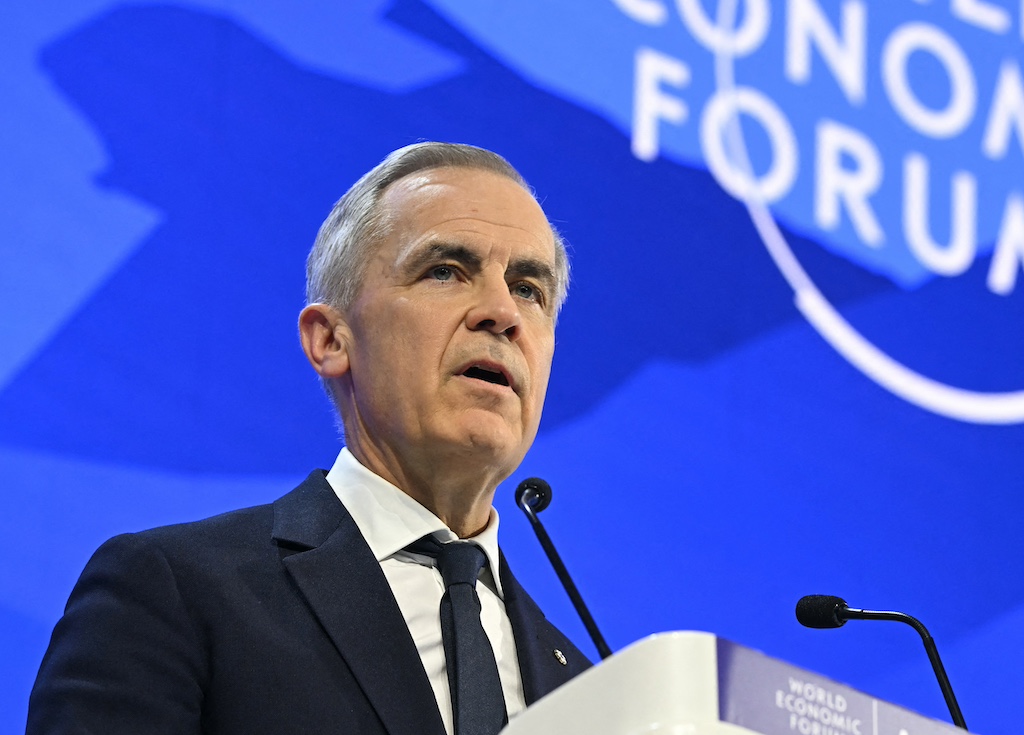
Mark Carney’s Davos speech enumerated the failure of liberal consensus while reaffirming the market logics that produced it. (Fabrice Coffrini / AFP via Getty Images)

Mark Carney’s speech at the World Economic Forum (WEF) in Davos this week has already generated a flurry of media commentary, the vast majority of which — at least from what I’ve seen — has ranged from positive to gushing. Given the speech’s content, this deluge is unsurprising and, to some extent, it’s also perfectly justified. For as long as most of us have been alive, the default register at international gatherings like the WEF has been a vaporous faith that things can get better. Much is signified but very little is said.

Carney’s address, in contrast, said a great deal and traded the standard bafflegab of liberal geopolitics for a language of candor and blunt realism. Its substance aside, I think this is one reason the speech has earned such a warm reception. Carney, in contrast to both the raw power realism of Donald Trump and the limp triangulation European elites have offered in response to it, communicated in a tenor of grandness and statesmanship — one that suggests states still possess agency and that international affairs can be something other than a clash of competing vanities.

In what was certainly the most striking part of the speech, he also saw fit to include a critique of what the now-defunct liberal consensus actually meant in practice:

We knew the story of the international rules-based order was partially false. That the strongest would exempt themselves when convenient. That trade rules were enforced asymmetrically. And we knew that international law applied with varying rigor depending on the identity of the accused or the victim. This fiction was useful. And American hegemony, in particular, helped provide public goods: open sea lanes, a stable financial system, collective security, and support for frameworks for resolving disputes. So we placed the sign in the window. We participated in the rituals. And we largely avoided calling out the gaps between rhetoric and reality.

These are, to say the least, not the sentiments one generally hears uttered from a lectern in Davos. And when it comes to the speech’s reception, there is clearly something of an “only Nixon could go to China” logic at work. That the messenger here is Mark Carney — an ur-figure of liberal globalism and finance capital speaking at the WEF — has lent the words quoted above an added gravity they might not have had if delivered by someone else.

Here Lies the “Rules-Based International Order”

Effectively, Carney conceded the essence of what many left-wing critics of US-led globalization have been saying for decades: that the so-called “rules-based international order” has mostly been a mirage, a shimmering artifice of norms and institutions designed to give a sheen of legitimacy to the self-interest of powerful states without actually binding their conduct. As Grace Blakeley observes, this system did more to influence “the framing and interpretation of states’ behavior” than guide or constrain the behavior itself. It allowed moral travesties like the invasion of Iraq and the more recent destruction of Gaza, but demanded Western powers and their allies at least make vague appeals to certain rules and universal principles.

As something any rational person with a moral compass can believe, this story has been on shaky ground for years. But in recent months, Trump has finally exploded it by tearing away whatever remained of the facade. As I wrote last May:

What we are really seeing with Trumpism 2.0 . . . is longstanding tendencies of the American state stripped of artifice; rendered finally without any pretense to idealism or the public interest; expressed as a politics of pure plutocratic transaction on the domestic front and the belligerent exercise of raw imperial power abroad. . . . [The ethos of Trumpism], borrowed straight from the transactional worlds of reality television and free market competition, is one of winners and losers; of pure acquisition, conquest, and unrestrained Id. These things, to someone like Trump, are the true realization of capitalist ethics and the final telos of American power. The exercise of trade and foreign policy is just the shaking down of small countries by larger ones. The state, by the same token, is a place where winners convene to extract value and profit however they can, not the institutional expression of “the nation” in abstract.

Throughout his second term, Trump has taken all this steadily further by applying the shakedown logic traditionally reserved for poor and/or non-NATO-aligned countries to allies like Canada and Denmark. (Indeed, as pundits steeped in the myth of American exceptionalism flail about like headless chickens, millions in the Global South are probably quite unsurprised.) In this respect, there was indeed something refreshing about Carney’s speech — which, if nothing else, correctly recognized that the old shibboleths of liberal internationalism under assault by Trump were largely bogus and have become impossible to maintain even in the abstract.

As such, the world now does indeed to face a stark choice between Trump’s neo-Hobbesian doctrine of the strong dominating the weak and a more humane alternative whose contours have yet to be determined. In sketching out what this alternative might look like, Carney, in turn, proffered the idea of “values-based realism”:

The question is whether we adapt by simply building higher walls or whether we can do something more ambitious. Canada was amongst the first to hear the wake-up call, leading us to fundamentally shift our strategic posture. And our new approach rests on what [Finnish president] Alexander Stubb has termed “values-based realism” — or, to put another way, we aim to be principled and pragmatic. Principled in our commitment to fundamental values: sovereignty and territorial integrity, the prohibition of the use of force except when consistent with the UN Charter and respect for human rights.

This is where the speech begins to take a more conventional turn. “Values-based realism,” as Stubb himself articulates it in the current issue of Foreign Affairs, is more or less a revised version of liberal internationalism as its adherents understood it. In effect, it imagines a similar dialectic of humanistic concern and national self-interest, albeit updated for a new era of multipolarity and capricious behavior from the world’s erstwhile hegemon. Carney, to his credit, was much less wistful about the old order than Finland’s president appears to be. But, to the values outlined above, he nonetheless added this rather bracing qualifier:

[A pragmatic approach means] recognizing that progress is often incremental, that interests diverge, that not every partner will share our values. So we’re engaging broadly, strategically, with open eyes. We actively take on the world as it is, not wait around for a world we wish to be. We are calibrating our relationships so their depth reflects our values. And we’re prioritizing broad engagement to maximize our influence, given the fluidity of the world order, the risks that this poses, and the stakes for what comes next. . . . This is not naive multilateralism. Nor is it relying on their institutions. It’s building coalitions that work, issue by issue, with partners who share enough common ground to act together. In some cases, this will be the vast majority of nations.

Of Values and Transactions

From here, the vision at the center of Carney’s speech potentially starts to look more conservative in its implications. In effect, the pragmatic posture he describes is the one so far embraced by his own government in the realm of foreign affairs: an approach that has emphasized the need for new bilateral relationships, trade diversification, and a case-by-case approach when responding to international developments.

Practically speaking, this has meant new trade agreements with the likes of China and Qatar in service of the domestic agenda to which Carney alluded around the speech’s midpoint — a program (as I’ve written here and here) of publicly subsidized but privately led economic development facilitated through the rolling back of environmental and regulatory safeguards, a lavish round of tax cuts, an austerian approach to public spending, and an embrace of military Keynesianism.

Notwithstanding Carney’s implicit posture of defiance vis-à-vis the United States, his government has also relentlessly sought conciliation and cooperation with Trump even as it has spoken of forging new partnerships and charting a more independent course. As former minister of foreign affairs Lloyd Axworthy observed a few days before Carney’s speech in Davos, it “went silent when Trump attacked a Canadian judge at the International Criminal Court, refused to comment on his breach of international law in Venezuela, declined to outright condemn his threats against Greenland, paid scant attention to the tragedy in Sudan, and backed away from climate commitments — to name just a few examples.” To this we can add the government’s chosen border policy, its recent acceptance “in principle” of Trump’s repellent “Board of Peace” in Gaza, its abandonment of plans for a digital services tax on US tech companies, and plenty else as well.

To point these things out is not mere hypocrisy-mongering because they speak to a potential problem with the project of “values-based realism” as Carney describes it. In the posited clash between enlightened values and the pragmatic pursuit of national self-interest, it’s clear that the second will almost always eclipse the first unless the values in question are anchored on much firmer ground. The course of the Carney government to date is testament to this very fact. Axworthy again: “Now, our actions are presented as purely transactional, driven by a narrow calculus of national interest that accepts morally uncomfortable trade-offs if they advance concrete strategic goals.”

We are, of course, in a moment of severe rupture, as Carney himself rightly puts it. The breakdown of one international system does not mean another will magically spring up in its place, and the construction of anything new will necessarily take time and inevitably play out in a somewhat ad hoc fashion. But if this new order is going to break from Trump’s atavistic neo-imperialism and avoid simply replicating the moral contradictions of the old one (perhaps with diminished US involvement), it will need much sturdier foundations than what the prime minister has offered us so far.

Crisis Atop Crisis

Ultimately, the crisis of liberal geopolitics is downstream from a much deeper economic failure. The context that produced and gave oxygen to Trump — that of neoliberal globalism — eroded the postwar settlement and enervated democracy without delivering its (decidedly unconvincing) promise of broadly shared prosperity in return. Instead, its guiding ethos of deregulation, financialized growth, and fiscal austerity has steadily funneled wealth upward while extending the market’s talons into virtually every area of public and private life. The upshot has been a weakening of civil society, a climate of diminished democratic participation, rising material precarity, and the corollary waves of social disruption that inevitably give rise to authoritarian demagogues.

Carney’s speech did at least allude to these crises and refreshingly spoke to the moral vacancy of the geopolitical settlement Trump has successfully unraveled. But Carneyism has, to date, offered us no underlying vision that is fundamentally distinct from the picture we’ve known for the past forty years. The prime minister himself deals in the language of urgency and talks up the need for sweeping change. But thus far he has largely pursued this end through a form of economic “realism” that intensifies rather than constrains the market forces that helped get us here in the first place.

Scaled up to an international level, the same logic will almost invariably express itself as conservative realpolitik rather than high principle. And, in doing so, it would merely replace the defunct Washington consensus with a more flexible kind of multilateralism that suffers from many of the same problems.

Averting that outcome will require a more fundamental change of course on the part of the world’s middle powers, both in terms of how they govern themselves and the ends they pursue on the global stage. Beyond simply naming the contradictions of the old liberal order, they must be meaningfully addressed. A reworked international system will not generate new legitimacy for itself, let alone create the conditions for shared prosperity and peace, through some amorphous fusion of liberally tinged cooperation and neorealist self-interest.

The end of US imperial hegemony, however, offers a clear — and potentially unprecedented — opportunity to develop something far more durable and ambitious. And here, I think, there are valuable resources to be drawn from the last century. Predating the neoliberal order of the 1990s, the post-1945 settlement similarly grounded itself in principles that, in practice, were often unfulfilled. But texts like the Universal Declaration of Human Rights and the UN’s International Covenant on Economic, Social and Cultural Rights still offer a set of critical ideals to which any new order can and should aspire, even as it acknowledges bare facts like the reality of national self-interest.

Drowned out by the din of clashing ideologies throughout much of the Cold War and subsequently eclipsed by the rise of neoliberalism, the twentieth-century democratic left basically had it right: societies cannot cohere or function if their foundational logic is one of rapacious market competition, and no internationalism will be viable or morally sound if it is just a partly sublimated form of the same.

Progressive Internationalism or More Realpolitik?

Carney’s intervention is welcome insofar as it stakes out potential ground for a break with what has so obviously failed. But, amid the ongoing clash of two fundamentally rudderless political projects, a more radical — if potentially riskier — course will be required for such a reset. Trumpism and neoliberal globalism might be adversaries, but what drives them forward is also mutually reinforcing. As Perry Anderson wrote in the London Review of Books last year:

The conflict between neoliberalism and populism, the adversaries that have confronted one another across the West since the turn of the century, has become steadily more explosive, even if, for all its apparent compromises or setbacks, neoliberalism retains the upper hand. The first has survived only by reproducing what it threatens to bring down, while the second has grown in magnitude without advancing in meaningful strategy.

Escaping this dangerous cul-de-sac will require profound changes in how countries such as Canada conduct themselves. In the short term, the immediate test for Carney’s stated vision will be how his own government behaves over the next several months. How, for example, will it react to renewed threats from the United States? Will it match the prime minister’s refreshing criticism of the old geopolitical order with any meaningful departure from the discredited economic orthodoxies on which it was based? Will it maneuver away from the Trump White House or continue along the same, failed path of conciliation it has largely followed to date?

Ultimately, the bigger question is whether Carney’s intervention in Davos hints at a revival of progressive internationalism or a new brand of conservative realpolitik refurbished for the coming age of multipolarity. I’m more inclined toward the second possibility than the first, but 2026 has already been full of surprises.