Mark Carney’s Trickle-Down Nation-Building

Canadian Prime Minister Mark Carney touts a new era of industrial policy and state-led development. But instead of rebuilding public capacity, he is turning the state into a guarantor of private capital while asking workers to trust in trickle-down prosperity.
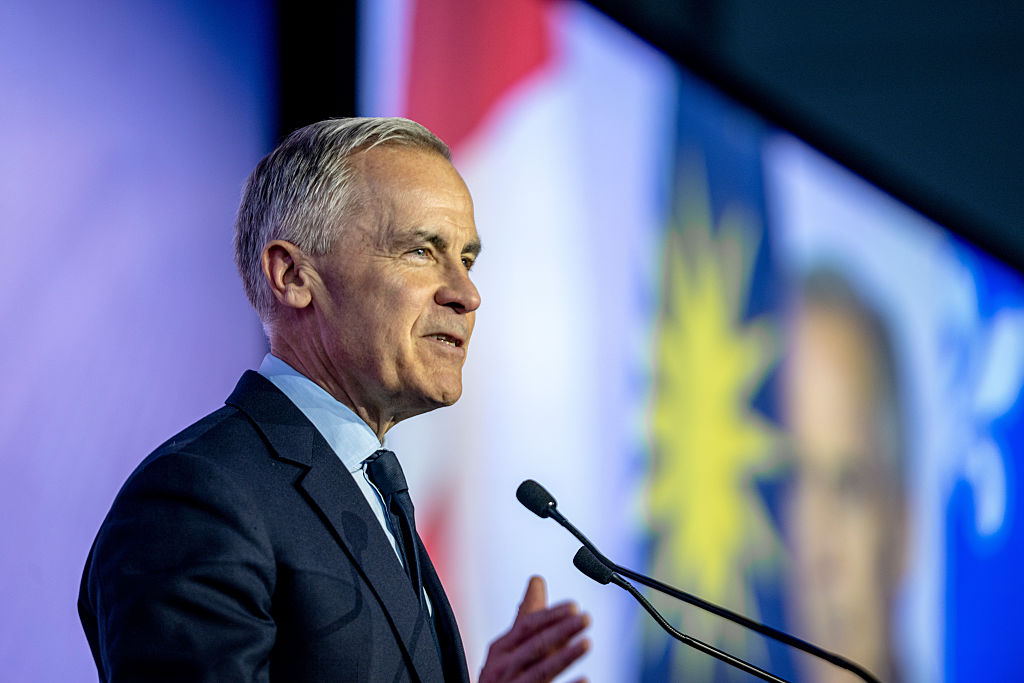
Canada's Prime Minister Mark Carney speaks during an event at the Airbus A220 delivery center in Mirabel, Quebec.

Mark Carney’s vision of nation-building is that of a banker. His new Sovereign Wealth Fund looks less like Norway’s model of collective public wealth than a state-backed investment deal built around privatization. (Andrej Ivanov / Bloomberg via Getty Images)


There is no doubt Canadian Prime Minister Mark Carney is popular. In the year since becoming Liberal Party leader, he has assembled a majority government through defections. His support has not budged despite the controversy surrounding those defections and the fact that he has not yet secured a trade deal with the Trump administration.

With his majority, Carney can now turn to furthering his nation-building project.

There is an irony in Carney’s frequent use of the term nation-building. While the term means different things to different people, it rose in prominence alongside Cold War–era liberal ideas about development and modernization associated with the John F. Kennedy and Lyndon Johnson administrations. It is a very American concept for a country that defines itself as Not America and wants to escape its economic dependence on its southern neighbor.

One cannot downplay the significance of such projects. From the Aswan Dam in Egypt to the Green Revolution in India and the TAZARA railway in Tanzania and Zambia, such massive projects can be transformative. China’s high-speed rail network stands out as the starkest example of this in the twenty-first century.

Canada itself is no stranger to nation-building projects. From the Canadian Pacific Railway to the St Lawrence Seaway, huge projects were required to connect the vast country. But, like many nation-building projects, it also came at a cost with the displacement and starvation of indigenous peoples.

Studying the literature on megaprojects, one finds that economic gains are distributed unequally. In the case of dam construction in India, poverty increases in the immediate area of dams while economic growth is enhanced downstream. China’s expansion of its highway system shifted economic activity from peripheral areas to already large urban agglomerations. In the late nineteenth century, the construction of railroads across the United States saw gains disproportionately accrue to landowners who benefited from rising land prices near the new rail lines.

These unequal distributions could be mediated through policy and institutional frameworks. But a closer look at Carney’s policy shows these projects as a gift to capital over workers.

The most glaring example of this is the Canada Strong Fund (CSF). This is being sold to the public as a sovereign wealth fund (SWF), though it is anything but. As Professor of Economic Geography Dan Cohen notes, unlike Norway’s SWF, “the CSF is notably not funded out of surpluses or commodity exports and is geared at investing internally rather than in foreign financial assets.” Cohen further highlights the tension in Carney’s promise that the CSF will generate market-rate returns while also creating good jobs and indigenous economic benefits. Those goals become much harder to achieve if the CSF behaves according to the logic of private finance.

While Carney has promised that the federal government will seed the CSF with CAD$25 billion, the fund’s long-term growth may depend on “asset recycling” — the sale or restructuring of public assets. Airports are already being positioned as the first major targets, with the federal government exploring ways to “unlock” their value. Institutional investors are circling like vultures at the prospect, and many expect airports to be only the beginning.

Build Canada Homes, which is a major centerpiece of Carney’s promise to tackle the housing crisis, is riddled with public-private partnerships (P3s) that prioritize profits over getting as many homes built as possible. Meanwhile, funding for housing is set to decline by 56 percent by 2029, which is not enough time to build the number of homes needed to push down housing costs.

The Limits of Military Keynesianism

Carney is deeply committed to increasing Canada’s defense spending to 5 percent of GDP, as well as building a strong Canadian defense industrial base. The new Canada Defence Industrial Strategy outlines its goals for the next decade:

  • Increase the share of defense acquisitions awarded to Canadian firms to 70 percent;

  • accelerate procurement of successful Canadian defense research and development (R&D) innovations;

  • boost government investment in defense-related research and development by 85 percent;

  • increase total Canadian defense industry revenues by more than 240 percent;

  • grow defense revenues for Canadian small- and medium-sized businesses by more than $5.1 billion annually;

  • increase Canada’s defense exports by 50 percent;

  • create 125,000 quality new jobs across the Canadian economy.

Though this may sound ambitious, the benefits of defense spending are not all they’re cracked up to be. In the American context, economist Heidi Peltier found that every $1 million spent on the military creates roughly five jobs, compared to thirteen when the same amount is spent on education. Peltier goes on to state, “Healthcare spending creates 84% more jobs than military spending, while infrastructure and clean energy create from 24% to 64% more.”

There are other negative knock-on effects of increasing the military’s role in the economy. While the US Defense Advanced Research Projects Agency is known for its technological spillovers into things like the internet and even the iPhone, scholars like Fred Block and Mariana Mazzucato have noted that the hollowing out of state capacity makes the likelihood of significant R&D spillovers less frequent than in the past.

Carney often touts the dual-use nature of this new military industrial policy. But the more specialized military technology becomes, the less likely there will be spillovers to civilian uses. Nor is military-led development the only path to innovation. The Nordic social democracies have shown that welfare states are no impediment to development and innovation.

Starving the Beast

With all of this in mind, it is important to understand what Carney is doing to the Canadian state, and why it threatens his own policy goals. The Canadian government has announced hundreds of millions of dollars in funding reductions and the elimination of forty thousand jobs in the federal civil service.

The Canada Revenue Agency was already facing layoffs in the final months of Justin Trudeau’s term as prime minister. This is continuing under Carney. The self-defeating nature of these cuts is obvious. With the government ramping up spending on these nation-building projects, it needs to collect every cent of tax it can.

And while Carney is touting a number of new trade deals, it is baffling that Global Affairs Canada is also facing cuts of up to 13 percent of its workforce, including skilled diplomats. This will only delay the more than a dozen trade and investment agreements Canada is currently negotiating, which have been a major part of Carney’s plan to lessen dependence on the United States.

This all ties into tax policy under Carney, which has been all over the place. Despite saying that Canada needs to build, Carney has overseen tax cuts, including canceling a planned increase of the capital gains tax. Despite its technocratic image, the Carney government is not above ill-advised populist tax cuts like eliminating the carbon tax and suspending federal fuel taxes in response to the Strait of Hormuz crisis.

These policies are based on hoping the private sector will step up to help Canada’s economy. But the numbers here do not make sense, especially with such global uncertainty. And with global oil consumption expected to peak in 2029 (even before the war on Iran caused a rethink on the issue of security and fossil fuels), the private sector has shown little eagerness to finance more pipelines.

As the private sector is wooed by the Carney government, the working class will ultimately pay the price. As Toronto Star reporter Althia Raj has noted, the Carney government has abandoned a number of progressive policies that Trudeau negotiated with the New Democratic Party. The federal government has also dragged its feet on signing new pharmacare agreements with provinces. The country’s much-touted $10-a-day childcare program faces shortages of both spaces and early childhood educators in many regions, while requiring more funding.

Alternative Nation-Building

Despite its faults, Canada’s universal health care system remains popular and a part of the country’s identity. It is an example of how real nation-building should provide security and uplift to ordinary people. Social programs do not simply redistribute wealth; they increase human potential by giving people the stability they need to flourish. They are foundational to nation-building projects and yet they are conspicuously absent from Carney’s agenda.

There are plenty of meaningful and transformative projects that Canada requires. There is the need to close the First Nations infrastructure gap and complete Medicare by cementing prescription drug coverage and universal dental coverage. And, as Canada’s population continues to age, much larger investments in the care economy are needed.

Carney’s current strategy reflects shifting conventional wisdom. Industrial and other interventionist economic policies are back in vogue. But instead of investing in increased state capacity and cutting down on wasteful contracting-out and P3s, Canada is heading toward an era where the state will be playing a much more aggressive role in acting as a catalyst for the private sector. Carney’s vision is one with a clear focus on ensuring profits for private capital with little guarantee of improving working-class living standards. Call it what it is — trickle-down nation-building.